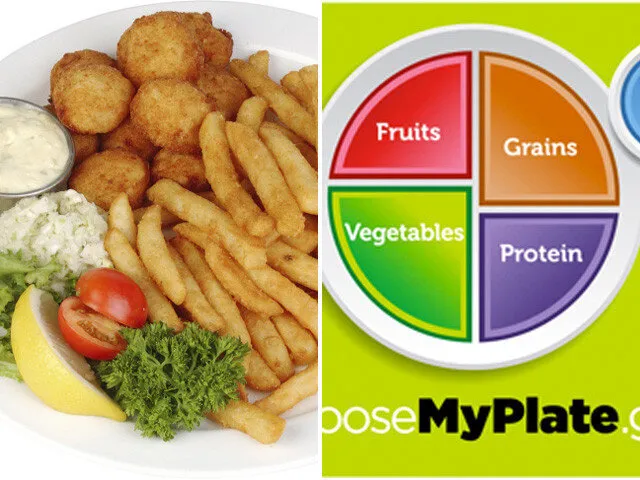
The USDA finally did away with the much-maligned Food Pyramid and replaced it with MyPlate. Many in the food world are calling it progress. It's certainly a clearer and more concise image and deserves some credit for the fact that half of the plate is comprised of fruit and vegetables.
"This is a step in the right direction," Marion Nestle wrote in an email. "It's the best they could come up with and some education needs to go with it, as always."
In my view though, when you look a little deeper, you see that beyond the clearer image not much has really changed.
The five food categories indicated in the image are: Fruits, Vegetables, Protein, Grains, and Dairy. At first glance the MyPlate image appears to eliminate many problematic sugary, processed foods, but when you actually click on the categories a host of unhealthy foods are revealed.
For example, the fruit category includes fruit juice which should be considered a "sugary drink" something the recommendations say to drink less of. There are 15 grams of sugar in one small four-ounce juice box of Mott's 100 percent apple juice and an eight-ounce glass of Tropicana Orange juice has 22 grams of sugar--depending on how many ounces consumed, these fruit juices approach or even exceed the amount of sugar found in sodas.
There's no doubt that fruit juice is a step up from soda, but in a country where 26 million people have diabetes and many other people exhibit signs of insulin resistance (the precursor to diabetes) liquid sugar in any form is detrimental. This is why the fruit category should be strictly whole fruit -- whole fruit contains fiber to help balance out the sugar content and thus has a lower glycemic load. Whole, fresh fruits also contain many vital vitamins, nutrients, and minerals not found in the processed juice version.
But many Americans don't have enough access to fresh fruit -- and the emphasis on drinking fruit juice appeals to food corporations who profit on fruit juices and other processed fruit products. Indeed, on the Web sites for Mott's and Tropicana, you find out that your apple and orange juice provide the required fruit recommendations by the USDA.
When you click on the dairy category you find that chocolate and strawberry flavored milks are included -- more examples of "sugary drinks" inexplicably deemed acceptable by the USDA. Flavored milks, regularly served in school lunch cafeterias across the country and subject to much debate, contain loads of sugar. A serving of strawberry milk contains 27 grams of sugar, equal to the amount of sugar in eight ounces of Coca-Cola. (Flavored milks were just banned by the Los Angeles Unified School District).
Meanwhile, the grains group remains amorphous. The guidelines do say to keep half of the grains you consume whole, but that's not indicated in the graphic. Again, this group is far too inclusive and leads the consumer to believe that many highly refined ready-to-eat breakfast cereals, white buns, breads, and rolls are part of a healthy diet. Given these vague guidelines one could eat Lucky Charms for breakfast, a Subway sandwich on a white bread roll for lunch, and a few slices of Domino's pizza for dinner and consider these processed grain-filled options as part of the healthy MyPlate meal.
Much on the MyPlate Web site is based on outdated science. The low-fat and fat-free dairy recommendations are based on the premise that saturated fats are harmful (see my article on fats for more on this) and that Americans should cut down on these calories -- but the truth is Americans are not getting heavier due to the fat in dairy products but rather due to the overconsumption of sugars and refined carbohydrates.
As is illustrated in this infographic, while obesity rates have soared since the 1970s the amount of calories consumed in the form of dairy, meat, and nuts has remained mostly stable. On the other hand, the amount of calories consumed in added sugars, added fats (the type of fats are not indicated in this graphic but I would bet they are in the form of highly processed vegetable oils and trans-fats) and grains has also soared. This suggests that the fats found in real foods like dairy are not the cause of our nation's massive weight gain.
The underlying issue is quality of food not just quantity. But this won't be addressed as long as industrial food corporations hold sway over the dietary guidelines. Discussing quality gets to the root problem of access to healthy, whole foods in this country. Quite simply, the USDA cannot insist that people eat only high quality foods while many don't have access to them. Herein lies a conflict of interest for the USDA since it has the dual role of promoting the business of industrial food production and simultaneously advising Americans on healthy eating.
Indeed, the MyPlate recommendation to, "Enjoy your food but eat less" is hardly helpful when the goal of the industrial food industry is to encourage Americans to eat more. Industrial food corporations are great at filling bellies with highly caloric yet nutritionally void food -- and sugar and refined carbohydrates are the main culprits. If the USDA truly wanted to endorse healthier eating, it would focus on promoting nutrient-dense foods. Switching to a nutrient-dense diet goes a long way in addressing portion control -- it's difficult to overeat a real food diet.
The ideal image would be more exclusive-that is to say, many foods now endorsed by the USDA as part of MyPlate would be eliminated. The fruit group would be strictly fruit, the vegetable group strictly vegetables. The protein group would include dairy (the fact that dairy is a separate category highlights the influence of the powerful dairy lobby) and would eliminate the many processed foods now listed as part of these groups: Flavored milks, processed cheeses, processed deli meats, and processed soy products. The grains group would eliminate refined and processed grains and reserve these to be used minimally in the form of treats. The same applies to all sugary foods and sugary drinks.
As Michele Simon rightly points out in her recent post, what's really needed to affect change are policy changes. She writes, "It's going to take way more than a measly $2 million educational campaign to get Americans to fill up half their plate with fruits and vegetables. It's going to take a massive overhaul of our agricultural policies."
And this is why we'll never see a real food MyPlate. As long as our current agricultural policies and farm subsidies remain the same, the government can't offer much else in the way of recommendations. What they've recommended is what's available to most of the American population--processed and packaged foods subsidized by government policies.
MyPlate is simply a cleaner graphic image with mostly the same old information. I can think of a much better way to spend that $2 million dollar budget: Fund urban farming projects so more Americans can actually fill those plates with fruits and vegetables. Now that would be real progress.
Originally published on Civil Eats