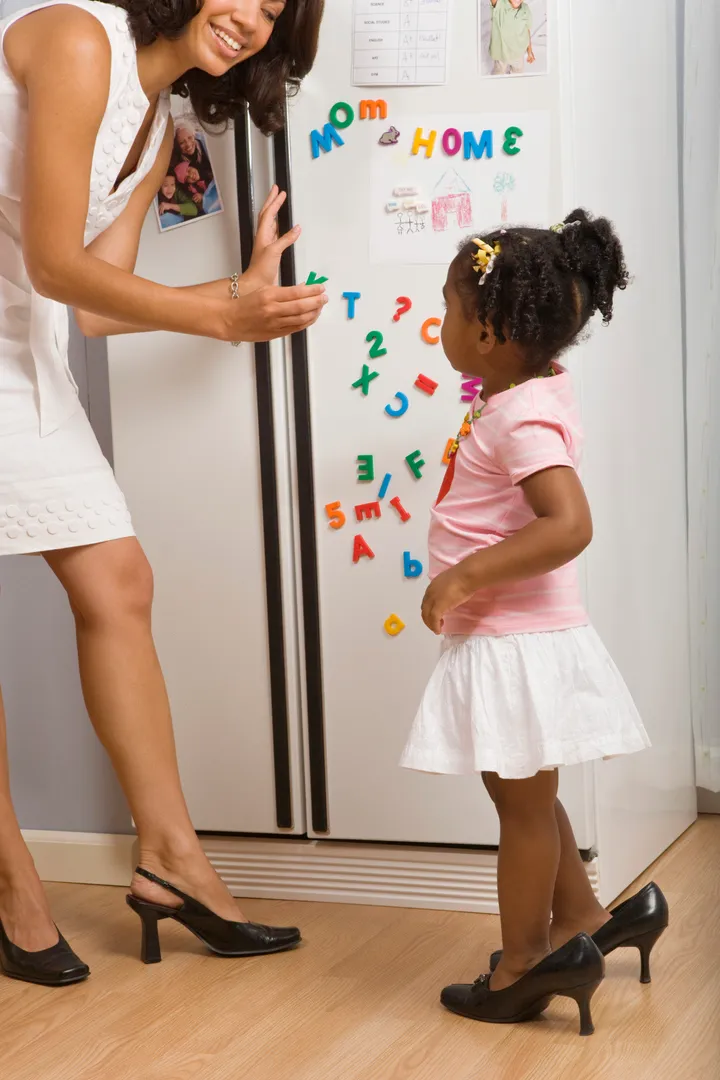
If you had asked me as a teenager what I was going to be when I grew up, I might have said Pulitzer prize winning writer or Emmy award winning producer, but stay at home mom? Nope. Never. That was after all, in my mind, something that white women did. Somehow the image of an apron wearing June Cleaver serving a pot roast to her husband had never been too appealing, and in the black community, where the path to success is through economic empowerment, the job of full time mother is rarely at the top of anyone's list.
But after graduating from college with a journalism degree, earning an Ivy League Masters degree and 13 years as a working journalist, I started to feel a gut- wrenching tug that I had never felt before. My mother had just passed away and the fire that burns in just about every good journalist's belly was starting to fade. On maternity leave with my second child, I yearned to put everything on the shelf and return to the nest. My husband had a steady salary with benefits, and after a trial run living on one income, we knew it could be done. I left my job at NBC News and never looked back.
Little did I know the repercussions of wiping away an identity that had taken me years to create. I was no longer Kuae the journalist, the one who used to work for high profile news organizations, who kept a bag packed in her office just in case breaking news beckoned me to rush to the airport. I was no longer the young journalist who moved from Miami to Chicago to work for The Oprah Winfrey Show. I had joined the ranks of the mommies who I saw pushing their kids in Peg Perego strollers around New York's Upper West side, the ones who lived to bounce their babies on their laps at Gymboree, clap their hands at Music Together and meet at the local Starbucks to share war stories about how their kids didn't sleep through the night.
It took me nearly two years to reconcile my newfound identity as a stay at home mother, not just from a journalist's standpoint, but as a black woman who had been raised, just like her friends, to excel academically, go to a good college and work twice as hard to climb up the corporate ladder. There were sleepless nights when I worried that I had made the wrong choice, that I had just let my career plummet down the drain. That is until I began to meet other mothers who looked like me, who had done the same thing... gone to college, gone to work, and made the unlikely choice to stay at home and raise their children. Many of their stories were similar to mine. Some had grown tired and weary of the daily corporate grind, a world that was often unforgiving and cold. Others decided they didn't want a sitter or nanny raising their children, and they didn't want them in day care either. Some were fed up with a broken public school system. They wanted greater control over their children's destiny. They wanted to focus on their families, and they were willing and able to make the financial sacrifice. Parents and friends told them that staying at home meant they were "throwing it all away," and implied that it would be an affront to their race.
Historically, African-American women have not had the choice, and the luxury, to stay at home. In the 1950s, when white women were heeding the call to stay at home, black women were working. In fact, black women have always worked, because generations before them worked and because they had to. We were the cooks and the cleaners and the maids and the seamstresses. During slavery, we took care of other people's children, a pattern that continues today.
So in 2001, as I sat in a living room with other black women who had not only chosen to stay at home, but to support each other, I realized that their choice was profound. We discovered thousands of other mothers who had made a similar choice through a national, non-profit support organization called Mocha Moms, Inc., started in 1997 by four mothers in Maryland. These women weren't the stereotypical stay at home mothers that I had once envisioned. They were smart and savvy, motivated and inspiring. They wanted to share ideas, discuss issues and topics. They wanted to educated their own, instill values and strengthen their marriages. And contrary to what the title suggests, they didn't stay at home. They were in the schools volunteering in classrooms, mentoring children, working in the community, serving on school boards and in town government.
Mocha Moms exists, on a basic level, to set the record straight... that there are in fact two parent African-American families in which one parent makes the choice to stay at home. Today, there are 100 chapters in 29 states. Mothers meet weekly for mother's support group meetings and monthly for mom's only get-togethers. They participate in a wide range of community service as part of a national initiative to help close the gaps in health, prosperity and achievement, and big companies and organizations are taking notice.
While the mainstream media has spent years both confirming and dispelling the notion that more professional white women are making the choice to stay at home, simmering below the radar is this quiet revolution of professional African American mothers who are making the choice. While the recession has dealt a particularly harsh blow to the ranks of black stay at home mothers, many have launched home based businesses, gone back to work part time or flex time and done what it takes to make it work.
The ability to make a choice that a generation ago might not have fathomed speaks to another level of success among African American women. Black stay at home mothers are raising their own children, supporting each other, giving back to their communities and here to stay.