
Ecological and economic welfare are two sides of the same coin and having to choose between developing economies and societies on one hand, and protecting the environment on the other, is a false dilemma. This false dilemma is often used by private companies to dismiss civil society and local communities, mislead policy makers, and then carry on with questionable practices.
Let me explain. Sub-Saharan Africa has been the scene of a huge land grab in recent years, with overseas governments and businesses buying up or securing long-term leases on large tracts of land. Some of the deals are straightforward acquisitions but many are contentious to say the least.
According to a number of the agribusiness corporations that are investing heavily in developing vast palm oil plantations throughout Central and Western Africa their primary aim is bringing much-needed revenue to local economies, providing jobs and improving the lives of the people living there. Don't let yourselves be fooled by this seemingly altruistic discourse: we rarely hear any mention of the millions to be made in trying to satisfy the unquenchable global thirst for palm oil. Could this be the real motivation?
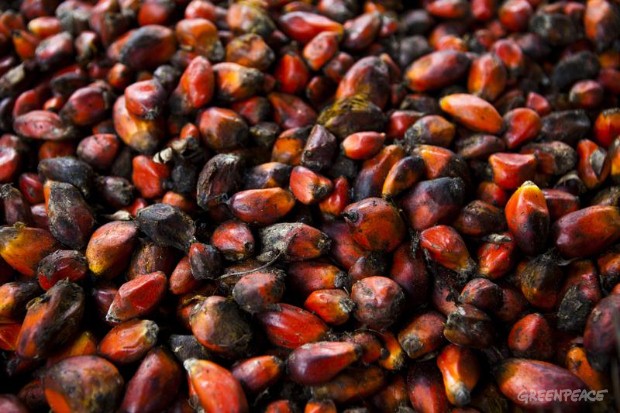
These seeds are ready for the press. The fruit itself is turned into "Palm oil," while the nut is used for "Kernel oil." This is the local variety grown by smallholders. (Copyright Jan-Joseph Stok / Greenpeace)
A perfect illustration of this false dilemma is Herakles Farms' rhetoric in relation to their latest project in Cameroon. Clearing of forest has recently begun; but this forest is important because it provides a key corridor between five protected areas including the iconic Korup National Park. This concession sits within the Guinean forested region of western Africa, which has been identified as one of the 25 most important biodiversity hotspots on earth, and is roughly 10 times the size of Manhattan, the island that is home to the headquarters of Herakles Farms.
The forests of Cameroon store huge amounts of carbon, critical to maintaining the global climate and preventing huge emissions of CO2, but they are also essential for local communities. These forests provide a home and income for thousands of people through cocoa farming and other commodities including palm oil production.
More than 70 percent of land in sub-Saharan Africa falls under the definition of customary domain. This means land that is formally state-owned but has been used by local communities, often for generations, although these customary users, such as those in Mundemba, Fabe and other areas of Cameroon affected by proposed developments, often have very limited rights.
The palm oil project in Cameroon has provoked fierce local opposition and division. Many local farmers Greenpeace spoke to in the villages falling under the concession area say that people have been forced off their land or that lines physically demarcating the concession area have been drawn on their land without prior notice. According to one lady from Fabe village who has been evicted from her farm:
"If the company takes all of the land then they will be the death of all of us. What will we live off? We will not have a livelihood. (...) Where will people do their farming? "
It seems incongruous that Herakles Farms claims it is trying to improve the lives of local people but then there is scarcely any consultation with those same people over what is to be done with the land they depend on for their livelihoods, nor any serious acknowledgment of the risks posed to local environments and the global climate.
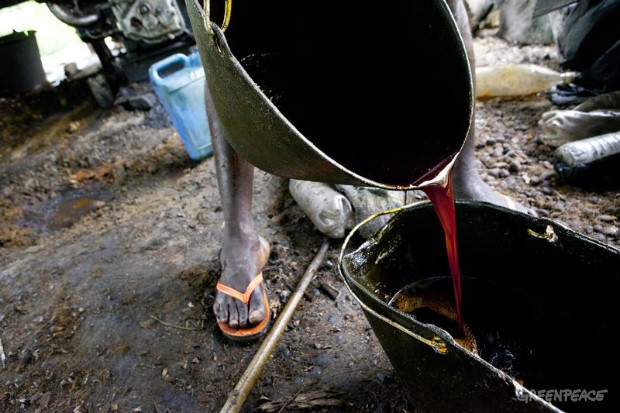
Palm oil is used by Cameroon people as a basis for their food consumption. (Copyright Jan-Joseph Stok / Greenpeace)
As an African, I am used to questioning supposed solutions to poverty, especially when they are implemented without the collaboration of the people they are allegedly helping. As the head of Greenpeace, I can say that we encourage development, but do not support development that is not mindful of people and nature.
https://www.facebook.com/NaidooKumi
Follow Kumi Naidoo on Twitter: www.twitter.com/kuminaidoo
Adequate food and water are also necessary for all. Biointensive gardening in a few hundred square feet could feed a family. Unleashing a Peace Corp-style support program from the developed world (staffed by people who have also been appropriately trained by cultural anthropologists) could contribute to high-level education for all.
The issue is not to make all the people in the undeveloped countryside into high-energy consumers. That is merely the vision promulgated by the masters of the universe, who only care about making money by ensnaring all the world within their capitalistic net.
The plantations, complete with modern slavery, whether palm, cotton, sugar or shrimp are not sustainable and indicate local and country official corruption. Progress in Africa? Sounds like they are repeating the mistakes other developing countries have suffered through - this time courtesy of American, Chinese and European corporations.
Sadly with all the oppression, the people starve while blood is traded for diamonds.
To be brutally honest, development is simply more important.
Right today, indigenous tribes exist in isolated areas. I recently saw photos of some Native peoples of South America. They looked healthy and well. One lady could have lost a few pounds. Science recently researched one native tribe and discovered, they never experience depression or anxiety. Stress changes the physical structure of the human brain while indigenous tribes have 80% more free time, not having to work so long and hard for the basics.
Perhaps, mankind got it right long ago. We can't breathe paper monies and palm oil while destroying everything that gives man, free gratis, the breath of all life. The vast majority of man's time on Earth was supported by the natural Earth without the planet butchers of industrial civilization that is killing all of man's lifelines to life.
Also, when we destroy the natural surface of Earth, we chance being exposed to new disease pathogens that industrial civilization spawns upon ecosystem [forests, grasslands] death. The Native Americans did not suffer from European diseases, like influenzas, chicken pox, measles and small pox, spawned by skinning the life giving surface of Earth.
If the author wants indigenous populations to improve their own conditions, then it is encumbant upon the indigenous populations to lift themselves up by the bootstraps, rather than to wait for someone to come alone to tie their shoe strings for them
After 500 years of oppression during which millions of Africans were kidnapped, enslaved and taken overseas, millions more were systematically starved to death, and hundreds of millions were brutalized. marginalized, and terrorized, you think that Africans should do for themselves what Europeans had millions of slaves to do for them? You are an imb*c*le Lil IQ.
This is accomplished with societal voices that tell them how much freedom they have and how good they have it, freedom to spend their lives working for the machinery that is destroying human existence and the viability of an ecosystem dependent planet.
Isn't biodiesel the fastest growing demand for palm oil? Seems like the regulations that are forcing biofuel content in motor fuels are therefor one of the causes of this problem. Correct? If so, why are these regulations not be more actively challenged?
Also, where is the rule of law in Cameroon? I would expect the government to protect the rights of the indivdual land owners who were forced off their land. Are corrupt government officials allowing the seizure of lands for their own profit? How is this being addressed?
Unfortunately when confronted with either having an income or maintaining the ecology the immediate rewards of consumption win most every time.
Costa Rica in Central America found a way through eco-tourism with it's own problems displayed.
Moving through a quagmire as this requires a full grasp of biology and economics that is too often lacking in Corporate development.
Where is the compensation for the people who are now without the beauty and diversity of the forest around them?
Ordinary people with no official status have a right and responsible to imagine and extrapolate as to what an inspiring and workable future might be. Imagining the process is an important part of fostering it, somewhat the way a collaborative art project is realized.
IMO, the least we can do is to live the solutions we see, for they are universal in large measure. Live simply. Honor beauty. Make the best of what surrounds you. You can't take this to the bank, perhaps, but I'm convinced that it will help in subtle ways.
Our terrestrial ecosystems provide the eco-nomy of life itself. When we destroy forests and natural landscapes for industrial civilization, we are killing all of our "life-supporting" services, cycles and systems, provided by the natural and wild Earth. The lifestyle of raping the planet for a few pieces of silver is a new lifestyle based upon ecological ignorance. We aren't breathing because of paper, gasoline, any oil or industry; we are only alive because of the natural, real first Earth that seeded all life and maintains it, right today.
Everything is sacrificed, including the breath of life, so a tiny few can live like kings while the rest are merely slaves to the financial economy, keeping the kings a rollin in the clover.