My guide, when I went to visit Chernobyl on the 25th anniversary of the accident, was a Greenpeace campaigner from Germany named Tobias Muenchmeyer. Tobias is the deputy head of our political unit in Berlin and also happens to know a great deal about nuclear power. But what really registered with me as we traveled together was the fact that Tobias has a personal tie to Chernobyl. His wife Katya was a 16-year-old schoolgirl in Kiev in 1986.
Katya was actually incredibly lucky, all things considered. Five days after the accident, which at that point was still a state secret, her mother was told about it by a someone in the know. Katya's parents scrambled to send their daughter away to friends in Moscow, and she was saved further exposure to the radiation that caused tens of thousands of deaths. Thirteen days on General Secretary of the Soviet Communist Party, Mikhail Gorbachev, finally admitted the magnitude of the disaster. Later on the Soviet government established mandatory resettlement for all people living in an area with exposure to radiation of 5 millisieverts (mSv) per year. (During the first days after the accident Kiev was already measuring 8 microsieverts per hour, which means a dose of 5mSv would be reached after approx. 25 days.)
Tragedy is often more easily apprehended when seen through a survivor's story, and I couldn't help but think of Katya and her parents as we drove north from Kiev, backwards in time, past stretches of abandoned land that reminded me of parts of underdeveloped Africa, to the site of the Chernobyl nuclear plant.
The reason for our trip to Chernobyl that starless night was to "bear witness" to the anniversary as part of Greenpeace's decades-long campaign to stop nuclear energy. After three hours, we passed a sign that read "Dityatki 30 Kilometers Checkpoint" and we were officially in the "Zone." Crossing a long bridge we turned left and drove the length of the empty nuclear plant, past Reactor No. 1 (shut down in 1996), Reactor No. 2 (shut down in 1991 after a fire), Reactor No. 3 (closed under international pressure in 2000) and finally the remains of Reactor No. 4, now covered by the infamous "sarcophagus" hastily constructed in 1986.
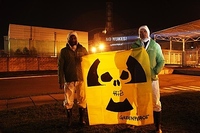
It was close to midnight when we arrived and prepared for our "action," which had been authorized by the Ukrainian government. Then at 1:23 a.m., 25 years to the minute after the disaster, as wild dogs in the area began howling, provoked by the distant ringing of bells at a Russian Orthodox chapel, we began our "action." We projected a gigantic image of Munch's "Scream" onto the shell of the old sarcophagus. Under the image ran the phrase "Stop nuclear madness" in a revolving series of Ukrainian, Japanese, Russian, German and English. Media around the globe used this material to illustrate their anniversary coverage.Afterward, surprisingly reticent to leave the ghosts of the past, we decided to stop at the ruins of the village of Kopachi, about two kilometers away. You've probably seen photos from this town, a sort of Pompeii with remains of concrete prefabricated buildings. Everywhere long sticks with little yellow radiation signs litter mountainous heaps of rubble, lest anyone forget that this is nuclear waste still waiting to be transported to a "safe" storage area.
One of the few buildings still somewhat intact is the kindergarten. Inside, our torches shed light on paintings of fairytale characters, children's beds, a big bathroom with five children's sinks in a row, blackboards and books -- all covered by the dust of 25 years. In the corner of a playroom I came across a pair of boy's baby shoes, their nameless owner quickly added along with Tobias's wife's in my personal collection of Chernobyl memories.
The area around Chernobyl once counted a population of 120,000 people. Today it is home to packs of wild dogs and a couple hundred elderly people who have returned, primarily for lack of anywhere better to go. It is a zone of the dying and the dead.
I am told that in Fukushima, which I will visit next week, life continues as normal, despite alarmingly high radiation levels being detected in schools, shrines and other places where people gather. Children have even been sent back to class. The government has instigated "voluntary" relocation -- but for those without the funds or means to pick up and move, this is meaningless.
In April, five weeks after a tsunami and earthquake damaged the Fukushima nuclear power plant, the Japanese authorities raised the upper level limit of acceptable radiation from 1 mSv per year to 20 mSv per year for school children.
It is hard to believe that the current Japanese government is falling so far behind the 5 mSv standard set by the Soviets. How can a government that lived with the fallout of nuclear bombs allow such high levels of radiation exposure for its children? Why is the Japanese government not actively decontaminating school grounds?
I think about Katya and the pupils of the Kopachi kindergarten who hopefully managed to grow up far away from the radiation. For those not endowed with memory of previous tragedies, surely these stories should be enough?
The Japanese government must do all that it can to protect its citizens from the aftereffects of Fukushima. Meanwhile, the rest of the world must join the Japanese, German and Swiss governments who have decided to stop funding nuclear energy. No more Chernobyls. No more Fukushimas. Never again.
Follow Kumi Naidoo on Twitter: www.twitter.com/kuminaidoo
http://www.youtube.com/watch?v=r__LvRsvXVI&feature=player_embedded#at=28
GREAT WORK NRC...
http://www.jaif.or.jp/english/news_images/pdf/ENGNEWS01_1307765213P.pdf
+
The risk of leakage of the high level radioactive wastewater accumulating in the Unit 2 and 3 T/Bs and concrete tunnels is increasing as the water level in the receiving facility was getting close to its storage limit. It has been decided to use Unit 2 and 3 main steam condensers as a receiving tank while revising the storage limit of the PMB (total increased capacity: approx. 4,300m3). Further revision of the storage limit of the facility (additional capacity: approx. 2,700m3) is under consideration.
The recent CDC Morbidity and Mortality Weekly Report indicates that eight cities in the northwest U.S. (Boise ID, Seattle WA, Portland OR, plus the northern California cities of Santa Cruz, Sacramento, San Francisco, San Jose, and Berkeley) reported the following data on deaths among those younger than one year of age:
4 weeks ending March 19, 2011 - 37 deaths (avg. 9.25 per week)
10 weeks ending May 28, 2011 - 125 deaths (avg.12.50 per week)
This amounts to an increase of 35% (the total for the entire U.S. rose about 2.3%), and is statistically significant. Of further significance is that those dates include the four weeks before and the ten weeks after the Fukushima Nuclear Power Plant disaster. In 2001 the infant mortality was 6.834 per 1000 live births, increasing to 6.845 in 2007. All years from 2002 to 2007 were higher than the 2001 rate.
http://www.counterpunch.org/sherman06102011.html
Spewing from the Fukushima reactor are radioactive isotopes including those of iodine (I-131), strontium (Sr-90) and cesium (Cs-134 and Cs-137) all of which are taken up in food and water. Iodine is concentrated in the thyroid, Sr-90 in bones and teeth and Cs-134 and Cs-137 in soft tissues, including the heart. The unborn and babies are more vulnerable because the cells are rapidly dividing and the delivered dose is proportionally larger than that delivered to an adult.
Data from Chernobyl, which exploded 25 years ago, clearly shows increased numbers of sick and weak newborns and increased numbers of deaths in the unborn and newborns, especially soon after the meltdown. These occurred in Europe as well as the former Soviet Union. Similar findings are also seen in wildlife living in areas with increased radioactive fallout levels.
(Chernobyl – Consequences of the Catastrophe for People and the Environment, Alexeiy V. Yablokov, Vasily B. Nesterenko, and Alexey V. Nesterenko. Consulting Editor: Janette D. Sherman-Nevinger. New York Academy of Sciences, 2009.)
They say YE$, I think Not, and you will not either after watching this recent video of our Reactor in Missouri that almost got flood out!
http://www.action3news.com/global/video/flash/popupplayer.asp?ClipID1=5930032&h1=Flooding%20Nuclear%20Power%20Station%20Property&vt1=v&at1=News&d1=116166&LaunchPageAdTag=News&activePane=info&rnd=85479352
http://www.rense.com/general93/radiation.htm
Radiology experts find up to 45 microsieverts/hour near school zone — 90 times higher than Chernobyl evacuation threshold
http://enenews.com/radiology-experts-find-up-to-45-microsievertshour-near-school-zone-90-times-higher-than-chernobyl-evacuation-threshold
The government should consider evacuating children and pregnant women from a wider area around the Fukushima No. 1 power plant because radiation levels remain high even outside the 20-km no-go zone, Kumi Naidoo, executive director of Greenpeace International, said Thursday in Tokyo.
Naidoo’s team of radiology experts found hot spots that had a maximum hourly reading of 45 microsieverts of radiation alongside a school zone. [...]
Jan Beranek, an expert on radiology from Greenpeace International who joined Naidoo’s trip to Fukushima, recommended that the government widen the evacuation zone to at least 60 or 70 km from the power plant.
He said there were parks and public spaces where the level of radiation activity hit 9 microsieverts per hour.
Even some nursery schools that have already undergone a decontamination process had a relatively high reading of 0.5 microsievert per hour, he said. That would translate into an annual exposure of 5 millisieverts, which was the evacuation threshold for Chernobyl, Beranek said. [...]
... AK-47 of the 21 Century and it can be used against
... mankind by terrorists and or any Rogue Gov't.'s
... to poison the Earth!
... their storage pools are now prime targets for nuclear
... terrorism and or Global pollution!
What is wrong with that picture?
http://www.huffingtonpost.com/2011/06/08/switzerland-nuclear-power_n_873012.html
WHAT IS WRONG WITH US?
and it has the potential to destabilized the rest of the World economy,
as the YEN goes down others will try and take over Japans businesses...
any day any reactor can fail die to Nature of any other number of "events" that can and are now causing Global Eco-Disasters like the Trillion Dollar Debacle in Japan!
http://www.chrismartenson.com/blog/exclusive-arnie-gundersen-interview-dangers-fukushima-are-worse-and-longer-lived-we-think/58689
"I have said it's worse than Chernobyl and I’ll stand by that. There was an enormous amount of radiation given out in the first two to three weeks of the event. And add the wind blowing in-land. It could very well have brought the nation of Japan to its knees. I mean, there is so much contamination that luckily wound up in the Pacific Ocean as compared to across the nation of Japan - it could have cut Japan in half. But now the winds have turned, so they are heading to the south toward Tokyo and now my concern and my advice to friends that if there is a severe aftershock and the Unit 4 building collapses, leave. We are well beyond where any science has ever gone at that point and nuclear fuel lying on the ground and getting hot is not a condition that anyone has ever analyzed."
* Arnie Gundersen is an energy advisor with 39 years of nuclear power engineering experience. A former nuclear industry senior vice president, he earned his Bachelor's and Master's Degrees in nuclear engineering, holds a nuclear safety patent, and was a licensed reactor operator.