Featuring fresh takes and real-time analysis from HuffPost's signature lineup of contributors
Kurt Ellenberger

GET UPDATES FROM Kurt Ellenberger
 

The Audience and the Educator: A Study in Blue

Posted: 04/30/2012 1:48 pm

2012-04-27-bluechair2.jpg


I've written about what I call "the education fallacy" in earlier posts:

The solution [to building a sustainable audience base for jazz], we've all been told ad nauseum, is "Education! Teach jazz in the schools, and we'll be creating new audiences and supporters for the future." This theory rests on a fallacy -- namely, that jazz is such a timeless and appealing genre, that exposure at a young age will create new fans and the music's future will be assured. We have ample evidence to assess the education theory, and the evidence is quite clear -- it is a complete failure. After over 40 years of Jazz Education, with enormous public and private support, we see no indications of a surge in supporters and fans, but we have seen a huge increase in the number of practitioners.

In a nutshell, it refers to the idea that classical music and jazz are suffering because we're not educating our children properly. It's an easy explanation for the art music audience malaise. We in the arts community love it because it places blame on the education system, or the government, or other nefarious entities who are plotting against Mozart, Mahler, Miles, and Monk. Conveniently, it also absolves us of responsibility. All we need to do is occasionally invoke "Education!" as the answer, and we can continue along on our merry way, using strategies and models from bygone eras that haven't worked for decades and aren't likely to work in the decades to come.

If you're thinking that there's no problem with jazz audience maintenance and development, then consider the fact that the 2012 Jazz Education Network conference in Louisville featured multiple sessions that were focused on something called the Jazz Audiences Initiative (JAI). This initiative featured a comprehensive analysis and report by WolfBrown on the demographics of those attending jazz concerts at several major venues across the country. The study was commissioned by the Jazz Arts Group in Columbus, OH, and was funded by the Doris Duke Charitable Foundation. This intense focus on audience development can only mean one thing: the jazz audience is disappearing.

Jazz Education is particularly well-suited to assess the education theory in regards to audience development. The reason for this is that before the 1960s, jazz was not a regular or common feature of the education system, but by the 1970s (after the founding of the National Association of Jazz Educators in 1968), high school and university jazz programs were proliferating all across the U.S. and Canada. By the 1980s, Jazz Education had grown tremendously. Here are some statistics from Jazz In America:

By 1980:
  • More than 500,000 high school and college students were involved in jazz activities.
  • Over 500 colleges were offering jazz-related courses for credit.
  • More than 70 percent of America's 30,000 junior and senior high schools had at least one stage band or jazz ensemble.
  • There were approximately 300 summer camp programs that included jazz.
  • Approximately 250 school jazz festivals were being presented each year, some attracting as many as 200 school jazz ensembles.

It's hard to then claim that the government and the education system (and private donors who have helped to fund university and other programs) haven't done enough. Hundreds of millions (possibly billions) have been spent on jazz education since 1970, but those untold sums did not deliver a sustainable jazz audience. The education theory as it pertains to jazz is a failure in terms of its ability to generate an audience base for the music.

Now, let's look at attendance at classical music performances. The following graph is part of a 2009 report from the League of American Orchestras which looked at the number of people from seven "generational cohorts" who attended classical music concerts in 2008.
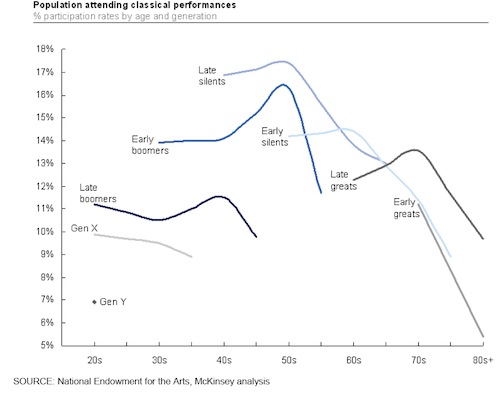
2012-04-26-FatalXGraph500.jpg

In his blog for the New Yorker, Alex Ross featured this graph in a post entitled The Fatal X which refers to the fact that Gen X has no uptick in participation rates as its members enter their 30s and 40s. The report from the League of American Orchestras describes the situation as follows:

If recent participation trends remain unaddressed, the audience for live classical music could decline by an additional 2.7 million people, or 14 percent, by 2018, as a result of projected trends in demographic momentum.

I'm going to use some of the data from this graph, but view it from a different perspective. By graphing the 2008 classical music attendance percentages of each generational cohort,* along with a brief timeline of when various arts and entertainment technologies/media came into common usage, we see a clear correlation:

Generational Cohort Attendance Rates at Classical Music Events in 2008 and Arts and Entertainment Technologies/Media
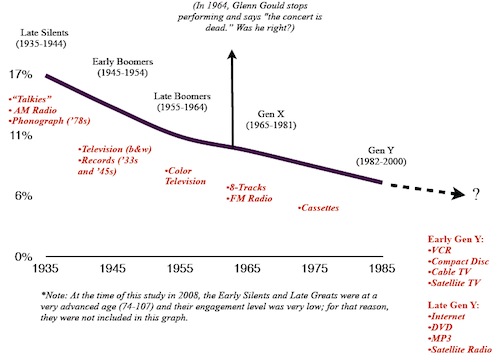
2012-04-26-GenCohortMedia500.jpg

While not a comprehensive media history, this graph shows that as the arts and entertainment options outside of traditional classical and jazz venues (concert halls, recital halls, jazz clubs) increased dramatically in quality and quantity, the cohort attendance rates decreased. As those options mushroomed between 1980-2000, the attendance rates continued their downward spiral until we hit Gen Y, of whom only a paltry 7 percent attended a classical music event in 2008. In the last 12 years (2000-present), these options have only increased, with HD Media (including the outstanding Metropolitan Opera HD broadcasts), high-speed internet, home theatre systems, on-demand viewing, and other online options becoming more available and more affordable. It appears that as our home arts and entertainment options get better and cheaper, we're less interested in going downtown and paying for parking, tickets, and $9 for a glass of wine just to be annoyed by someone texting or chatting or unwrapping a cough drop in the middle of a Mahler 3rd Movement. This shouldn't be a surprise to anyone.

On the education spending issue, it's common to hear musicians say, "well, we're not spending enough, that's why we're not building classical music audiences -- we need to spend more on education." To answer that, I return to Jazz Education, where we went from spending very little, to spending hundreds of millions, with nothing to show for it in regards to audience development. Why did the jazz audience decline, not grow, as the spending rapidly increased? Is there any reason to think that more spending would succeed with classical music where it has failed with jazz?

The music education system is very good at helping to create great artists and ensembles, and it does so consistently and regularly. (Read the biographies of the members of our fine orchestras and jazz ensembles, and in most cases, you'll see references to the excellent colleges, universities, conservatories, summer programs, and high schools, in which they received their training). Music and general arts education, (particularly programs for young students such as, for example, Education Through Music), are also very effective in helping students' intellectual and social development, so there are certainly excellent reasons to maintain and strengthen this part of our education system, but significant audience development does not appear to be one of them.

But if the system can succeed with such lofty goals as creating great artists and increasing intellectual development, why can't it succeed in the more mundane task of creating a mediocre audience base? Intuitively, it seems like such a great theory -- we create an audience base by using the education system to mold hearts and minds to love what we love. Wrong. You don't need to be Paulo Freire to know that one doesn't simply pour information into an empty vessel and then reap desired outcomes. A human being is not a piece of clay that can be so easily molded to provide us with a ready-made audience member--you can lead children to Water Music, but you can't make them love it.

In the blog post about jazz that I referenced earlier, I suggested that "... music is a cultural artifact, and the culture has moved on [from jazz]." The education system cannot overcome the culture, and by the 1970s, the dominant culture was moving further and further away from jazz. No educational intervention could have changed the downward trajectory.

The education system can certainly expose students to classical music and jazz (hopefully enriching their lives by doing so), but it cannot make them love the music. Many, I'm sure, will listen to some jazz and classical music throughout their lives, but they will probably listen to it at home and in their cars, not at performances in traditional venues. If we're lucky, a few (outside of those who choose music as their profession) may even develop a deep relationship with the music from this type of exposure, but probably not in large enough numbers to make a difference in terms of creating a sustainable and adequate audience base. The best we can hope for from the education system is for it to instill a modicum of respect and/or understanding of what we do in music; to ask for any more than that is beyond what an education system can be expected to accomplish.


Follow Kurt Ellenberger on Twitter: www.twitter.com/FraKathustra

FOLLOW CULTURE
 
 
  • Comments
  • 21
  • Pending Comments
  • 0
  • View FAQ
Comments are closed for this entry
View All
Favorites
Recency  | 
Popularity
Page: 1 2  Next ›  Last »  (2 total)
01:45 PM on 05/25/2012
The bottom line, I think, is this: The majority of people who listen to and buy music don't have two things required to appreciate more subtle music such as jazz and classical and that is: 1) the attention span and 2) time and patience. Why do you think that so called "country" is one of the bigger selling musics right now? People can relate much better to a stupid 3 or 4 minute song about something as inane as a red solo cup than they can John Coltrane's "Love Supreme"! Joe (or Jane) Public does not care for the most part and that is just the way it is...
11:50 PM on 05/18/2012
There is no "education fallacy." The kids who get the jazz education - which means the ones who actually play in school bands - also go out and listen to the music. They fill the high school gym to hear the Gordon Goodwin Big Band. Then, even after they stop playing, they go to hear their college jazz band concerts. And the college, for the music majors, is bringing in Joe Henderson or Maria Schneider for workshops, and the kids who have THOSE experiences never stop listening to the music.

If you want the audience to increase, keep providing opportunities for people to play - at all ages.

The core argument here is illogical. Live concert attendance is in decline in all areas. How much WORSE would the jazz decline be if there had been no jazz education? Just because the jazz audience has "declined" (see below for the numbers they're failing to count), doesn't mean jazz education hasn't brought great, significant numbers of listeners to the music.

None of the studies cited mention attendance at concerts by school groups, so Wynton Marsalis appearing with the Juilliard Jazz Orchestra would NOT be an event they measured. Schools are becoming significant patrons of jazz, so if you want to really measure the jazz audience, you need to look at who goes to these school events.
This user has chosen to opt out of the Badges program
photo
11:37 PM on 05/02/2012
Perhaps the cause of declining live jazz audiences has less to do with education and more to do with the experience. Most of the jazz venues that I've visited recently are exactly the type of venues where one would expect to annoy others by "texting or chatting or unwrapping a cough drop". That type of stifling atmosphere is totally unappealing to a younger audience. Gen X and Gen Y aren't entertained by sitting quietly and behaving properly while music is performed. If we wanted to sit and listen to music without chatting with our friends, we would do so at home on our headphones. Instead, venues (and some musicians, too) need to adapt the experience to allow for a greater sense of community and entertainment. Make it less about the intellectualism and education by returning to the emotion that is rooted in the cultural heritage of the music. Incorporate new trends into how the product is offered and you may gain new followers. If we start selling live jazz music as an entertainment experience rather than education, you might just engage a younger audience base that's thirsty for authenticity.
photo
HUFFPOST BLOGGER
Cicily Janus
Cicily Janus, Random House author
05:15 PM on 05/17/2012
Have you looked into festivals such as the Undead Festival in NYC? etc? There's a group called, Search and Restore that is doing just this. They're removing the perceived pretense that audiences moan about when it comes to "listening rooms" at jazz clubs.

Check out this article written about this organization on NPR's A Blog Supreme:
http://www.npr.org/blogs/ablogsupreme/2012/05/10/152424882/why-a-jazz-festival-is-asking-musicians-to-do-it-yourself

Also check out organizations such as musicfortomorrow.org and similar. It's not all rooted in cough drop wrapper no-no's and snobs that smell like moth balls.That's just not how it is these days.

Great smaller clubs in NYC like Zinc Bar and Smalls and the 55 Bar...Smoke etc. They don't have that pretense and there are absolutely amazing musicians playing there every night of every week of every year.

Hope this helps you find more of what you're looking for.

~Cicily
photo
HUFFPOST SUPER USER
Alex Krislov
Writer, Editor, Webmaster
06:08 PM on 05/02/2012
I'm curious; was there an audience uptick during the Ken Burns Jazz documentary? I seem to recall a lot of PR (and, from most jazz fans, a fair bit of whining about his choices). But did the audience increase, even for a short time?
05:42 PM on 05/02/2012
Counting the funding from 1970's is misleading even in estimation. Gen-x went through the worst Art and Music cuts during Recession that occurred under Bush Senior. The cost of Education & deficit kept going up, the economy was bad and the expansion of of head start and early education didn't have the money despite the then 60 million plus members of gen Y enrolled. They kept the same budget amount and just cut programs including Art, & music curriculum, extra curriculum and after school activities. I remember because I was a high school student at the time. And since I had 2 years of Art, there was no music class for me. None
03:38 PM on 05/02/2012
There is one issue not touched on in the article....and as a jazz lover I respectfully tread on this subject lightly, but there is a moment in the timeline of this genre when it became more about the musician than about the universality of the music. As jazz moved moved from be bop towards fusion, it became so introspective that it is difficult to listen to it. Think I am a ludite who does not appreciate the evolution of jazz? Answer this question: What is your favorite jazz album? I could be wrong but I suspect many of you thought of an album released in the 40's 50's or early 60's. Why....because it is well played and thought provoking but it is also accessable to the listener. Simply put it is beautiful. I know that many jazz artists had felt trapped in big bands for years and wanted to express their art in an individual way, but there has to be a balance.Fusion and experimental jazz became so complex and so focused on what the artist wanted to express, I theorize audiences felt excluded and stopped listening. There have been very popular jazz albums in the last 30-35 years that were not simply remakes of Louis Armstrong songs, they were creative, yet still included what all of us posting love, the soul and artistry of a great art form.
10:39 AM on 05/07/2012
i take you one step further, the switch from Kansas City swing ala Basie and McShann to Bebop on 52nd Street ala bird monk and diz made it a lot harder if not impossible for people to dance that was the end of mass appeal in my estimation
photo
HUFFPOST SUPER USER
Gilbert Albright
02:44 PM on 05/02/2012
Never liked Jazz. It either sounds like noise or muzak (elevator music) in one form or another and in other forms has a very dated sound. I could never understand what the fuss was about in the first place.
photo
HUFFPOST BLOGGER
Cicily Janus
Cicily Janus, Random House author
05:21 PM on 05/17/2012
You just haven't found the right sub genre of jazz that suits your ears. I encourage you to check out people like Rudder, Sean Jones, Jason Miles and DJ Logic, Marcus Miller, Chris Tarry, Chris Cheek, Anthony Molinaro...what about Kind of Blue w/Miles Davis? Or Melody Gardot? She was on David Letterman not too long ago...her voice is one with such distinction and beauty, there aren't really good words to describe it.... Or, go wild and actually check out the music of the author of this article. Kurt Ellenberger is an absolutely astounding pianist and is also featured in my book, The New Face of Jazz. It's not crazy noise or muzak or something just to listen to while you're heading towards the office in the elevator.

Jazz musicians are often sidemen in bands like, Dave Matthews Band, Sting, Rod Stewart and so many more. Open your eyes a bit more to what's available. You'll be, I hope, pleasantly surprised. If not, oh well...but at least you gave it another glance...
02:37 PM on 05/02/2012
America has never been a country where music counts for much, unless it makes a lot of money. Americans relate to song, not as much to instrumental music, and definitely not to complex long forms. Music is, for Americans, an accompaniment to their daily activity, and as such has the value of wallpaper. For individuals, of course, it is another thing. But the idea of going to a concert is strictly a limitation of shelf space. To take the time to go see an artist means one has to be interested in that artist. Too many different types of performance art means a smaller audience for everything. It's really not something to worry about, it just means that different musical genres get popular then fade. That jazz has lasted for nearly 150 years as an evolving genre is pretty amazing. Only classical music and popular song have done better. But, when you take into account that popular song has had a run of over 500 years, whereas classical and jazz less than a third of that, it kind of puts things into perspective. On the other hand, music is now everywhere, and people hear more "classical" sounds in movie soundtracks than they ever could in a concert hall. Not too bad.
01:11 PM on 05/02/2012
That'll be the day MY FAVORITE MUSIC retires. How silly~~~~~~~~Rap with negative words yes, Jazz, never.
12:29 PM on 05/02/2012
Oh no!
12:28 PM on 05/02/2012
I agree with the fact that you can only get the majority of the younger generation to respect jazz and classical music most of the time. I think its because they aren't exposed to music that go outside the traditional form of these genres. When most young people think of jazz or classical music, they think of Mozart or Louis Armstrong and so might get turned off by the old-fashionedness. As a college student, I enjoy a bit of Cab Calloway from time to time and like a tiny bit of Mozart's music. However, I love Herbie Hancock's album The Imagine Project b/c it has different sounds alongside jazz that make it unique and more relatable. In addition, I listen to film and video game scores that connect me to my favorite moments in the film or game, inspire me, or relax me. The latter would be considered nerdy and the former simply boring to most people. It's a matter of having an open-mind and the will to find your own taste.
HUFFPOST SUPER USER
Frod43
11:13 AM on 05/02/2012
I always hear that jazz is still very popular in Europe?...that jazz clubs are always full , etc. ....whats up with that ?..
..and like mentioned earlier ...I pretty much stick to fifties, sixties ..guitar jazz greats ...
WishfulThinkingRulesAll
Your micro-bio is empty
10:48 AM on 05/02/2012
I love jazz, but I haven't gotten into anything new.

I pretty much just stick to stuff from the 40s, 50s and 60s.
photo
HUFFPOST SUPER USER
CarlIII
Liberal Virginian living in Remlap Alabama
10:20 AM on 05/02/2012
As long as New Orleans exists there will be Jazz.
photo
BeBop33
bob's yer uncle
09:20 AM on 05/02/2012
Jazz isn't dead. It's just drowning in a sea of cacophonous jingles masquerading as music....