iPhone app iPad app Android phone app Android tablet app More

Featuring fresh takes and real-time analysis from HuffPost's signature lineup of contributors
Lama Surya Das

GET UPDATES FROM Lama Surya Das
 

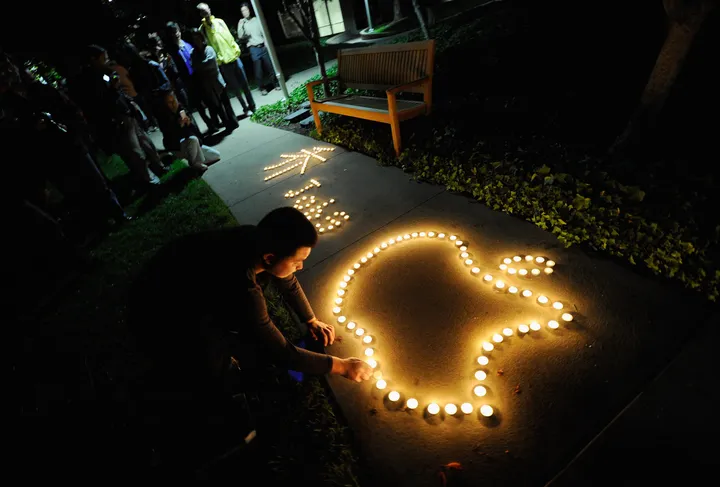
The Zen of Steve Jobs: Right Livelihood

Posted: 11/17/11 04:30 PM ET

Many people have been asking me of late if Steve Jobs really was a Buddhist. The answer is yes, and for many years.

He was a Zen Buddhist, which inspired his simple, informal, monkish black dress code and the meticulously minimalist yet elegant consumer products he so ingeniously designed. If you look at Vincent van Gogh's self-portrait as a Zen monk you'll find many similarities with that other famously difficult creative genius.

Perhaps Steve was van Gogh's tulku (reincarnation).

Like Jobs, van Gogh was also a religiously inclined lay preacher of sorts, full of mystic zeal, creative energy and egalitarian ideals -- and an equally volatile spirit who didn't play well with others. In 1888, van Gogh painted himself as a monk in "Self-Portrait Dedicated to Gauguin." He describes how he painted it "as the portrait of a Bonze, humbly worshipping the eternal Buddha and made the eyes slant slightly, after the manner of the Japanese." Some scholars think the painting was meant as an intense affirmation of an ideal: to be the "calm monk" who can discipline and control the "mad painter." (At the time, van Gogh was imagining founding a community of artists. In representing himself as a bonze [Buddhist monk], he painted himself as an inhabitant of his ideal community.) All these components also informed Jobs' spiritual search, career path, proselytizing and the new silicon community he helped initiate. In his letters, Theo van Gogh said of his brother Vincent: "It is as if he had two persons in him -- one marvelously gifted, delicate and tender, the other egotistical and hard hearted. ... It is a pity that he is his own enemy."

Sound familiar?

Jobs was a late product of the 1960s, who openly admitted that his psychedelic experiences had greatly informed his creative thinking. He'd actually dropped out of hip Reed College in Oregon after one semester, hung out at the Berkeley and Stanford campuses, and tripped around chaotic, cacophonous India for half a year or so as a truth-seeker, meditating and inquiring intently into mystical matters. After returning to the South Bay area in 1975, over the years he sat in Zen meditation retreats at sylvan Tassajara Zen Center near Big Sur and was good friends with some of my hippie vagabond friends, who had also spent time in India.

Some wonder exactly what kind of Buddhist could be so famously impatient, rude and demanding. How could he be so emotional, even throwing tantrums? Relentlessly stubborn, he could be brutal to close friends, family and colleagues, act ruthlessly in both business and personal affairs and claim credit for others' ideas. Speaking as a fellow Buddhist, albeit of a different lineage, I have no easy answer or apology to offer for him in this respect. I think his having been adopted played into it -- the master of design simplicity had some very messy elements of his personal life. We teach what we need to learn, as the saying goes.

Maybe that's why this very complex and even contradictory personality so assiduously sought and loved simplicity.

As it happened, he became a Zen Buddhist and followed for two decades a Japanese master living in Santa Cruz, Kobun Chino Roshi, and a married Zen monk. Roshi seems to have had an influence on Jobs in one notable respect --- as a spiritual leader more interested in the great Zero (of sunyata, the void), than in oneness and other larger, more collective numbers. Kobun seemed focusessed too much on cold and clear emptiness, not enough on warm and empathic compassion, attitude-transforming loving-kindness practice. Too much head and not enough heart, a common critique of some Zen Buddhist lineages.

It was no accident that Kobun Sensei, as his students call him, attracted Steve Jobs. Kobun was buddies with the provocative and controversial master Tibetan lama Chogyam Trungpa Rinpoche, the pioneering founder of the Naropa Institute in Boulder, a valuable teacher to many of us in the 1970s. Jobs could be more of a ronin -- masterless samurai -- than a saintly sattvic spiritual seeker. In fact, he was the personification of, as one oft-misunderstood Zen saying puts it: "If you meet the Buddha on the road, kill him." (Which cautions against believing in any such thing as Buddha, or anything substantial, outside. It has nothing to do with life taking.) Consider the grandiose tone of Jobs' in-your-face challenge to then Pepsi-Cola chief John Sculley: "Do you want to spend the rest of your life selling sugared water, or do you want a chance to save the world?"

There was method in Jobs' madness, as Sculley became the head of Apple and the highest paid executive in Silicon Valley.

I don't use Apple products (for no real reason, other than I got started with DOS) and hadn't seen Jobs in years when he died, but I did get to know him a bit while staying in his home for a couple of days in 1978. He had just opened his original one-story Cupertino factory, living alone in an empty suburban house with little or no furniture. His bedroom had a double mattress on the floor and two huge stereo speakers, one on either side, and little else. (Steve thought couches were superfluous.) My friend and I slept and sat to meditate on the carpeted floor in another bedroom even barer than Steve's. I think we ate cold cereal for breakfast and broccoli for dinner, more than once. There was a phone with a cord attached to the kitchen wall. (I could see he was obviously handy, knew carpentry and learned a little Japanese calligraphy -- all early influences on his engineering style.)

At the time, Steve was working intensely, as usual, on some kind of new electronics, which was news, as well as Greek, to me. (It was both new and geek to everyone, we'd eventually discover.) Steve said that sitting in meditation helped him focus as well as gain an uber-view of his own inner mind, effects I could certainly relate to. And he wondered how to use this in his work, electronically. It was obvious that he was working very hard, obsessing about his new project day and night.

He also paid a psychedelic relic friend, clad in flowing handmade Indian cotton garb, to walk around the half-empty factory floor and strum his Indian instruments, singing mellifluous kirtan, hymns of divine praise we'd all learned at ashrams in India. He told us Jobs had hired him "to upgrade the group consciousness." I remember wondering at the time how serious and high-minded Steve actually was, given the electrical engineering shop environment and his alpha-male tendencies and ambitions. To his credit, Steve did help the following year with some much-needed seed-money -- a $5,000 donation with no strings attached -- for some of us to create in 1979 the SEVA Foundation, (a charity working in developing nations), which is still going strong. I'm grateful to him for that.

So he wasn't especially generous, humble or kind. Then perhaps the virtuous aspect of the Noble Eight-fold Path taught by Buddha that Steve Jobs did exemplify was Step Five, Right Livelihood and True Vocation, one of the most interesting, challenging and relevant aspects of our life's journey. How to align our work and our life, our personal and professional lives with (and inseparable from) our home, love and inner spiritual lives? Is this not one of our greatest challenges? Jobs seemed to skillfully blend his occupation and talents into his creative true calling -- working wholeheartedly at the intersection of the humanities and the science, as he once said.

Jobs often said he wanted to make something beautiful and not just new, useful or successful. The inner level of Right or Wise Livelihood is doing what needs to be done, something we all aspire to but are often insufficiently aware of or able to achieve. I believe that making this world and life a better and more beautiful place for all is our true work and vocation.

Fairly, some might dispute that Steve's business ethics and tactics accorded with the principles of Right Livelihood, or even that the compassionate life of the altruistic Enlightened Leader could ever possibly combine running a grand entrepreneurial business with the even greater work of edifying and enlightening the world. I personally would love to hear this further discussed and explored for the benefit of upcoming generations. Suzuki Roshi of San Francisco Zen Center used to say: "You're perfect just as you are -- and still you could use a little improvement." This is fine wine, heady stuff. How to get from here to truly and totally here is the modern conundrum, beyond linear ideas of progress, where mindful awareness proves indispensable.

Now everyone is talking about and even apotheosizing Steve, which is, like most public discussion, both more and less than the whole story. Seasoned journalist Walter Isaacson's big new biography of him is an excellent read, and full of stories and historical record (although Isaacson remains tone-deaf to things foreign to him, such as Zen Buddhism's cryptic teaching and ancient Asian-style chanting and rituals), including those at Jobs' 1991 Yosemite wedding to Laurene Powell, where his Zen priest-teacher Kobun officiated.

In his 20s, Steve predicted he would die before the age of 40, although no one seems to have known why. What affected me most about his untimely death was how young he was, only 56.

How rarely does such a brilliant shooting star pass through this local universe where people like us live, breathe, walk, wonder, work and play.


Follow Lama Surya Das on Twitter: www.twitter.com/LamaSuryaDas

Many people have been asking me of late if Steve Jobs really was a Buddhist. The answer is yes, and for many years. He was a Zen Buddhist, which inspired his simple, informal, monkish black dre...
 
 
  • Comments
  • 57
  • Pending Comments
  • 0
  • View FAQ
Comments are closed for this entry
View All
Favorites
Recency  | 
Popularity
Page: 1 2  Next ›  Last »  (2 total)
This user has chosen to opt out of the Badges program
06:26 PM on 11/29/2011
I'd be zen-like too if my begging bowl had $76 billion in it.....
12:57 PM on 11/27/2011
This is a better example of spiritual materialism. There seems to be no consideration of emptiness and continuing to trap oneself in samsara. Popular Buddhism.
This user has chosen to opt out of the Badges program
photo
07:54 AM on 11/27/2011
He is truly a saint, probably a better person than all of us combined. After Steve Jobs died, I started believing in heaven again, because how could such a perfect soul exist, and then die?
12:59 PM on 11/27/2011
you are not a buddhist?
09:24 PM on 11/24/2011
As a business owner myself, I think there is often an inherent tension between Right Livelihood and our capitalistic system, a system that seems more about competition (some of it quite ruthless) than cooperation. One need look no further than Wall Street to see the effect of capitalism devoid of ethics. For me personally, having the principles of Right Livelihood as an integral component of how I run my business has been a great benefit not only to myself but to all of my customers.
09:20 PM on 11/24/2011
An informative, thought-provoking article. Thanks, Surya Das!

I knew Jobs considered himself a Zen Buddhist, but I did not know much beyond that, so this gave me a little more insight into who he was.

Your comments about Zen resonated with me. I started my Buddhist practice (35 years ago) in the Zen tradition, first in the Soto and Obaku traditions (the Roshi trained in both) and later, in Rinzai. Some years later, I was introduced to Tibetan Buddhism (the Gelug School) and it was a revelation to me, for a number of reasons. I realized, immediately, that I had very little understanding of basic Buddhist teachings, aside from teishos (talks/teachings) at sesshins and what I happened to read on my own. The second realization was how much the compassion side of Buddhism seemed missing in the group I trained with. I don't think I encountered the word Bodhicitta before my exposure to Tibetan Buddhism.

So, I think, if Steve had possibly had more exposure to the compassion side of Buddhism it would have had a significant effect on how he treated his colleagues and his employees. It certainly had a significant effect on me!
photo
somewhatodd
micro-bio undetectable to the naked eye
01:41 PM on 11/24/2011
Lama Surya Das - appreciated your down to earth eulogy and happy thanksgiving. btw, i noticed your new book and got a kindle copy, it's really good.
12:41 PM on 11/23/2011
Dear Lama, reading your words I feel unwell. I miss a sense of equality and justice. What is creative? Would you please check your point of view concerning creativity and genius? It seems to me you are so very impressed by fame and what is called job performance. I hear Charlie Chaplin: "We think too much and feel too little. More than machinery, we need humanity."
06:19 PM on 11/24/2011
Dear Lama, friends and non-friends, please forgive me. I am only learning to express myself in another language. "I feel unwell" is exaggerated. I felt a little disappointed is more appropriate. Then, instead of "would you please check" - "would you be so kind and think again about your view concerning.." is better. Thanks for patience, and best wishes to all :-)
11:43 AM on 11/23/2011
Thanks for posting this!

What is interesting about the story is whether or not Steve Jobs was a Buddhist or a "good" Buddhist, but an exploration of if and how Buddhism may affected one of the most successful hi-tech consumer product companies of all time. Or perhaps it is the other way around :).

I met Jobs in the early 80s and you can read some of my thoughts here at http://whatmeditationreallyis.com/index.php/lang-en/home-blog/item/263-meditating-on-steve-jobs-technolgy-and-buddhism.html

It's about the intersection between Buddhism, Artificial Intelligence, Steve Jobs, me and the lack of an inherently existing self. Enjoy!
01:22 PM on 11/27/2011
There is no such intersection, except in your own thoughts.
02:49 PM on 11/27/2011
And that explains why I was able to write about it :)....
photo
White Raven
Eyeballs are tasty
06:03 AM on 11/23/2011
Here is my zen contribution to this discussion:

I do not know Steve Jobs.
photo
HUFFPOST SUPER USER
Jared Keith Jones
your friendly neighborhood buddhist
06:36 PM on 11/21/2011
@Lama "Who worships the scholar diety of Hinduism"

Haven't we heard enough about Steve Jobs? His time has passed. He has moved onto his next life. The only thing he can teach us at this point is: Regardless of who you are, where you live, and how much money-power-influence-friends-colleges-houses-technological prowess you have.. you will die and move onto your next life. That is certain. You cannot know when you will die. That time is uncertain. You currently have access to information that will enact permanent transformation to your mental continuum.. regardless of where you end up after this life.

Take advantage of this opportunity now.
photo
HUFFPOST SUPER USER
Saidas
10:13 AM on 11/20/2011
Please. Enough already with the deification of Steve Jobs. He was a master designer and pitchman, but nothing more. Going to a Zen monastery occasionally and wearing black turtlenecks does not make you a Zen Buddhist. A Buddhist is as a Buddhist does. Steve was often harsh, cruel, and uncaring...hardly traits of a Buddhist.

Just let Steve rest in his iTomb and just be remembered for the great products he made and leave it at that.
photo
HUFFPOST SUPER USER
Jared Keith Jones
your friendly neighborhood buddhist
05:51 PM on 11/21/2011
One of the Buddha's main disciples was a mass murderer. Angulimala, a warrior who vowed to his martial arts instructor he would kill 1000 people (eventually this included his own mother). You think he was a nice fellow? Some sources claim Angulimala realized the selfless nature of reality immediately after killing a messenger boy who accidentally bumped him with his horse on the road.
photo
HUFFPOST SUPER USER
solitude1951
12:39 AM on 11/24/2011
Amen
photo
HUFFPOST SUPER USER
Jared Keith Jones
your friendly neighborhood buddhist
09:44 AM on 11/24/2011
On the other hand, I am not putting forward the Zen path of drugs, sex, and rock 'n roll. Just to make things clear: for the majority of us, we will also need to exert effort to engage in ethical practices. My main point, actually, is who cares about Steve Jobs? Unless you are a psychic, you have no idea what his mind was like before the moment of death and you have no idea where he is now. Even if you did know, it does not help you.
02:22 AM on 11/20/2011
I appreciate your effort to try to define right livelihood in terms of "how to align our work and our life, our personal and professional lives with (and inseparable from) our home, love and inner spiritual lives," using as an example Jobs' skillful blending of "his occupation and talents into his creative true calling" in order to make "make something beautiful and not just new, useful or successful," but let's not forget that most Buddhists have defined it in terms of purity of thought, deed and action, especially as it relates to one's occupation. Specifically, it has referred to "not make a living by stealing, gambling, killing, pandering," and so on (see http://guest@www.buddhism-dict.net/cgi-bin/xpr-ddb.pl?q=正命). I much prefer a definition along these lines, not only for its usefulness in criticizing unjust business practices that harm actual people, but for its recognition that action that does not harm leads to enlightenment. Portraying some sort of new age aesthetic self-actualization as right livelihood sells the Buddhist teachings short.
relevancematters
You're so full of what's right, you can't see what
12:39 PM on 11/19/2011
Whether or not he achieved a level of Zen Buddhism that better practitioners can approve of, I think it was astonishing that he even tried, given the pace, context and focus of his life. That he found and continued to nourish a spiritual component in such a hard-wired life is both admirable and endearing.
10:51 PM on 11/18/2011
Lordee bee. Steve was a Zen Buddhist ... really? .... and therefore dressed in black? Spare me. The author wouldn't know Zen if it hit him upside the head.
photo
BurtonDesque
Fear a Blank Planet
08:26 PM on 11/18/2011
Why is a Tibetan lama trying to tell us about Zen? We might as well ask the Pope to tell us about Mormonism.
photo
HUFFPOST SUPER USER
Jared Keith Jones
your friendly neighborhood buddhist
05:52 PM on 11/21/2011
Mahamudra/Dzogchen (within Tibetan Buddhism) is Zen - Chan - Dyanna.
01:15 PM on 11/27/2011
Seems inaccurate. Dzogchen's main tenant is direct transmission from master to disciple.
What form of Buddhism do you practice, as I see you posting often and do wonder?