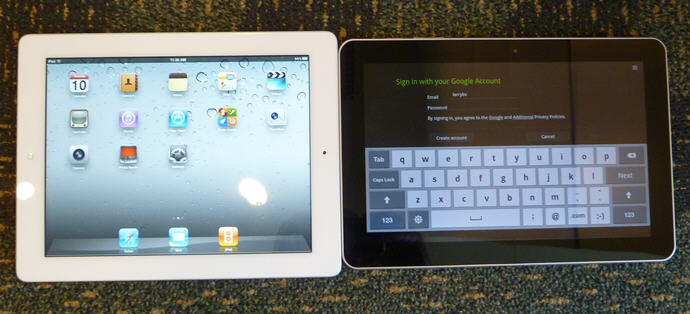
Samsung Tab 10.1 (right) is lighter and thinner than the iPad 2 (Photo by Larry Magid)
San Francisco -- Day one of the annual Google I/O developer's was all things Android. The day began with a recap of Android's growth in the two and a half years it's been on the market. Google says that there are now 100 million activated Android devices, 400,000 new devices activated every day, 200,000 apps in the Android market and that Android users have so far downloaded and installed 4.5 billion apps. Those numbers aren't as gargantuan as what Apple can claim, but they're respectable and indicate enormous growth for the only serious competitor to Apple's popular iOS operating system that runs on iPhones, iPads and iPod touch devices.
The company announced update to Honeycomb, the version of Android optimized for tablets but also said that later this year they'll ship a new version of the operating system, called Ice Cream Sandwich, that supports both phones and tablets. The just released Honeycomb 3.1 adds resizable widgets and a new task switcher.
Google also announced an update to its Google TV platform which will soon run applications from the Android marketplace.
Thinner Tablet
In the past couple of years, Google has given out Android phones to developers attending Google I/O but this year they handed out an as-yet-unreleased tablet from Samsung. The Samsung Tab 10.1, which will be available to the public sometime this summer, is actually thinner and lighter than Apple's iPad 2 and feels great in the hand. I'm not going to declare this device an iPad killer, but it's certainly a contender. The device connects to the Internet via Wi-Fi, there is no 3G cellular option available as there is with the iPad, Motorola Xoom and several other tablets.
Perhaps the biggest news of the day is the Google music service and its video rental service. The music service will allow users to upload their own digital music files (up to 20,000 songs) to Google servers so that you can stream them or download them to a PC or Mac, an or an Android phone or tablet. With all your music in the cloud, you can synchronize it to a device via the net without having to use a cable to connect to a computer. Even though Apple CEO Steve Jobs has said that he expects many people to replace their PCs with tablet devices, the only way to get your music collection to an iPhone or an iPad is to connect it to a computer via a cable.
Movies and Music
Google's movie rental service, which is now part of the Android market allows you to rent movies to instantly stream to a computer or an Android device. As with other movie rental services, once you rent a movie you have 30 days to start watching and once you start, you have 24 hours to watch it. Because it's on the cloud you could start viewing a movie on a PC and finish viewing it on an Android device. One relatively unique feature is called "pinning" which allows you to download the movie to the device to watch when you don't have an Internet connection such as on an airplane. Apple doesn't currently support streaming so the only way to view a movie on an iOS device is to download it.
Connecting Hardware
Google also announced Android@Home that will allow Android phones and tablets to control home appliances, light switches and other devices. Another project, called Android Open Accessory, will allow hardware developers to create an interface between Android devices and accessories. One example is an exercise bike from Life Fitness that lets you play a fitness game on the Android phone while you peddle the bike. Another example shown at Google I/O allows someone with an Android tablet to control a labyrinth game with an Android tablet. I'm not talking about a virtual on-screen labyrinth but a physical board with motors that tilt the platform based on how you move the tablet. It's not the most practical demonstration in the world, but it shows the potential for hardware accessories.
Based on what I saw on Tuesday, it's clear that Google is a major force in both the tablet and phone market. On the tablet side, it's a distant second to Apple's wildly successful iPad franchise but its running fast in an effort to catch up.
Follow Larry Magid on Twitter: www.twitter.com/larrymagid
Timothy Karr: Is Apple Launching a Pre-emptive Strike Against Free Speech?
John Bergquist: Having Patience With Tablets
That's right, don't confuse Angry Birds with Angry Nerds!! ; )
Similarly, even if Samsung and other manufacturers come out with really good tablets that use an Android OS, that doesn't mean that any of them, or even all of them collectively, will be an "iPad killer." It also doesn't mean that there is anything wrong with the iPad OS. It just means that there is room for multiple operating systems in the tablet market also, just as in the phone market.
Free is unstoppable.
On the enterprise level, this really shows the importance of having the proper tools in place to manage a mobile fleet, no matter what type of OS system employees choose. With so many options to pick from, it’s not surprising to see some enthusiastic iPad fans and (more and more) enthusiastic Android tablet users. But assuring the company data stays safe, no matter what tablet employees choose will be important as these devices make it through company doors.
Stephen Midgley, Absolute Software
http://blog.absolute.com/
If you do your homework, Android tablets are a cheaper, faster alternative to the iPad. Once you throw in the fact that you can root them without voiding your warranty, they offer open source development, and Google isn't trying to DRM everything you own, then the only advantage to the iPad is that it will impress all your friends who think that brand matters.
No more fruit company.
And don't forget that they're thinner, which is proof positive that they're better.
You see, let me spell this out for you sfkjeld. They're just like iPads, only thinner, faster - better and different, which makes them completely original - absolutely nothing at all like iPads! Get it?
So forget about that dated iPad and get something truly original for a change.
Enough with the Apple fanboi routine, if you really concentrate you can become a robot, drone or droid and prove that you're thinner, faster and better than the rest! ; )
*** Shared systems (AKA Servers) ***
- Operating Environments = Linux+Java, Windows+Java, Linux or Windows (in market share order)
- Typical applications = Web Server, SQL database, CRM, ERP
*** Personal systems - desktop/laptop ***
- Operating environments = Windows, MacOS and Linux (in market share order)
- Typical applications = word processing, spreadsheet, presentations, photo editing, etc.
*** Personal systems - hand-held ***
- Operating environments = MacOS (iOS), Linux (Android) and Windows (in current market share order - eventually Linux will displace MacOS because of Apple's anti-license paranoia, but Windows will probably lag)
- Typical applications = phones, games, content players, etc.
*** Embedded Systems ***
- Operating environments = Linux, Windows, QNX, VXworks, etc. (in market share order - Linux and Windows have pretty much crowded everyone else out)
- Typical applications = These systems are the heart of many common devices humans use, such as TVs, automobiles, toasters, cameras, etc. This is actually the largest market for CPU chips.
*** Notes ***
- notice that Linux and Windows are used across all four segments. In each segment Linux and Windows are tweaked to perform best for that environment, but for the most part is identical across all four segments.
- Notice that MacOS is only used in two of the four segments (yes, I know there are MacOS servers, but the segment share is close to non-existent and the only embedded system,
How does that work?
If Linux beats Apple because of Apple's paranoia about licensing, how does Windows get beaten by both since they don't have the licensing paranoia? Wouldn't they beat Apple?
Reevaluate?
Even though MS now has Nokia in its camp both are STARTING the race about three years late.
In consumer's minds it is a two horse race, Apple and Google. Because these two are willing to listen to the consumers and try to beat each others brains out, they eat up most of the market oxygen. In every computer market segment there is ONLY room for 2.5 operating systems, with two dominating and the 0.5 sucking wind trying to stay alive.
Shared Systems - Linux and Windows dominate, all the rest have miniscule market share.
Desktop personal systems - Windows and MacOS dominate, all the rest have miniscule market share.
Handheld personal systems - Linux and MacOS dominate, all the rest have miniscule market share.
Embedded systems - Linux and Windows dominate, all the rest have miniscule market share.
It is very hard to unseat two very extremely dominant market leaders, no matter how much money a competitor throws at the market.
That being said, there is over a 35% profit margin in the iPhone, iTouch and iPad, so if ME wanted to really hurt Apple and gain market share, they could drive the prices for handheld devices down by 40%. It would hurt Google and MS, but they can both afford it, whereas Apple has much fewer resources. I depends on how hungry MS feels it is.
On a similar side of the coin of thought here, I find it odd and amusing that Apple inspires such fanatical hatred and love. Most other companies drift along without anyone really caring one way or the other, but not Apple. It is both God and Satan, and that bizarre mentality seems insane.
not: "Larry Says There Is No Room For Apple",
Most Android fanboys spend their time trying to just demonstrate that iOS isn't made of rainbows, unicorns and miracles and it has strengths and weaknesses just like Android does.
When that perception is broken and people take things at face value then there won't be a need for any more fanboyism on either side.