
(Credit: ConnectSafely.org)
As we start the school year, there are two trends in online child protection that are worthy of scrutiny.
The first is the growing trend towards software and services that monitor what kids are doing online and with their phones. The second are proposed "do not track" laws that would require Internet companies to change the way they present advertising to children. Both have strong appeal but, like any strong medicine, there can be negative side effects. Another option -- the one that I prefer in most cases -- is to teach digital citizenship and critical thinking, which, together, help children build skills and attitudes that will last a lifetime.
Do we really need to monitor our kids?
The trend towards monitoring is based on the assumption that kids will see and say dangerous or inappropriate things on the web and phones. Until recently the concerns were mostly about pornography and predators but now the focus is mostly on protecting kids from being bullied or becoming bullies as well as from posting content and images that could harm their reputation or get them in trouble. One example is "sexting," the sending of nude or sexually explicit images.
The products, which range from cloud based services that scour the Internet for any content by or about your child to computer software and phone apps that analyze content on the device, are mostly designed to look for clues that the child may be sending or receiving problematic messages or images or visiting inappropriate websites. The software or service notifies parents if something is suspicious, leaving it up to the parents to intervene as necessary.
The advantage is that a parent, armed with information on what his or her child might be up to, is in a position to provide guidance and turn a possible misstep into a "teachable moment." But one concern with this approach is whether the data being sent to parents could trigger a false alarm. Does the software fully understand the context of the words or actions it detects?
Also, kids can find work-arounds, by using devices or services that aren't protected by the software or by using phrases or spellings that the software isn't able to pick up. Some programs literally record everything the child does, which raises all sorts of issues including violation of the child's privacy and bombarding the parent with too much information.
The software between their ears
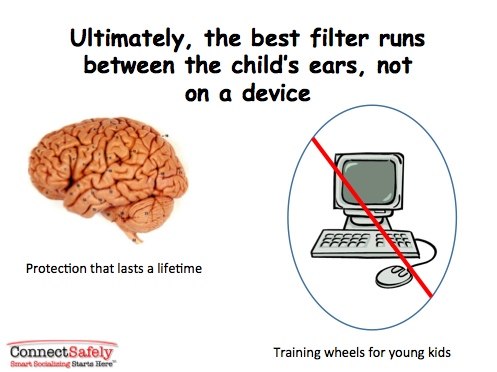
Regardless of whether you use parental monitoring tools, the most important child protection "software," is not the application running on the device or in the cloud, but the software running on that very adaptive computer between the child's ears. Monitoring or filtering services are never a substitute for helping children develop the critical thinking skills they need to protect themselves.
Just as surveillance cameras and police on the street won't protect adults from all misdeeds, monitoring and filtering programs won't protect kids from all potential problems online. Children need education and guidance to learn to make good decisions on their own, to protect themselves and treat others well.
Some of the leading monitoring programs include SafetyWeb, SocialShield, United Parents Child Protection Service, Trend Micro Online Guardian, Zone Alarm Social Guard and Norton Online Family. For more analysis and details on recent monitoring services and software, see this post by my ConnectSafely co-director, Anne Collier.
Do not track is a double-edged sword
I'm sympathetic to the motives behind legislation to "protect" children from advertising by passing "do not track" laws that limit information that companies can collect. While such legislation is well-intentioned, it may actually backfire.
The proposed laws would limit the ability of sites to place "cookies" and other tracking code on machines that trigger browsers to display targeted ads based on sites you've visited. For example, if a person visits websites dedicated to photography, they're more likely to see ads for cameras. While it might feel creepy to have such ads aimed at you, it's important to realize that these cookies are not reporting your name or other identifying information to companies but simply directing ads to your device. The result is that you are more likely to see ads about products that interest you than you are random ads aimed at the general population.
The major browsers have tools that enable you to notify web operators that you don't want to be tracked and most responsible ad networks have agreed to honor these requests. Users who opt out will still see ads, but they'll be more generic which means that they'll be less relevant. They also bring in less revenue to websites so prohibiting them could affect sites' ability to provide free content, drive them to charge for access or to put up more obtrusive and obnoxious ads.
Some argue that this opt-out approach is fine for adults but that kids should automatically be opted out of any tracking. But before we adopt technology designed to protect children, we need to make sure that it doesn't inadvertently jeopardize their privacy. My main concern about creating special advertising rules for minors is that it might require that the user be identified as a minor which would actually be a more serious invasion of their privacy than the status-quo.
Solution is critical thinking and digital citizenship
I realize that adults feel an obligation to protect children, but let's not under-estimate the ability for kids to actually make pretty reasonable decisions, especially if we embark on a campaign to create a truly digitally literate society, starting at a very young age.
What we need are educational campaigns that teach kids how to use whatever controls are built-in to the browsers, how to distinguish between advertising and editorial content and how to evaluate whatever information they come across to be able to make informed choices. The same skills that will protect kids from misleading advertising will also protect them from scammers, phishers, spammers, hackers and anyone else who would try to take advantage of them
Kids (and adults too) need to learn to critically evaluate what they see so that they become more resilient consumers or information.
Tools and laws sometimes have their place, but they're never a substitute for parenting, education, awareness and skills that help us and our children enjoy the benefits of the Internet safely and securely.
This post is adapted from an article that also appears on SafeKids.com and in the Palo Alto Daily News.