What do Christianity and animals have to do with each other? I get that question all the time. My response, "Where shall we begin? They have so much to do with each other!"
While a cursory glance at this religious tradition might make it seem void of animals, one need not search far to find them around every corner. Several years ago while doing research in Italy I asked a couple of my students to look for animals in the churches and report back to me. Initially they were skeptical, not expecting to see very many at all. Two days later they returned with eyes wide open overwhelmed by the number of animals they encountered.
Yes, images of animals abound in some of these classic old churches. Paintings of the Last Supper often include a dog under the table (where else would a dog be, they're always under our tables when we're eating). Depictions of the birth of Jesus show not only the commonly assumed ox and ass, usually watching carefully over the baby, but sheep and camels and, again, dogs who bow before the holy child. The eagle, bull and ox are symbols for three of the evangelists so they are everywhere (Mark, Luke, John).
Lions, donkeys, birds and horses, to name just a few, are also found in the scriptures. A dog licks Lazarus' sores (Luke 16), Jesus spends time with the wild beasts (Mark 1), God reminds Job of the majesty of the horse thus humbling the human (Job 39), God provides shelter and water for all the wild animals (Psalm 104), Jesus permits breaking of the Sabbath laws in order to save an ox or a sheep who has fallen into a well (Matthew 12, Luke 14), and the list continues. In all of these cases, animals are included in the circle of God's compassion and care; according to the Biblical texts this is a God who saves humans and animals alike (Psalm 36).
Equally compelling are some stories from the apocryphal scriptures, incredibly important early Christian texts that, for a variety of reasons, did not end up in the New Testament. In the Gospel of Pseudo-Matthew, full of stories about Jesus as a child, there is a lovely narrative about lions. According to this gospel, the eight-year old Jesus was traveling with other pilgrims on a road out of Jericho to cross the Jordan River. Beside the road was a cave where a lioness was nursing her cubs. Everyone was afraid to pass thinking that the lioness would attack. But Jesus entered the cave without any fear. The adult lions bowed in reverence and the cubs played around his feet. The description evokes a lovely image of Jesus happily romping with these baby lions, safe in the cave together. Eventually, in the sight of the large crowd, he emerged from the cave with all of the lions, praising the felines for recognizing him. Then they cross the Jordan together, with Jesus providing safe passage to the lions. On the other side, he bids them go in peace. Significantly at this point he also says loudly so all the humans hear, "let no man injure you," thus offering his protection to the lions. What a story! And there are others like it. Jesus resurrects a fish (Infancy Gospel of Thomas) and curses a man who is beating his mule (Coptic apocrypha). Jesus even heals the mule in that story.
Yes, once we open our eyes to see them, animals are everywhere in the history of Christianity. But at least in recent memory, animals have been ignored and even demeaned by Christians and Christianity. Humans became the sole focus of most forms of Christianity and, as a result, cultures influenced by Christianity have not been kind places for most animals.
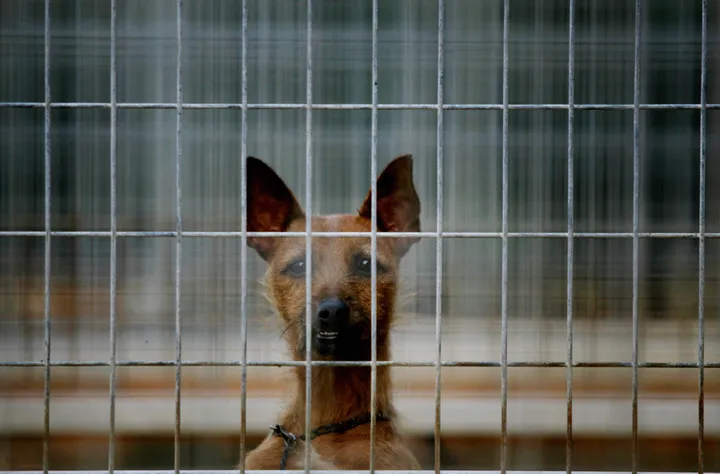
In the U.S., where approximately 75 percent of adults identify as Christian, the lives of many animals are miserable and short. According to statistics provided by the U.S. Department of Agriculture, in 2010 almost 10 billion animals were killed for food in the U.S. alone. That is the equivalent of almost thirty animals per person. Thirty animals per person! The vast majority of these animals live in cramped, filthy conditions. They are forcibly removed from their mothers, who are treated as breeding machines not as living, breathing beings. In the Bible God is compared to a mother hen who protects her young under her wings. In the U.S. a mother hen is kept in a battery breeding cage, she is never allowed to protect herself or her young.
Several years ago I was honored to be part of a documentary produced by the Humane Society of the United States entitled "Eating Mercifully." We examined the history of Christianity and asked how beliefs intersect with practices of eating. Christianity, which not only focuses on justice for humans but also has a rich tradition of thoughtful eating, is no longer living up to its own calls for compassion. Numerous saints chose diets that caused the least amount of pain and suffering to others. Fridays were traditionally a day of fasting or, at the very least, of not eating meat. Christians seem to have forgotten that what we eat is a reflection of what we believe.
Rooterville is a pig sanctuary in Florida and the founders of this wonderful place, Elaine and Dale, were also involved with "Eating Mercifully." They are committed Christians who, after seeing the cruelty of factory farming in person, decided that they had to do something. Based in their faith, they created a place of safety and compassion for animals. For them, the way we treat animals is an issue of mercy.
My days are filled with dogs. I teach about them, research their stories and connections to humans, live with them and try to help rescue them. But in reality I think that my relationship with dogs (and so many other animals) tries to embody the love of God. Christianity calls for hospitality, justice, humility, forgiveness, acceptance and mercy for all of God's creatures. Excluding animals from this call narrows and impoverishes Christianity. Just as Jesus, the good shepherd, had compassion for the sheep, so must all Christians embrace the call to love animals.