
Lauren Cahn

Lauren Cahn

Posted December 7, 2008 | 07:39 PM (EST)

Walking: Meditation for Non-Meditators

digg Share this on Facebook Huffpost - stumble reddit del.ico.us RSS

You know who you are. You never do less than two things at once. You read while you eat. You check your email while you're on a conference call. You're restless, and it works for you because you get things done. And when it comes to calming your mind, you have no interest in meditating because that would require you to sit still and do nothing.

Right?

Not right.

You don't have to sit to meditate.

To meditate, you only need to focus the mind. In some forms of meditation, the focus is on NOT focusing on any one thought. When the mind realizes that it has attached itself to a thought, the meditator tries to "let go" of the thought and allow it to drift away. In other forms of meditation, the focus is one one thought, a mantra (such as "relax" or "let go" ). When the mind realizes that it has drifted from the mantra, the meditator tries to come back to the mantra.

Meditation is used as a relaxation technique because it helps the mind to rest from its usual state of frenzied thought. It doesn't make life's problems disappear, but it gives us time away. Meditation is like a vacation from our thoughts. Taking time out for meditation can make us more productive in the long run in the same way that taking a vacation from work can make us more productive when we return: time away allows us to come back refreshed. Distance from our thoughts -- our worries, our planning, our soul-searching -- affords us more clarity when we return from our mental vacation.

For some, knitting is a form of meditation. For some, gardening. Many people find that practicing yoga brings them into a meditative state. Personally, I garden throughout the spring and summer and practice yoga on a daily basis, and generally speaking, I find myself calmer for having done so; however, I feel that both of these avocations are flawed as reliable platforms for meditation (and I would imagine that knitting would have the same flaw). The trouble is that inherent in these activities are goals and desired results, which can make a meditative state elusive, if not impossible.

So then what activity can we do that doesn't require analytical thought, that doesn't require us to judge our progress, that doesn't contain a built-in goal?

Walking.

If you can walk, then you can meditate.

For me, there is no better tool for meditation than walking in the woods. I don't have to worry about crossing the street or bumping into anyone I know. I don't have to dress for the occasion. In the colder months, I simply have to dress warmly and wear comfortable shoes. I don't take music with me on my walks because that would take me out of my focus, "nothing".

So, how do I do it?

I park my car, I set a timer for 15 minutes, and I walk. When the timer goes off, I turn and walk back exactly the way I came. All the while, I'm listening to the leaves crunching under my feet, to the trees rustling, to water flowing over rocks. My eyes are observing my surroundings, and watching for trail markers to make sure that I stay on a marked trail. Other than that, my mind tends to go blank. I don't have to force it to do so. It just does.

You see, I don't specifically set out to not think about whatever it was I was thinking about on the ride over. But within moments of my feet hitting the ground, my mind is seduced by the rhythm of the walking, by the relative consistency of my surroundings, by the general lack of stimuli. When the timer sounds, I'm usually amazed that 15 minutes has passed so quickly. The second half of my walk often passes even more quickly.

If you'd like to try walking as a tool for meditation, you can do it on a well-marked trail in a nature preserve, like I do now that I live in the country. Or a winding path through a public park, like I used to do when I lived near Central Park (I think that it goes without saying that you should walk only where you feel that your personal safety is not in question, and that you should carry a cell phone and identification):
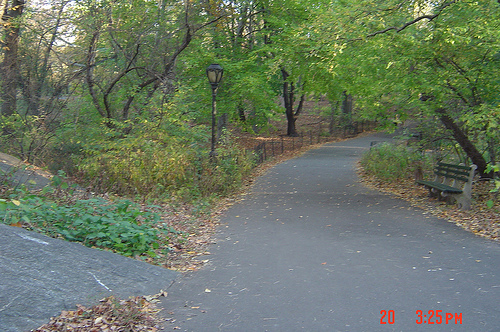
2008-12-05-apublicwalk.jpg

Or you can do it in your own yard, as I have done when it's too dark to go walking in the woods. In those cases, I have simply walked around the perimeter of my property or through the paths that I carved out of the woods along the edge of my property this summer:
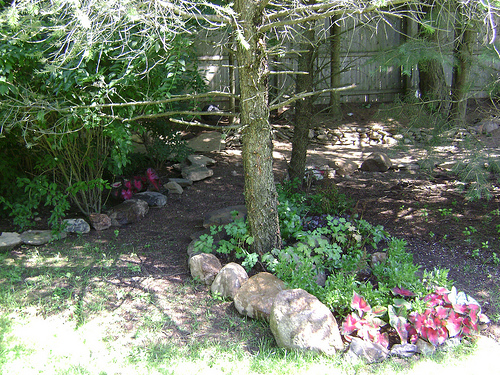
2008-12-05-paths.jpg

If you live in a city, or the weather is bad, you can walk around your home. You can walk around your living room, your kitchen, your bedroom. It doesn't matter how far you go. I've even walked loops around this frozen pond when time or weather has mandated it:
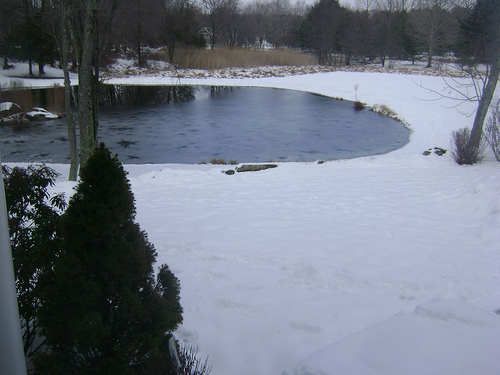
2008-12-05-winterwalk.jpg

All you have to do is walk. Walk, and focus on the action of walking. Don't make it about exercise, even though it IS exercise. Just make it about walking. If you need a specific focus to get you going, then think, "I'm walking". Or perhaps, "Walk....walk....walk...."

I don't set out to use a mantra, myself, but I have noticed that sometimes I'm humming the same few bars of a song, over and over in my mind. Today, I found myself repeating the names of the trails over which my walk was going to carry me: "birch to blueberry to maple, birch to blueberry to maple"...and so on.

If you don't have 30 minutes, try 15. Or five. Or two. If you find it difficult to be alone with your thoughts, try not to judge yourself harshly. Simply acknowledge that fact and see if you can redirect your thoughts. If you catch yourself getting caught up in a vortex of thought, you can stop anytime and say, "just a thought, let it go, just a thought, let it go" until you really do let it go. And if that doesn't work the first time you get boggled up in your own thoughts, then maybe the next time. Or the next time.

And if all else fails, at least you've walked.

You know who you are. You never do less than two things at once. You read while you eat. You check your email while you're on a conference call. You're restless, and it works for you because you g...
 
Comments
10
Pending Comments
0
iPhone App Promo

Want to reply to a comment? Hint: Click "Reply" at the bottom of the comment; after being approved your comment will appear directly underneath the comment you replied to

View Comments:
photo

Walking meditations are great to help you get centered and get in touch with yourself. There are also ways you can be mindful. If you're interested you can read http://www.newrinkles.com/index.php/mental/mindfulness-techniques

    Favorite    Flag as abusive Posted 05:00 PM on 12/27/2008
photo

The way I get in the moment is riding my motorcycle. Winding roads require absolute focus so I don't have a chance to think about things.

    Favorite    Flag as abusive Posted 08:22 AM on 12/09/2008
- Lauren Cahn - Huffpost Blogger I'm a Fan of Lauren Cahn permalink

I find meditation instruction so interesting...and so totally non-intuitive. When I was writing this piece, I looked up "walking meditation" and found a very very different take on the way it is to be done: hands clasped in front of you, stand still breathing first, walk slowly and meticulously, meditate on the heel hitting the ground, then the rolling of the foot, etc.

To me, all that stuff just takes the joy out of the experience. But it works for some, no doubt.

    Favorite    Flag as abusive Posted 09:27 PM on 12/08/2008
photo

From my practice the point of the forms associated with walking meditaion is to replace noticing the breath to noticing the movement of you feet, but with the same goal, to notice when you have checked out. Formless meditaion, which is what Dzogchen meditation is, and what you seem to be describing, is much more dangerous in a way, because there is less structure against with to notice that you have checked out and are not on the dot anymore. Of course this should be efortless, if you put strain of effort into it you are going to the opposite extreme. Buddha was all about avoiding both extremes, the exteremes in this case of spacing out and the extreme of effortful noticing. Just a light touch is all that is needed.

    Favorite    Flag as abusive Posted 08:56 AM on 12/10/2008
- Lauren Cahn - Huffpost Blogger I'm a Fan of Lauren Cahn permalink

I don't want to associate my suggested meditation with Dzogchen or any other form because that is what turns some people off. Of course, refusing to align with some accepted, named form of meditation will turn others off. I figure that the latter group doesn't need me. But the former group does. How many people would benefit from just walking...just walking..walking without goal....walking without talk...walking without purpose or label or anything...just walking...?

SO many, in my opinion.

    Favorite    Flag as abusive Posted 10:16 AM on 12/10/2008
photo

I've been asked by clients whether they should engage in similar ritualistic formalities, and I caution them against such contraints. Better to simply lose one's self in the moment - the real value lies in the gathering and directing of attention which frees up the perception to take in sensory experience without the interruption (or increasingly less interruption) of mechanical, repetitive, uncontrolled thought.

Getting to the quietness, the SILENCE, is a stunning, staggering gift.

T. Lavon Lawrence
Mental Fitness Trainer, Brain Training Author
www.dynamicmentalfitness.com

    Favorite    Flag as abusive Posted 12:55 PM on 12/11/2008
photo

Great post, this reminds me of the form of meditaion i practice, Dzochen. Just be the moment, not separate, not controlling or gathering power or info, not "doing" just BEING. No need to fight your thoughts, just bow to them and let them go. The operative word for Dzogchen is relax.

    Favorite    Flag as abusive Posted 10:10 AM on 12/08/2008
photo

Absolutely FANTASTIC post, Lauren!
Walking Meditation as a form of 'Mindfulness' - of being 'Present' in the here and now while engaged in movement ('Movement Meditation') - is supported by Scientific Study to affect positive changes in the actual structure of the brain itself.
Walking Meditation provides profound lessons to someone who implements it, and its principles can be adapted into other brain training techniques that increase mental power such as:
- Eating Meditation
- Writing Meditation
- Breathing Meditation
- even Speaking Meditation!
Anything we do as human beings wherein we fully invest our attention into the task so that our thoughts are quieted and our perception given full reign to enjoy the experience contributes to the expansion of our being, our overall mental health, and our zest for life!
I can't wait to see your next article on Meditation, Yoga, etc. Great job!
T. Lavon Lawrence
Author, NEURO-SCULPTING!©
Mental Fitness Trainer
www.dynamicmentalfitness.com

    Favorite    Flag as abusive Posted 07:59 AM on 12/08/2008

Most meditation advice is goal-oriented and enhancing of the egoic drive for "more"--this post is pretty good. I especially liked where she said, "...simply acknowledge the fact...".

That is, if "acknowledging" means "noticing" and if "the fact" means "this unique present moment of life as it is".

That's probably enough..

    Favorite    Flag as abusive Posted 09:43 PM on 12/07/2008
Comments are closed for this entry

You must be logged in to reply to this comment. Log in  or  Connect