On June 10, 2009 Captain Charles Moore set off on Algalita's Oceanographic Research Vessel for the first leg of a four month expedition from California to past the Northern Hawaiian Islands to test for plastic marine debris.
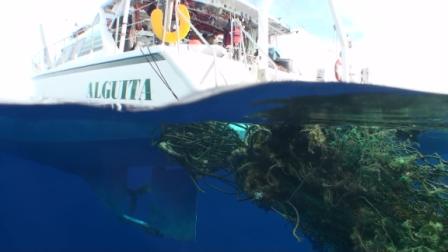
Captain Moore discovered the Eastern Pacific Garbage Patch, known as the the Pacific Gyre, and he is continuing his research to help all of us understand that the rapid rise in global plastic production is leading to a rise in plastic pollution and its devastating effects on our oceans and our lives.
Over the next few weeks, I will be posting emails directly from Captain Moore so we can follow his journey and better understand what we are doing to our oceans.
In Captain Moore's email from July 6th, the Alguita is well on its way to the International Dateline, the crew has an unique Independence Day and Nicole performs a 20 minute stopwatch survey, the results of which will shock you.
Day 25
July 6, 2009Dear Laurie,
Our voyage to the International Dateline to assess plastic debris levels is now in full swing. After four days of chasing non-existent tradewinds, we have finally found them up at 33 north lat, 165 west lon, and are sailing happily under our beautiful red and green spinnaker.
The motoring was punctuated by two instances of prop fouling by ghostnets (lost or abandoned fishing gear) which had to be cut and unwound from the propellers -- a difficult job, especially at night. The calm weather, while forcing us to use half our fuel supply, also afforded excellent sampling conditions for plastic trash. To a person, the crew was shocked by the amount floating by (which they often netted) and the amount pulled up by our manta trawl.
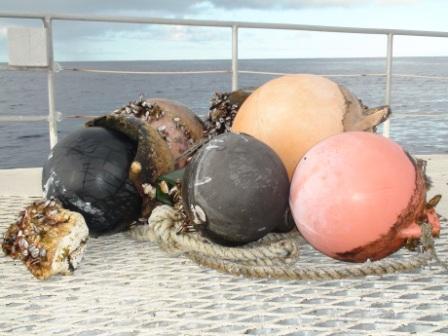
On Independence Day alone, we recorded 34 large objects netted, including a dozen fishing floats, a hairbrush, a Japanese survey stake (definitely not from a ship), and a PET bottle of Mitsoya Cider. That does not include the many smaller bits we scooped up and didn't record in our "collected debris log."
I can imagine young people on voyages in the not so distant past, when the ocean was teeming with life, excitedly netting up fish and other sea creatures in abundance. I see the same excitement in my young volunteer crew shouting and netting up debris in an ocean teeming with trash.
Of course, our longest handled net can only reach out about 10 feet from the boat, so we see many, many more pieces floating by than we can collect. In fact, Nicole did a stopwatch survey from the starboard bow and counted 217 pieces of plastic in 20 minutes or a little more than 10 pieces per minute.
We are well and truly in the Subtropical Convergence Zone, as described by the NOAA Marine Debris Program, a band several hundred kilometers in width centered around 30 degrees north latitude, and stretching from far offshore California to far offshore Japan.
One of our goals is to see how levels of plastic pollution fluctuate within this area. We have another species to add to our list of fish that have ingested plastic particles. I netted up a fishing float with a long tail of rope heavy with barnacles and a 9" Chub (nenue in Hawaiian) came up with the float. Chubs, genus Kyphosidae, have extremely long digestive tracts and "use bacterial fermentation to extract maximum nutrition from their diet of seaweed." (Guide to Hawaiian Reef Fishes, by Hoover)
Christiana was surprised to find on dissection, pelagic crabs in the stomach. Apparently, when you have to live off the ecosystem created by plastic debris, your vegetarian preferences may have to be compromised. In addition, she found two small plastic fragments along with the real food.
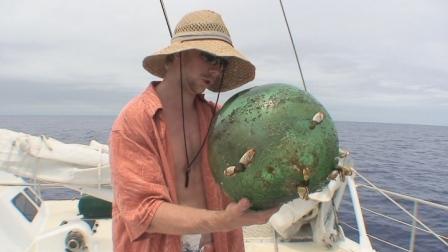
Drew spotted the first glass fishing float of the trip and we were able to grab it for his collection. He got a similar large green glass float on the 2002 gyre voyage.
Aloha from the place where civilization's unconscionable waste converges.Captain Charles Moore
Oceanographic Research Vessel Alguita
Adele Israel: No More Plastic Water Bottles
I attempted to estimate the number of plastic bottles of water sold in Grand Junction in one week. But discount giants and other corporations hold on to sales figures tighter than oil companies hang on to fracking formulas.
Want to reply to a comment? Hint: Click "Reply" at the bottom of the comment; after being approved your comment will appear directly underneath the comment you replied to
Trash as a beneficial floating reef...you've got to be joking.
Thank you for your good work!
Good on ya, Laurie.
I was unaware of the amount of plastic pollution in the Pacific until moving Down Under. Any sailor will tell you the horrific amounts of plastic they encounter. Entire small islands are hidden in mounds of the stuff. It also interferes with turtle breeding.
I reckon a lot of the pollution comes from Asia, but it's certainly a subject that needs more attention.
Hate to spoil a good tear-jerking eco-story with scientific facts,
but the '(north) Pacific Gyre' is not the name of a garbage patch, it is in fact a
large ocean current/vortex that spans the larger part of the North Pacific-
Any floating debris in the ocean is an invaluable haven and source of food and shelter
for an entire ocean ecosystem, from the zooplankton, to seaweed/kelp and all the fish / birds
that feed there.
Cleaning it up is purely a matter of human aesthetics for us, and a fantastic gig for Cap'n Moore
and his buddies to cruise the Hawaiian islands on other people's money, hats off to him!
I wish I'd thought of it!
you've got to be joking. you seriously think that tons of floating toxic plastic trash is a good thing for sea life?
Actually yes Kristin,
I know it may seem counterintuitive to us, but it is true I promise you.
Animals just don't have the same sense of 'tidyness' that we do, they seek
food and shelter whatever the aesthetics, visit a landfill!
Consider that most aquariums contain far more plastic by volume than any patch of ocean, many are even made of plastic. Plastic is just not very toxic, and degrades very slowly.
Ocean life thrives around places to shelter and cling, just as around ships that are sunk to create habitats,.
Notice the reports are full of things like ;
' I netted up a fishing float with a long tail of rope heavy with barnacles and a 9" Chub '
every fall,we have a storm that washes tons of plastic debris, on the oregon coast,small,shattered pieces,to sneakers, while everyone searches for the glass floats,they leave the plastic where it lies, humans have a long slog to get it right. g.
Just a little question, I know that fishing is horrible to some people, but that first picture is nothing but floats from fishing gear.
I would like to explain that fishermen really don't like loosing those plastic floats, they are very very expensive. They are not litered on purpose but lost because of weather, or machanical failure. But as someone that has spent quality time at sea, I can tell you that you do see random waste, and you will pull up plastic bottles in your nets, close to shore or way out to sea. If people want to do something about it they should look in the mirror, that gargabe out on the ocean comes from people on land.
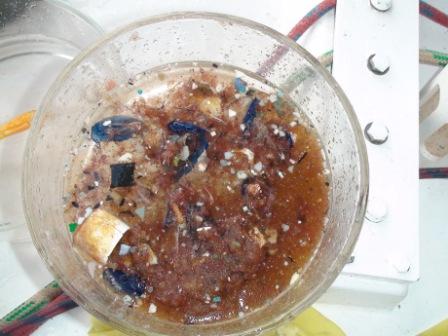
I don't think the article was arguing that, maybe the picture of the floats was just more pronounced because of their size. For me the sludge in the cup was more revolting and most likely was a by product of some land based activity. The fact is when we pollute the ocean we are polluting our own dinner table. Sometime I wonder if a fish, say a tuna, from a few hundred years ago had a much different flavor before we starting polluting the oceans to such a large degree.
Probably only have to go back a few decades.
Laurie:
Thanks for posting Captain Moore's emails. He is doing such important work.
I’d like to share an observation. In most of the discussions I have seen and heard concerning plastic debris – and debris and environmental waste, in general – one thing is usually missing. And to me, it is the proverbial elephant in the middle of the room.
It is DISPOSABLE MENSTRUAL PRODUCTS -- & plastic applicators are a huge part of the package.
The statistics astound. While I doubt that 100% accurate counts exist, it is estimated that, in a woman's lifetime, she’s likely to use 15,000 sanitary pads or tampons. Put another way, she throws away 250 to 300 pounds of tampons, pads and applicators in her lifetime. And the plastic tampon applicators may not biodegrade for several hundred years.
But these numbers are too large to fully imagine. To VIEW A COMPARISON PHOTO, showing the amount of waste caused by tampon use in 1 month, 1 year, 10 years, and 40 years (one woman’s average menstruating lifetime), go to http://www.keeper.com/photographs.html, the web page of The Keeper reusable latex menstrual cup. You’ll be shocked by what you see there. (A DUMP TRUCK was used to show an average lifetime use!)
I work with The Keeper, Inc., and would be happy to provide you with more information about environment-friendly alternatives -- including reusable menstrual pads.
Thanks so much for your important work.
Julia Schopick
http://www.HonestMedicine.com
I think we should be lobbying Kotex and Tampex to make a more eco-friendly product.
With all this "global warming" nonsense, people should first and foremost clean up the oceans.
I understand the Western World really dumped into the ocean in front of Somalia, affecting their
lifestyle with fish being contaminated. This CAP and TAX Bill don't make those things go away, cannot
tax yourself out of this mess.
Well at least we can agree on something. I believe in man made climate change, BUT, who doesn't want to use less oil (it will run out eventually), who doesn't want to fight less wars to secure oilfields, who doesn't want to have lower electric bills (i.e. conservation), and who wouldn't want less polution, either in our seas or landfills. Leaving cap and trade out of it (honestly, I'm not sold on the measure myself), can't we at least agree on the above? Just because I like to include him in as many posts as I can, but that Glenn Beck guy gloating over a caller who was purposely wasting energy on Earth Day and calling him a true American, can we also agree that that is the single most immature attitude on the subject?
I would not say global warming is nonsense, if you can accept the impact humans make on the ocean why can't you think us capable of doing the same thing to the air we breath? Pollution is pollution and the effects of which on land, sea, and air, we are just beginning to comprehend. Look at what dumping waste as done to the ocean, it's created vast dead areas, killed fish, and upset the balance of life in the ocean. Why do you think pumping the same waste into the air does not carry a consequence?
The United States is the ONLY country where people are skeptical of scientists yet more than willing to believe big industry lobbyists and politicians.
It also happens to be the only country where man-made climate change is still being debated.
And also happens to be the only country where EVOLUTION is still being debated.
And on and on.
Unless you're a scientist, don't call proven scientific fact "nonsense."
Thanks to the Captain for continuing to monitor this and to you for the coverage. I am trying to go plastic-free, knowing that much of the plastic we use is not recycled (even when we put plastic in recycling receptacles) - either because it is sub-contracted ultimately to the least honest dealer or because the plastic (especially caps, etc.) are not recyclable.
The ballooning consumption of water in plastic bottles (please, people, is this necessary - use the tapwater already) is astounding. Seventeen years ago (personal memory of being thirsty in a Chicago park in July that year), bottled water was either water cooler bottles or Perier in glass bottles. Other than that, people drank water from the tap. Now we are like babies, drinking water out of a plastic bottle. A total assault on mother earthy including her beautiful seas.
Thanks to people like the Captain who are willing to do the hard work to bring this to our attention. Now, the rest of the hard work is up to us!
You must be logged in to comment. Log in or connect with