How heavy is 35,000 metric tons? For starters, it's the weight of 193 jumbo jets or 2,917 African elephants. It's also the amount of Atlantic bluefin tuna that have exceeded the official catch quota in the Mediterranean Sea in the past two years alone, according to a Pew-commissioned analysis of the international trade in Atlantic bluefin tuna.
Exceeding quotas
As I've written before, illegal and unreported fishing is a real and ongoing problem in the Mediterranean bluefin fishery. The International Commission for the Conservation of Atlantic Tunas (ICCAT), the body that manages bluefin tuna in the Atlantic and Mediterranean, sets an annual fishing limit, but there is clear evidence that these quotas have been surpassed in recent years, often by a large margin. In 2007, ICCAT's scientists indicated that the number of fish caught that year might have been double the official limits. In an effort to combat overfishing of the species, in 2008 ICCAT reduced the quota and put in place improved compliance measures, such as a paper-based catch documentation system, meant to track bluefin tuna from sea to plate.
But because of a complicated supply chain that can stretch halfway around the world, and the fact that tuna can change hands many times before it becomes someone's meal, it is very difficult to quantify the amount of bluefin traded each year. That's why the Pew Environment Group commissioned Roberto Mielgo Bregazzi, a bluefin tuna trade expert, to sort through years of import and export documents from countries around the world to provide a clearer picture of the true scope of the trade in Mediterranean bluefin tuna. We were especially interested in years 2009 and 2010 so that we could learn whether new ICCAT compliance measures have been effective.
A growing problem
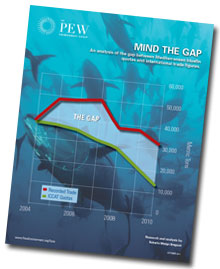
Although total catches and trade have been decreasing since 2008, and improved compliance measures have been put in place, the report found a striking difference between the quota and the amount traded on the global market. Specifically, the report showed that:
- In 2008, the number of bluefin traded around the world exceeded the quota by 31 percent.
- By 2010, that percentage had grown to an astonishing 141 percent.
- The combined trade for 2009 and 2010 was double the quotas set by ICCAT (70,646 metric tons and 35,306 metric tons, respectively).
The problem of unreported fishing of Mediterranean bluefin tuna continues.
There are several reasons why we should care about this problem. For starters, it directly affects the conservation status of Atlantic bluefin, a species whose numbers are already at near-historic lows. When the catch is double the official limits, and the future of the population is jeopardized. Unreported fishing also affects the accuracy of the stock assessments (a scientific method of determining the amount or number of fish) used to set future quotas. Illegal and unreported bluefin are often not included in the official catch data used in these assessments, which leads to overly optimistic evaluations of the health of the population. Using ICCAT's 2010 stock assessment for bluefin tuna, if the actual fishing level continues to be twice the quota, as indicated by this analysis, there is a less than a 24 percent chance that the Mediterranean bluefin population will rebuild by 2022.
According to Bregazzi, many of the problems of underreporting and misreporting of catches originate in Mediterranean tuna ranches, floating sea pens where juvenile bluefin are fattened before being killed and sold on the world market. The young fish are caught and transferred to the ranches, where there is often a discrepancy between the amount of fish reported in the ranches, compared to the amount that comes out.
Fortunately, there are several steps that ICCAT member countries can take to address these problems. In previous posts, I've mentioned how an electronic bluefin catch documentation (eBCD) system could better count and track the number of bluefin caught each year, as well as provide information that could improve enforcement and science. An eBCD system would be particularly helpful to officials in the Mediterranean charged with monitoring the amount of bluefin tuna coming out of ranches.
Technology, such as stereoscopic video, can also help get a more accurate count of the number of fish transferred from vessel to ranch. In addition, countries have the ability to increase their enforcement efforts at the dock by dialing up inspections and turning away vessels that have been fishing illegally.
Let's hope ICCAT member governments take a real leadership role and help protect one of the most fascinating and sought after fish in the sea.