
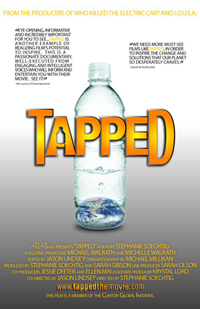
Tapped is a movie about water. The kind of water we drink in bottles that we throw away. Water that in many cases is free, municipal tap water that Coke and Pepsi repackage at a huge profit. Yup, Coke and Pepsi sell you water you can get for free from a faucet. We feel good drinking bottled water, but we're just helping Coke and Pepsi keep their market share. Those who drink their sugary products put money into their corporate pockets, and we who drink their watery products are doing the same. Tapped sounds like the kind of movie that should play on Planet Green. But the producers of Tapped found out that Planet Green won't show the movie because it might upset Planet Green advertisers like Nestle, Coke and Pepsi. You know, the people who are selling us all that hugely-profitable bottled water. Planet Green brands itself as an environmentally green network. Looks like they care about a different kind of green a lot more.
Capitalism sucks, right?
Hold on now.
Causecast is a group that is using the engine of capitalism to drive social change. (RED) is a cause-driven marketing campaign that has raised millions of dollars, using capitalism to divert corporate marketing budgets to address HIV health issues in Africa. Creative Visions Foundation supports creative activists worldwide. LivingHomes uses a for-profit capitalist business model to build healthy, green, sustainable houses. The people who founded or manage these companies were on a panel event in Santa Monica this week called Changing the World IS My Business co-hosted by The Writers Junction, Smarty, and Causecast.
The message was simple. You can do well by doing good. Making money is okay. Social movements can start online and then be heard in the corporate boardroom.
(RED), for example, is a for-profit business that hired a talented marketer named Julie Cordua. She signed on big brands like Apple, Gap, Converse, Dell, Starbucks and Nike and got them to buy into the idea (literally - the corporations pay license fees to participate) that a shopper's purchase would benefit The Global Fund. When you buy a (RED) branded shirt at GAP, Gap sends 50% of its profits to the Global Fund, and in turn the Global Fund uses all of that money to finance HIV health and support programs in Africa, focusing on women and children. We feel good about GAP (even though GAP sometimes does bad stuff, too) and we buy more.
Causecast informs you about causes and encourages you to help. Its founder and CEO, Ryan Scott, created "opt-in" email marketing and made a bundle, so he knows about capitalism. (Causecast also manages this section of the Huffington Post.) Capitalism, as everyone on the panel pointed out, is a huge social driver. Why not use it to drive social change? Ryan cited a study that showed that corporate values matter to buyers. According to the Cone 2007 Cause Evolution Study, 83 percent of Americans say that companies have a responsibility to support causes and 92 percent say they have a more positive image of a company that supports a cause they care about.
It's good for business if a company's values include supporting a worthy cause.
It's good for your company if you filter your actions through a clearly-defined set of values. Steve Glenn, for example, said that every decision his company LivingHomes makes about materials and methods arises from an examination of its values. He finds that the homes he builds change the people who live in them. Green as a way of life.
So what's up with Planet Green, the somewhat greenish network? Spurred on by Stephanie Soechtig, the director/producer of Tapped, people are friending Planet Green's Facebook page to tell them to act, um, a little more green. Facebook as an engine of social change? Not surprising. Another Cone research study has it that 62% of Americans believe they can influence corporations by sounding off on social media platforms.
Big companies may act like infants sometimes, grabbing at an advertiser's money at the expense of their stated values. Do we really have to be the parent here? Yes, we do, when it comes to helping corporations remain true to their stated vision. Online voices keep corporations real.
Hold Planet Green to its values by going on Facebook and telling them to live up to the environmentally green part of their name. Join Planet Green the Group = Planet Green Washing on Facebook.
Editor's Note: HuffPost Impact is a collaboration with The Huffington Post and Causecast.