
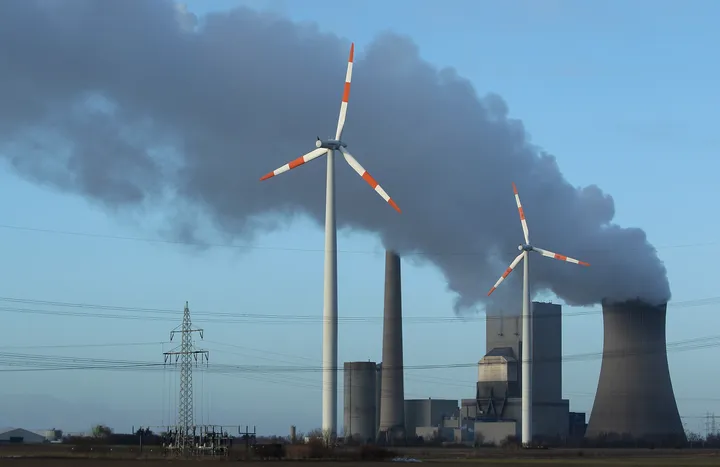
If President Obama and Congress had announced that no financial reform legislation would pass unless Goldman Sachs agreed to the bill, we would conclude our leaders had been standing in the Washington sun too long. Yet when it came to addressing climate change, that is precisely the course the president and Congress took. Lacking support from those most responsible for the problem, they have given up on passing a major climate bill this year.
It's true that passing legislation to rebuild our fossil fuel-based economy was always going to be a momentous challenge. Senators and representatives feel in their bones (and campaign accounts) the interests of utilities and the coal and oil industries. Even well-intentioned members of Congress struggle to balance the competing needs of energy-intensive industries, coal workers and American families.
But with climate change a stated priority for President Obama and Congress, how did they fall so short? By weaving four coordinated threads into a shroud of inaction. This began long before President Obama took office, but rather than rip up the old pattern -- as he advocated during the campaign -- the president quickly took his place at the loom.
Thread No. 1: Climate is out; green jobs are in. Despite climate change being the greatest challenge of our time, with millions of people facing inundation, starvation and conflicts over scarce resources, the White House directed advocates not to discuss it. At a meeting in April 2009 led by Carol Browner, the White House coordinator of energy and climate policy, administration message mavens told climate bill advocates that, given the polling, they should avoid talking about climate change and focus on green jobs and energy independence.
Had Lyndon Johnson likewise relied on polling, he would have told the Rev. Dr. Martin Luther King Jr. to talk only about the expanded industry and jobs that Southerners would realize after passage of a federal civil rights act. I could imagine Dr. King's response.
The urge to avoid the topic of climate change is not new. While Bill Clinton and Al Gore have done noble work on climate since leaving office, when they had the presidential megaphone they did little to educate the public about the wolf at our door. President Obama has followed suit, and our national comprehension of climate change continues to stagnate. Virtually the only public officials working to shape opinion on this over the past two years have been those committed to misrepresenting the science.
Thread No. 2: Devising a bill for historic polluters, not the American people. Remember the president's campaign pledge to represent the people, not the lobbyists? That's not what he's done on this issue.
For several years the Beltway wisdom has been that it is impossible to pass a bill without the approval of historic polluters, particularly the utilities, which run coal-burning power plants, the nation's single largest source of climate-changing pollution. The administration and Congress did their best to get the industry's permission for new regulations. They proposed handing power companies hundreds of billions of dollars worth of allowances to pollute, additional billions to subsidize the development of technology to sequester carbon from coal-fired plants, and evisceration of federal authority under the Clean Air Act to regulate carbon. Peter Orszag, the budget director, said giving away pollution permits would be "the largest corporate welfare program that has ever been enacted in the history of the United States." But no matter -- it wasn't enough.
Thread No. 3: A Rube Goldberg-policy construction. Because Congress built a policy machine designed for special interests, most proposals were chockablock with policy contraptions impossible to even explain, much less put into effect. Provisions included pollution allowances for favored corporations, carbon credit-default swaps, complicated worldwide offset provisions to enable avoidance of actual pollution reductions at home and loopholes to extend the life of the dirtiest coal plants. By the end of the process, even Campbell Soup demanded a special deal for the carbon-intensive job of making chicken noodle soup.
This rush to the trough was inevitable once President Obama ditched his plan to push a simple market-based bill that would have required polluters, rather than citizens, to pay for switching from fossil fuels to renewable forms of energy.
Thread No. 4: The public sits it out. American history has few examples of presidents or Congresses upending entrenched interests without public pressure forcing their hand. Teddy Roosevelt is on Mount Rushmore for a reason.
Citizens wouldn't support an approach they couldn't understand to solve a problem our leaders refused to acknowledge. Even the earth's flagging ability to support life as we know it couldn't stir a public outcry. The loudest voices insisted that leaders in Washington do nothing.
They obliged.
Lee Wasserman is the director of the Rockefeller Family Fund.
Cross-posted from the New York Times
and planning that keeps us from making big plans for the future. Corporations and the government need to develop long term 5 to 10 year plans and review/adjust them annually.
China is moving ahead at a rapid pace to invest in the technologies of the future. Wind, solar,
biofuels, high speed mass transit are all being pursued by China for the future. This will provide
jobs and profits selling the new technologies to the world.
We need a National plan for energy security and economic security. Diversifying our energy
sources and adding alternative energy is one way to do it. Wind, solar, biofuels, biomass,
can all contribute to our energy security. It sure seems strange that the National Security
party (or so they say) can not get on board to energy security because big money contributions
from corporations tops their concern. Selfish self interests are more important than what is
good for the Nation.
The money we keep sending to countries that want to harm us can be better spent at
home providing jobs and developing the industries of the future.
Which explains point #4. The guys who are against climate change action (Republicans, those who watch Fox) were naturally against this, on general principles, even though it promised to be ineffective.
The industry would like Congress et all to just walk away from the problem until, say, New York City, Miami, Baltimore, Washington DC, and a bunch of other places are man-made reefs for the fishes.
And, given how miserable the actual approach was, people committed to climate change action were hard pressed to push for or even support what Congress / the administration had come up with.
So .... does this administration and president and Congress really believe we have a problem here?? Or are they also waiting till we can see NYC from a glass-bottom tour boat?
americans can only choke down some pork, not too much
the bill was flawed
However, this was a behind the scenes debate held outside of public view. There was no alrge national measure the environmental community and progressives could be seen as compromising with business on and as a result Cap and Trade got tagged as an environmentalist proposal.
This meant when the debate on a federal bill started in earnest "Cap and Trade" industries proposal was perceived by the public as the progressive environmentalist proposal, not a compromise.
Instead the correct strategy was a cap and tax with direct regulation bill that forced business to advocate loudly for cap and trade then a compromise to that approach.
This is really the environmental communities strategic blunder, end of story. I do appreciate the gentlemanly nature of their advance accomodation but it was politically foolish.
That all depends on who you define as "the environmental community." If you mean the Washington-based environmental lobbying groups, and the self-styled environmentalists in the Democratic Party, then I agree with you. They bought into cap and trade.
That being said: over here in the Green Party, we've been crying foul the whole time.
Also: we mustn't forget how the carbon-regulation proposals of the mid 1990's played out. Back then, the environmental community called for straight taxes -- a carbon tax, and/or a BTU tax. The Republican response was, "that's not a 'market-based' solution. Let's have a cap-and-trade system like we used to control the acid rain problem." You must admit, cap and trade worked well for acid rain. That success story, plus the GOP's ability to get Americans to genuflect at the sound of the word "market," killed climate legislation.
So perhaps the environmental community sought to call the GOP's bluff. They said, "all right, cap and trade."
Whoops, the Republicans IMMEDIATELY backpedaled. Overnight, the GOP view on cap and trade changed. It became a "massive hidden tax on the American people."
The biggest crime, as I see it, was that no one in the media EVER called the GOP out for this shameless flip-flop.
Then Nunez hijacked Pavley's bill AB 32, Schwarzenegger desperately needed a green angle for his green campaign for relection and rather than stick to a strict Pavley bill political accomodations were made to get a bill that included Cap and Trade as a possibility. Why I use the 2005 timeline as the shift not earlier considering Kyoto was already out there but as indicated by Pavley's first drafts clearly not the fully endorsed path forward in the US until after AB 32.
As we can see already some were charged with fraud overseas. If the government would do anything for the environment I would be all for it. I believe this bill was killed because our government will mandate 15% ethanol in our gas tanks. Ethanol creates smog and that does not go well with what they want to convey. Look for this to come out this fall and then all cars older than 1999 won't be able to run and will be worthless. I guess this is one way to create jobs in the
car repair business, because that is a bad mandate!
400 parts per million of carbon has recently been found to be the Arctic Tipping Point, which could conceivably endanger everyone. We are approaching 390 ppm and adding 2 ppm each year. The safe limit is 350 ppm.
According to one scientist, a very thin oil film on the surface of the Atlantic and Arctic oceans that could spread from the Gulf, threatens to raise temperatures toward the catastrophic Tipping Point.
It seems possible to effectively attack the problems we face only with a monumental effort on a wartime scale.
If the threat is real, renewable energy systems that can be deployed in time should rapidly be produced on a 24/7 basis. The White House, Congress and anyone concerned should check the facts without delay - and if confirmed, provide whatever incentives are necessary to make that possible.
See What to Do! at http://www.aesopinstitute.org It outlines: A 5 Step Emergency Program
Little known and hard to fathom breakthroughs involving radically new energy technologies can help to supersede petroleum much more rapidly than might be readily understood or readily believed.
See Moving Beyond Oil on the same Aesop Institute website.
If the threat is confirmed, Congress and the White House must initiate the action needed to prevent catastrophe and provide truly effective climate legislation.
The lives they save may include their own and those of their loved ones. Maybe that will move them.
Liberals think they control the agenda..they don't
Conservatives think they can change the agenda..they can't
- Obama, 2008
So much for hope and change.
Pardon me for shouting, but the only other option is going to my reps' offices during recess and slapping them vigorously (still getting in shape for that).
A perfect description of the Obama bidness as usual administration.