
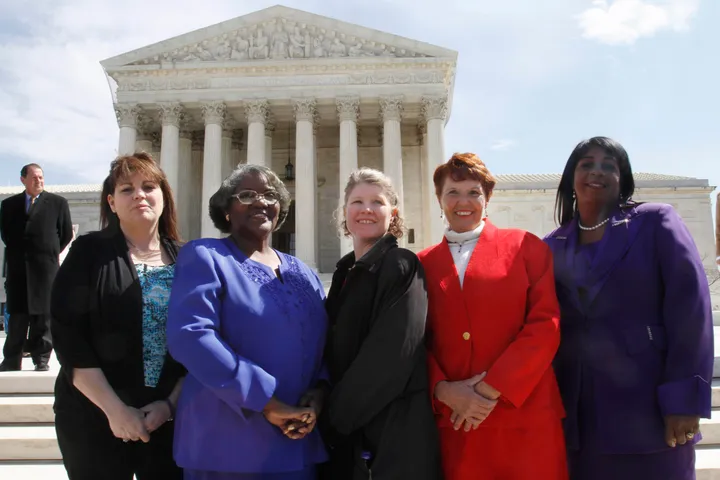
Today, more than 48 years after the Equal Pay Act was passed, and as we urge action in support of the Paycheck Fairness Act, women's ability to band together to demand fair pay has been dealt a blow. The Supreme Court ruled this morning, 5-4 that a nationwide class action lawsuit challenging sex discrimination in pay and promotions at Wal-Mart cannot go forward.
A group of female employees sued Wal-Mart, the nation's largest private employer, claiming the company paid them lower wages and gave them fewer promotions than men -- even when they had higher performance ratings and more seniority than their male counterparts. Now, ten years after filing their lawsuit, the Supreme Court has said that they will not get their day in court -- at least not as a nationwide class. In ruling so, the court discounted evidence -- emphasized in Justice Ginsburg's partial dissent -- that women were paid less than men in every Wal-Mart region and were subjected to gender bias in the company's culture.
The implications of this decision are major:
In their lawsuit, the women of Wal-Mart allege that they, like many working women, were subjected to limitations at work based on stereotypes about what constituted appropriate work for women (working as a cashier or in the cosmetics department) and what constituted appropriate work for men (working in the sporting goods department and managerial positions), with resulting wage discrepancies.
Not being able to move forward with this case as a nationwide class action is a major defeat. Requiring retail workers like Betty Dukes and each of her co-plaintiffs to file their own individual lawsuits demands that they face a truly David vs. Goliath uphill battle. In many cases "David" faces a real possibility of being squashed by the giant corporate "Goliath." Companies like Wal-Mart are so big, with so many employees in different locations, that it is nearly impossible for any one employee to learn of and compile the vast evidence necessary to prove her case or to make an impact and bring about major institutional reform through an individual lawsuit.
Furthermore, the women of Wal-Mart, like those employed by other giant corporations, work primarily in low-paying retail jobs. Most women with low-paying jobs cannot afford to hire attorneys to take their individual cases. As a result of this split decision, it will be much more difficult for such women to bring their claims jointly as a class action to challenge systemic discrimination. Instead, they will be forced to litigate their claims individually, or in smaller classes -- and many will not have the resources to do so. The court's decision is therefore a major setback for women seeking to challenge sex discrimination by their corporate employers. We are disappointed that the Supreme Court did not recognize this difficulty and allow the women of Wal-Mart to have their day in court as a class. While the Court has made it much more difficult for women to band together in nationwide class actions to challenge systemic pay discrimination, Congress must act now to ensure that women can receive equal pay for equal work in the first place by passing the Paycheck Fairness Act.