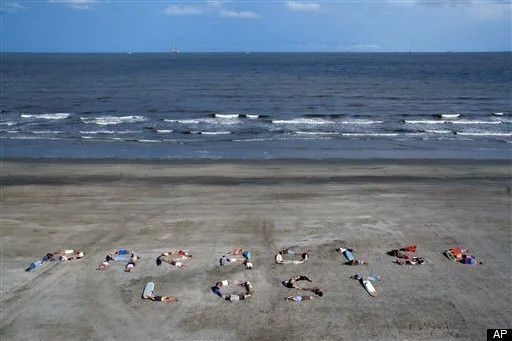
As oil mucked the Gulf of Mexico and families mourned 11 dead rig workers, BP officials proclaimed that the corporation's priority always was safety.
This tracked the tack taken by Massey Energy, whose officials also declared safety was paramount after an explosion in the corporation's Upper Big Branch mine killed 29 workers.
CEOs commonly make such incongruous assertions to protect profits after corporate-caused disasters. They're driven by the same factor that is fundamental to the catastrophes -- greed.
Nothing wrong with that, right? Not in a society that has converted greed from a vice to a virtue. Not in the place that inspired the book, Greed is Good: The Capitalist Pig Guide to Investing. Surely it's no problem in the land where "Greed" has its own game show on Fox and where Ayn Rand, the "money-is-the-root-of-all-good" philosopher, reigns as Republican queen long after her death.
Americans worship God on the Sabbath and the rich every other day. Billionaire Warren Buffett's word is investment gospel. Americans gave Wall Street banksters hundreds of billions in bailout money -- protecting their multi-million dollar bonuses. But in the midst of the Great Recession caused by Wall Street recklessness, America has repeatedly delayed renewal of unemployment benefits and now is terminating federal health insurance support for the furloughed middle class.
Middle class workers are the ones who die in coal mines and on oil rigs.
Afterwards, CEOs say anything to save the bottom line -- the one that will determine their bonuses.
Discussing the Upper Big Branch Mine disaster, Massey CEO Don Blankenship told stock analysts in a conference call late in April:
"Some of the implications have been that we don't focus on safety or we put dollars in front of safety and nothing could be further from the truth."
Though the Mine Safety and Health Administration (MSHA) issued 1,342 safety violation notices to Upper Big Branch over the past five years, Blankenship explained that's just life in the coal business:
"Violations are unfortunately a normal part of the mining process."
In addition, Blankenship said the titles of two Massey programs proved safety was supreme:
"The naming of those two programs speaks for itself: S1 -- safety is job one; P2 -- production is job 2. That's been the case for my entire tenure."
Still, 29 miners are dead. And dozens died at Massey mines in the past decade. Three died at Upper Big Branch between 1998 and 2010. The Massey dead include two workers who suffocated in a mine run by Massey subsidiary Aracoma Coal Co. on Jan. 19, 2006, just three months after Blankenship issued a memo ordering underlings to produce coal to the exclusion of other activities, such as building ventilation systems called overcasts. Aracoma officials pleaded guilty in December, 2008, to removing and failing to replace ventilation devices, the lack of which contributed to the suffocation deaths. And Massey workers aren't as sure as Don Blanekship that safety is job one. Several spoke to NPR about it. Teddy Cole, who worked a dozen years at Upper Big Branch, said Blankenship prioritizes production:
"It's supposed to be safety first, but to me, it was production first."
Former co-worker Brian Jerral agreed:
"A lot of times, it's production first and safety third."
Adam Vance, who worked at two Massey mines, described a culture of greed:
"They cover [themselves] with their safety meetings, but the main thing Massey's out for is to get that all-mighty dollar. If the coal ain't running, they ain't making no money."
And it's a lot of money for Massey -- $1.02 million a day in 2008.
Massey miner Ricky Lee Campbell 24, of Beckley, W.Va., told reporters about his safety concerns on April 7. Massey suspended him a week later, then fired him. He has filed a federal whistle-blower complaint. Similar to Massey, BP officials claim safety is job one.
Shortly after BP named Tony Hayward CEO in 2007, he told the Houston Chronicle:
"I think we have the opportunity to set a new benchmark in industrial safety. . .We have to have a work environment where people don't get injured or killed, period."
That was significant since an explosion two years earlier had killed 15 workers and injured another 170 at BP's Texas City, Texas oil refinery, and federal regulators blamed the catastrophe in part on cost cuts initiated by Hayward's predecessor. The following year, BP admitted oil leaks into Alaska's Prudhoe Bay were caused partly by cost cutting.
Despite Hayward's safety assertions, another 11 workers are dead. And survivors told CNN that PB routinely cut corners and pushed production despite potential safety problems. They also told CNN co-workers had been fired for raising concerns about dangerous practices that could delay drilling if remedied and that BP had insisted on an unsual process shortcut on the day of the blast.
Immediately after the rig explosion, BP contended its under-Gulf pipe was spewing only 1,000 barrels of oil a day. Fairly quickly, it revised that estimate to 5,000 barrels, but continued to refuse to make public its live video of the oil-churning pipe.
After a freedom of information request and Congressional pressure forced BP to release the video, federal officials estimated as much as 40,000 barrels are being discharged daily.
Still, BP's Hayward flatly denied the existence of underwater oil plumes, saying:
"The oil is on the surface. There aren't any plumes."
And he discounted the effect of the unleashed oil on the environment:
"The Gulf of Mexico is a very big ocean. The amount of volume of oil and dispersant we are putting into it is tiny in relation to the total water volume."
Hayward had a good (greed-based) reason to deny access to the video, discount the amount of oil spewing into the sea and defy the assessment of government and university researchers who confirmed the plumes of dispersed oil stretching for miles beneath the ocean surface. BP will be fined based on the number of barrels of oil its well disgorges into the gulf - somewhere between $1,100 and $4,300 a barrel -- depending on whether the government can prove gross negligence. David Leonhardt, an economics columnist for the New York Times, described BP's Texas City, Gulf of Mexico and Alaska crises this way:
"Much of this indifference stemmed from an obsession with profits, come what may."
Greed.
It's one of the seven deadly sins. When it afflicts corporate CEOs, it's deadly to workers. Honest profit is fine. But it's perverse to celebrate greed, to elevate it over human life.