
More

Featuring fresh takes and real-time analysis from HuffPost's signature lineup of contributors
Lewis Richmond

GET UPDATES FROM Lewis Richmond
 

Elderhood: A Buddhist Approach to Aging Well

Posted: 06/21/11 04:52 PM ET

This March I turned 64 -- one year away from Medicare, two years away from Social Security. So there it is: I'm a baby boomer, a Buddhist, and one individual face to face with his own aging. But I'm not alone. Each day and every day for the next twenty years, 10,000 boomers will turn 65. This is a fact with enormous implications for our politics, our society -- and, I believe, our spiritual life.

Forty years ago, when my Buddhist teacher Shunryu Suzuki was in his mid-sixties and the students around him were mostly in their 20s and 30s, someone asked him, "Why do we meditate?" He replied, "So you can enjoy your old age." We all laughed and thought he was joking. Now that I am the age he was then, I realize he wasn't joking at all. Some aspects of growing old can be hard to enjoy, and a spiritual practice can definitely help. This isn't just theory; the Handbook of Religion and Health by Koenig et al. presents research showing that people who have a regular religious attendance or practice live, on average, 7 years longer than those who do not. That research result is even more significant when we remember that for the first time in human history, people will be living in relative good health into their 70s, 80s, and even 90s. What are we all going to do with that extra gift of time?

For the last several years I have been developing a contemplative approach to growing old and aging well. I have come to believe, as my teacher did, that spiritual practice can help us to age gracefully, and that the last part of life is a fruitful time for spiritual inquiry and practice. As part of my research, I logged on to Amazon, put in the search word "aging" and sorted by descending best-seller. Yes, there were a lot of best-selling books with the word "aging" in the title. But when I looked more closely I could see that most of the titles really weren't about aging per se, but about postponing, disguising, or reversing aging. It was only when I set aside sales rank as my criterion that I found some good books with a spiritual approach to aging. Two of my favorites are The Gift of Years: Growing Older Gracefully by Benedictine nun Joan Chittister, and Spirituality and Aging by gerontology professor Robert C. Atchley.

What other resources do we have for accepting aging with grace, about learning the lessons of wisdom that aging teaches, about investigating the deep questions of our human life? 2,500 years ago, the Buddha had a lot to say about the inevitability of loss and change. What could all of us aging folks learn from his teaching today?

The Buddha taught that "everything changes," and many of today's Buddhists repeat that teaching as a patent truism. But suppose we were to rephrase those words to say, "Everything we love and cherish is going to age, decline, and eventually disappear, including our own precious selves?" Suddenly this "truism" takes on a different coloration and urgency. It's all going to go, the Buddha is saying, all of it -- everything that matters to us. In fact that process is always happening; everything is aging, all the time. How is it that we didn't notice?

When we are young, we don't notice. In youth, life is full of opportunity, and when things go wrong there are do-overs and second chances. But on the downhill slope of life, we start to notice the worrisome finitude of time. We go to more funerals, we visit more hospitals, we view the daily news with more distance, and we start to feel an autumnal chill in the air. There are joys too, of course -- grandchildren, time for travel (if we can afford it!), the pursuit of long-dreamed-of avocations and new beginnings, as well as the energizing impulse to "give back" to community and society.

There is also a fresh opportunity to look to the inner life, to revisit the deep questions that a busy career and family responsibilities might have long pushed into the background. A regular contemplative practice can indeed be a part of this journey, and Buddhism offers rich resources in this area. In my upcoming book Aging as a Spiritual Practice: A Contemplative Guide to Growing Older and Wiser (Gotham Books, January 2012) I offer many such contemplative practices -- from traditional meditations on breath, gratitude, and compassion, to more innovative reflections on time, worry, fear, and what I have ecumenically termed "the inner divine." The last section of the book -- "A Day Away" -- is a guided personal retreat that uses these contemplative exercises as a way to reflect on aging in all its many dimensions. I use the term "elderhood" to refer to the totality of this effort.

Elderhood is the culminating stage of a life fully lived. When the time comes, we can (although we may not always ) assume the mantle of elderhood as a kind of birthright, and traditional cultures have all honored and supported elderhood, giving their elders specific roles and tasks to do. In today's wired, youth-oriented world, elders don't typically garner that same kind of respect. These days, each of us has to imagine and construct our own expression of elderhood, and find ways to bring it forward.

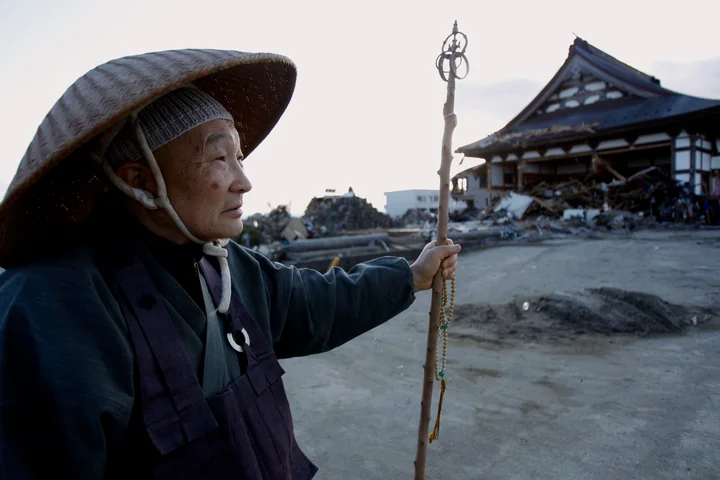
Recently I read an online article which described a group of elderly Japanese who volunteered to help with the cleanup of the damaged nuclear reactors. They vigorously refuted any notions that they were some kind of "suicide squad." They were just being practical, they said. "I am 72 and on average I probably have 13 to 15 years left to live,"one said. "Even if I were exposed to radiation, cancer could take 20 or 30 years or longer to develop. Therefore us older ones have less chance of getting cancer." Some might say these elderly Japanese were just expressing a strong cultural value of sacrificing individual well-being for the good of the group. But elderhood is culturally specific; it shows up in different ways in different times and places. Elders are not the same as identified leaders; often elders are invisible, behind the scenes, shining like gold nuggets at the bottom of the stream.

I thought their offer was a particularly courageous expression of elderhood. Elderhood means to take responsibility, to mentor, to offer perspective. The nuclear crisis in Japan is only one of many dire situations the world over that cry out for a mature, seasoned response. I think contemplative practice can give us inner strength and help us develop the resources to assume our elders' role in a troubled and often rudderless world that needs us, now perhaps more than ever.


Follow Lewis Richmond on Twitter: www.twitter.com/lewrichmond

This March I turned 64 -- one year away from Medicare, two years away from Social Security. So there it is: I'm a baby boomer, a Buddhist, and one individual face to face with his own aging. But I'm ...
 
 
  • Comments
  • 74
  • Pending Comments
  • 0
  • View FAQ
Comments are closed for this entry
View All
Favorites
Recency  | 
Popularity
Page: 1 2  Next ›  Last »  (2 total)
10:26 AM on 07/11/2011
In a few days I will be 74. I have been studying Buddhist teachings for 7 years and meditating most mornings for 1/2 to one hour. I have seen a completely new approach to my life and the existence of our one Self. As we grow older, if we are willing to uncover the knowledge that is always within us, always available to us, we will experience a joy without boundries. We will begin to see what is important and what is not. Changing the world begins with the Self. There are no quick fixes. World peace IS possible but it begins with me.
photo
blondebeblonde
Blondes also prefer gentlemen
08:20 PM on 07/06/2011
I just want to "go peacefully," as the old saying goes.

I used to meditate but I got away from it. After reading this article--and having grown a bit older--I think it's time to start again. It might help with the prospect of going peacefully.

Thank you for the inspiration, Mr. Richmond.
photo
HUFFPOST SUPER USER
Tulka2
Solidarity. Courage. Humor.
07:32 PM on 07/06/2011
Skillfully said.
photo
Jradxit
Faithless morality over baseless faith
11:48 PM on 06/26/2011
I love those Japanese elders. What heroes to good sense and rationality. Bravo!
05:20 PM on 06/26/2011
Your article dovetails the Vedic four stages (ashramas) of life:
Brahmacharya (youth learning about life)
Grihastha (householder)
Vanaprastha (retirement)
Sannyasa (super-retirement):-)

Although not to be taken to literally, these four stages trace an arc from innocence through establishing oneself in the world to building a household for a family to nourish the next generation and then receding back to allow that generation to take over while preparing, if circumstances allow, one's departure from this life. And a disciplined outlook that involves the cultivation of virtue, concentration, samatha (calm abiding of mind), and compassion is the binding thread that ties all four stages together. It helps the young to cope and prepare for entry into the next stage. It helps the householder live in society and rear his or her children. And finally helps the retiree prepare for the exit to cross the river.

Thank you for this wonderful article.

Yours truly,

Lover of Run On Sentences..
This user has chosen to opt out of the Badges program
photo
cuoi
The obstacle is the path
11:23 AM on 06/22/2011
If you wait til you're old to deal with it or wait til your dying to deal with it, is a tad late and you will not be happy. As Chuck Rewalt said below, meditation is a tool to teach you how to live and how to die. Knowledge is the key to dealing with it. Learn all you can about aging and death now. Knowledge and meditation is sort of like opening the closet where you were sure a monster lurks. No monster and just what you would expect. But do not expect instant results. It takes daily practice.
HUFFPOST SUPER USER
Chuck Rewalt
Photography Koi Ponds Veleveteagle Redbubble
10:53 AM on 06/22/2011
It does not matter who or what you believe in ... Meditation can help you learn to really live. Nowadays we spend to much time running about trying to fill ourselves with senseless fulfillment's..
photo
HUFFPOST SUPER USER
Captain Doobie
Remember... Be Here Now.
07:50 AM on 06/22/2011
A philosophy to emulate, that is for sure. A practical, logical common sense approach to understanding one's own aging.
07:42 AM on 06/22/2011
The problem with American culture is that it is American culture. We do not value age like collectivist cultures such as those in Asia do. We are so focused on idolizing youth that we continue to make aging an extremely negative process let alone asking people to do it gracefully. Until popular culture helps turn that tide, Americans will continue to get plastic surgery in droves and shut away our elderly in nursing homes never to be seen again.

It wasn't always that way. My mother was from a generation of women who did age gracefully. Age never bothered my mother and she was beautiful all of her life having grayed early but never having more than a couple of small wrinkles. She never lost her faith despite a number of hardships and loved her family most of all. I should hope to age as well as my mom did...thankfully she set a good example.
07:11 AM on 06/22/2011
Good for those Japanese elders. That's the sort of attitude the dearth of which is making American health care cost so much. In America, we all want to live painlessly and forever. It would be cruel of me to deny that wish to anyone else, but when I am older, I hope I will have the courage to let go, and not spend hundreds of thousands of dollars in order to live another month.
photo
Jradxit
Faithless morality over baseless faith
11:49 PM on 06/26/2011
You may not have that choice unless you make it now. Please consider a living will and durable power of Attorney.
photo
HUFFPOST SUPER USER
Mari Harmon
Your Kung-Fu Is Weak And Obsolete!
07:10 AM on 06/22/2011
I've always found advertisements about anti-aging, de-wrinkling, skin-firming, ointments and techniques irksome. Not only do they not work (Clinically tested! Scientifically proven! *eye roll*), but they propagate the denial of old age, as if it can be "defied" or "beaten back". All surface, surface, surface. You're going to die no matter what you do, eat, or rub on your face, and hopefully you'll make it to the wrinkly stage before that happens.
Personally, I'll be fine with the old-age part of life. At least then I'll be relieved of the suffering of worrying about my appearance permanently. I'll be able to relax into being "that old crazy lady".
06:16 AM on 06/22/2011
Sensible philosophy.
03:59 AM on 06/22/2011
It is healthy to adopt a realist's perspective to life. Cause and effect informs us that on every Death Certificate the cause of death should be Birth. Like death, aging is a fact of life that needs not be feared nor glorified, but acknowledged. Buddhists included old age as one of the eight inescapable human sufferings (birth, aging, sickness, death, unfulfilled desires, running into undesirables, parting ways with loved ones, and the endless burning consumption required by the body and mind.)

All cultures teach young people to show some respect to the elders, at least more so in the old days. Showing people respect is always a good thing. However, old age does not automatically give rise to wisdom that's worth sharing with the young. In some cultures the elders stifle youthful energy. No need for young people to confer elders unwarranted authority.

Humans are special in their ability to preserve accumulated knowledge and pass it on to the next generation. What elders can and should do is to tell their stories, share the lessons learned, and provide a sense of history to the young ones.
apoyo
Micro-bio? Sounds serious.
03:42 AM on 06/22/2011
Getting old is not for sissies.
06:16 AM on 06/22/2011
No joke.
photo
HUFFPOST SUPER USER
David Rozgonyi
Writer and traveler
01:45 AM on 06/22/2011
What a lovely article! I'm not particularly old at the moment, but it has given me much to ponder. Thanks!