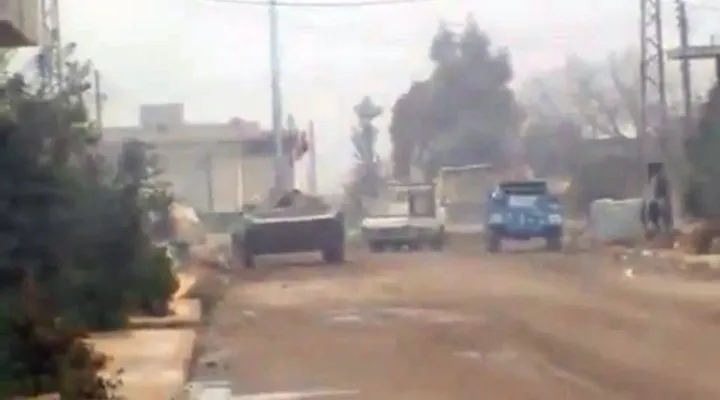
In the summer of 2008, when Russian tanks rolled into Georgia, Americans took a timeout from watching the Olympics to express their collective outrage. John McCain boldly declared, "We are all Georgians," even dispatching his wife to Tbilisi to investigate. Yet when Syria's regime brutally slaughters thousands of its own civilians -- including a hundred in a recent massacre, half of whom were children -- there is barely a peep of outrage from the candidates or the incumbent. Why?
The reasons have partly to do with realpolitik, partly to do with the pressures -- and vagaries -- of campaign politics. Russia, after all, will always serve as a useful punching bag for candidates who came of age during the Cold War. Americans also love a good David and Goliath story, which explains our standing up for small states and plucky movements resisting brutality or ethnic cleansing -- it motivates our interventions in places like Bosnia, Somalia and, more recently, Libya.
But the Georgian war, while important, was only five days long. The Syria conflict, by contrast, has lasted well over 15 months. So why were candidates so animated in 2008, yet have gone largely silent this time around on Syria? There are numerous theories.
In 2008, Georgia became a metaphor for the candidates' willingness to sound tough and stand up to foreign aggression. By a margin of 52% to 27%, voters in 2008 supported McCain over Obama to deal with a resurgent Russia, according to a Quinnipiac poll conducted shortly after the war. Interestingly Obama's vice presidential candidate, Joe Biden, who had previously visited Georgia, sounded decidedly more pro-Georgia than his running mate. "The war that began in Georgia is no longer about that country alone," Biden told reporters at the time, summoning World War II-era rhetoric. "It has become a question of whether and how the West will stand up for the rights of free people throughout the region. The outcome there will determine whether we realize the grand ambition of a Europe that is whole, free, and at peace." (He later convinced the Bush administration to greenlight $1 billion in emergency aid to Georgia, which is much larger than the $100 million initially promised to Syrian rebels). Similarly, McCain's running mate, Sarah Palin, made headlines after hinting in an interview with ABC News that she would be willing to "go to war with Russia" to defend Georgia.
Standing up for Syrian protesters is a more complicated enterprise. The policy prescriptions do not make for a nice soundbite, and there is less daylight between the candidates. It is relatively easy to cut Georgia a check for a billion dollars and wag one's finger at the Kremlin. Standing up to a strongman like Vladimir Putin plays well among security moms and in swing states, and a violation of any state's sovereignty is bound to provoke a reaction in the West. Yet it is a much more daunting task to commit military air strikes in yet another Muslim country on the brink of civil war.
Syria is not Libya, which lent itself much more readily to imposing a no-fly zone and isolating the regime. "Restraint," which McCain railed against in 2008, has been the order of the day (To nobody's surprise he has pushed for greater intervention in Syria). The recent massacre there should have warranted a greater emotional response from the West, yet it hasn't. The reasons partly have to due with Assad's media blockade, but also the rumor mill (Aren't these protesters swarming with al-Qaeda types? Wouldn't intervention only unleash a sectarian civil war?). There have been no Kony 2012-style videos made about Syria, only grainy YouTube footage. No Hollywood A-listers or politicians have come out and said: "We are all Syrians."
But the main reason has to do with campaign politics. A Fox News poll earlier this year showed that 82% of Americans only support our sending humanitarian aid, not delivering arms to rebels or ordering Libya-style air strikes. Which is why the candidates have cautiously straddled the fence on intervening in Syria, caught between appealing to voters' wariness of messy foreign interventions and their reflexive instinct of sounding tough and defending those who seek freedom abroad, even if it won't win them any votes. Mitt Romney has favored arming the rebels but not militarily intervening. Obama has favored giving the rebels non-lethal equipment but not arms.
Yet nobody believes that sending night-vision goggles is going to tip the balance of power in Syria in the rebels' favor. The world responded almost in unison to intervene diplomatically in the Caucasus in 2008 -- an EU-led investigation was swiftly launched -- while Syria has appeared to drive the international community apart.
The pressures of campaign politics has influenced -- tempered in some cases, heightened in others -- our response or non-response to these wars (Indeed, world crises that occur during the late-inning stretches of a U.S. presidential campaign should almost get their own analytical category among historians and political scientists). Maybe there is something of Arab Spring fatigue setting in among Western policymakers. Still, one has to wonder that if this were not an election year whether there would have been a more forceful U.S. response to the bloodshed in Syria.
An election has a funny way of suspending our rationality abroad -- we hyperventilate when Russia invades its neighbor, but hold our breath when Assad slaughters his own citizens.