I believe in climate change. I ride my bike everywhere, I work at a solar company, I buy organic and local when I can. I am young, liberal and idealistic. But I'm not an environmentalist. And I'm not alone.
Over the past decade the number of Americans who identify as environmentalists has steadily declined, from a peak in 1990 of 75 percent to less than half of Americans today. For most of the past three decades, a strong majority of Americans prioritized the environment, even at the risk of curbing economic growth. But since 2009, most of us have been unwilling to make that trade-off.
At the same time, as the New York Times recently reported, a large majority of Americans believe that the weird weather of late is at least partially caused by global warming. Another poll showed that 83% of Americans want more government support for clean energy. Yet another showed that three in four Americans recycle, have reduced their household energy use and buy environmentally friendly products.
In sum: Americans are beginning to believe in climate change and most of us have adopted various forms of environmentally-friendly behaviors. But, we now prioritize economic growth over the environment and don't want to be called "environmentalists." So what's changed? Is it just a matter of labeling?
The "environmentalists" don't seem to think so. In 2004, Michael Shellenberger and Ted Nordhaus famously proclaimed that environmentalism is dead, spawning a firestorm of controversy but also getting many prominent environmentalists, including former president of the Sierra Club Adam Werbach to agree with them. They argued that environmentalism, with its focus on technical solutions and narrow scope of issues, is unequipped to handle the holistic challenge of global warming.
Historically, environmentalism has defined itself as preserving wilderness from human interference. John Muir and others like him built a movement around saving beautiful natural spaces such as Yosemite Valley and Sequoia National park. Rachel Carson's Silent Spring in the 1960's brought further attention to the way that humans were harming the environment through pesticide use. This environmental awakening culminated in 1970 with the first Earth Day in which one out of every 10 Americans participated.
At some point in the 21st century we became tired with the idea that planet had to come before people. With close to 7 billion of us in this world, we can't separate ourselves from our environment and we need a way to clothe, feed and shelter all of us. We're changing our natural environment and we will continue to do so. The issue at hand is simply how we go about it.
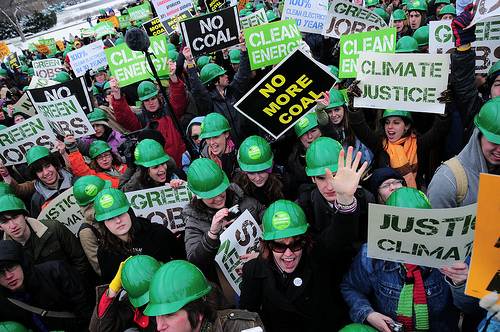
In 2007, civil rights advocate Van Jones sparked a new movement around the idea of "building an inclusive green economy strong enough to lift people out of poverty." Though right-wing conservatives managed to kick Jones out of his role as President Obama's Green Jobs Czar, the movement for green jobs continued to grow. In 2009, over 12,000 young people gathered in Washington D.C. and stormed Congress demanding green jobs and clean energy as a part of Powershift, a conference organized by Billy Parish and the Energy Action Coalition.
I was at that conference. I distinctly remember looking around and realizing that we weren't there to protect the wilderness. We were there to build a more sustainable and equitable world. And we're not alone.
Follow Lisa Curtis on Twitter: www.twitter.com/lisacurtis
Jan Mazurek: The Climate Post: Arctic Oil Drilling Opens as Pitfalls Pondered Miles Away
Craig Bennett: The Speech That Never Was - A Missed Opportunity to Re-Energise the Economy
Will Braun: Earth Day Revival Amuses and Transforms: Reduce, Reuse, Repent
Annie Spiegelman: Queen Bees Are Demanding some R-E-S-P-E-C-T, Fool!
Despite meager government investment compared to historical norms for emerging energy sources like nuclear and fossil-fuels, growth in clean energy is outpacing the rest of the economy.
"Renewable energy jobs grew at an average annual rate of 11.1 percent between 2003 and 2010, more than twice as fast as the rest of the economy."
from the conservative Brookings Institute, 2011, National and Regional Green Jobs Assessment
http://www.brookings.edu/reports/2011/0713_clean_economy.aspx
"Investments in clean energy produce better results than other sectors. Clean energy investments generate 3.2 times the number of jobs as investments in the fossil fuel sectors
(2009, Univ. Massachusetts-Amherst)
http://www.peri.umass.edu/fileadmin/pdf/conference_papers/Surdna/Pollin-Heintz-Garrett-Peltier_paper_for_Surdna_Conf---3-16-10.pdf
Report from the Pew Charitable Trusts:
"... despite a lack of sustained policy attention and investment, the emerging clean energy economy has grown considerably--extending to all 50 states, engaging a wide variety of workers and generating new industries. Between 1998 and 2007, its jobs grew at a faster rate than overall jobs. Like all other sectors, the clean energy economy has been hit by the recession, but investments in clean technology have fared far better in the past year than venture capital overall. Looking forward, the clean energy economy has tremendous potential for growth..."
http://www.pewcenteronthestates.org/uploadedFiles/Clean_Economy_Report_Web.pdf
But we have one question, with all the people involved in caring for the environment, we feel something more should be done with the unborn - other than throwing these potential people in a garbage can.
Sincerely.
===
That same thing happened to "feminism" in the 90s, and to "labor" in the 70s. After making some gains, people lost interest and the gains were largely lost. In the workplace, our rights and benefits are back to the 1890s, with no pensions, no paid vacations, no overtime, and we have to work 50 hours to get paid for 40. As for feminism, just look at the "War on Women." Did anybody in the 80s think that we'd still be dealing with this stuff 30 years later?
Unfortunately, this is all due to the character of the American, an immature, child-like society in which bits of shiny TV compete with cultural fads like feminism and environmentalism. See, we're not a committed people. We jump from fad to fad, like the kid who opens eight presents at Christmas and then wants to know where the rest of his presents are. The fad of environmentalism is over. You can't pick up chicks anymore with phony stories of white-river rafting. Soon we shall see the few gains lost, just like we saw them with feminism.
Environmentalism is simply a movement that focuses on our ENVIRONMENT and the challenges it presents our species. It includes global warming and population control which IMO should be more of a focus of the movement.
I don't know who "tired of the idea that the planet came before people" but that is the reality. The planet is the basis from which humans get what they need to survive. The environmentalists' role is to protect it from greedy entities exploiting it for profit as well as work to conserve its resources and attempt to clean it up/keep it clean. Green innovation and technology comes under the heading of conservation. "Environmentalist" is a multifaceted term that can be applied to activists, educators, scientists, innovators, entrepreneurs and so many others. Environmentalists don't "separate ourselves from the environment" we, more than others, realize we are inextricably linked to the planet and that when we, as just one species, put our insatiable needs first and foremost we upset the balance resulting in devastation for our species.
Don't disown the term Environmentalism rather expand it to acknowledge how it has evolved.
I am proud to call myself an environmentalist. If you care about the green movement you shouldn't discredit any part of it. Criticism from within is just one more attack on the credibility of us all.
We're all in this together. We shouldn't underestimate passion for a cause and dismiss it - that's the trouble today (besides the redefining of words!), people think that a reasonable emotional response is inferior to a so-called "rational" response, but pure reason can be amoral unless tempered by reasonable emotion, and it's the rare human being who doesn't have both.
We can't think that people getting upset and angry with, for example, the total ineptiude of the handling of the BP Oil Spill and needing an outlet to express that feeling is inappropriate. Do networks (all of them) and the parties involved (all of them) take advantage of it and/or completely exaggerate it for ratings? Of course. But it doesn't mean everyone is a "vast underbelly of uneducated simpletons" - their reactions and feelings are valid. as far as animal rights and welfare people as being "whack-a-doodle" and "fanatical" - I don't know why caring about animals and by extension, all life is considered an extremist idea.
Yes I do - it's because its gets in the way of the steamroller of business as usual.
Well, that's your problem right there. It is not an either-or question. The greatest economic growth over the next few decades is going to come from new technologies for alternative energy, renewable energy, and energy efficiency. Sticking to old, outdated, highly polluting technologies and business models will only lead to economic stagnation.
The same folks who taught you that liberals is a dirty word, and conservative is good.
Even though our founders were Locke liberals fighting against the Burke big money conservatives.
Conservatism means to conserve the days of rule by the rich and the monarchies before our revolution.
You are an environmentalist, and don't let the conservatives rich folks scare you away from proudly proclaiming it.
To create these media spectacles, Fox News and talk radio lump all kinds of things under the umbrella of 'environmentalists' including whack-doodles from Green Peace, Earth First, and fanatical animal rights activists. They then insinuate that any-and-all people who advocate for long-term conservation of critical resources belong under this same umbrella. Aggravating these fabricated us-vs-them media spectacles are the big-bucks profiteers of extraction industries who very much want to discredit conservation of critical resources.
Time to make one thing crystal clear - educated and professional biologists and other natural resource professionals have ZERO in common with the whack-doodle greenies, and in fact, many professionals have a more difficult time battling the greenies than they do negotiating solutions with industry representatives.
I think the thing you're alluding to is the environmentalist shift away from conservation and into Green Politics as the cause of the alianation and rejection of Environmentalist Organizations. Its not that we've changed its simply the fact that we no longer support their new causes.
But he is not a communist, and not really a socialist either.
But you don't even know the definition of communist, nor socialist,
do you?
Environmentalism is actually defined as "advocacy or works to protect the air, water, animals, plants, and other natural resources from pollution or its effects."
If you define the terms properly, I think most sensible people would heartily agree that they are environmentalists. The rest are willing to turn a blind eye to turning the wilderness into septic cesspools of mining for coal, gas and oil in exchange for a few pieces of silver. Shame on them, and shame on environmentalists whose apathy lets get away with it.
Want to save the environment? Vote for candidates from the Democratic wing of the Democratic party.
Oh, by the way, environmental professional since 1986.
http://www.cr.nps.gov/history/hisnps/NPSThinking/nps-oah.htm