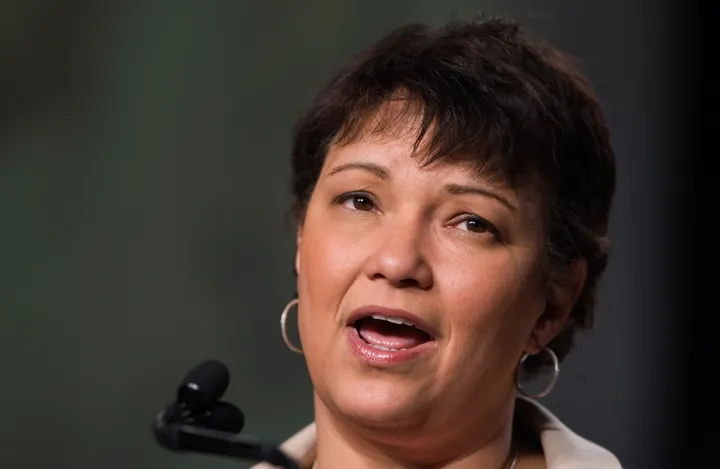
One of my colleagues at the Environmental Protection Agency (EPA) recently met with a leader from a national African-American advocacy organization, and spoke about raising the profile of environmental challenges in minority communities. The response he got was that, though the group shared his concerns, they didn't think they could "sell" environmentalism to their members.
Cynical as that sounds, they were probably right. Over the years, environmentalism has largely been seen as an enclave of the privileged. The term "environmentalism" brings to mind pristine wilderness and wide-open landscapes. What doesn't come to mind is an apartment building, a city block, or an inner city kid who has trouble breathing on hot days. Even issues like climate change are distant concerns for poor and minority citizens (and their advocates) who are struggling daily for equality in education, health care and economic opportunity.
It's the environmental movement's own inconvenient truth, and it has tragic consequences. Blacks die from asthma twice as often as whites, and have higher cancer mortality rates than any other group. Nearly 30 million Latinos -- 72 percent of the US Latino population -- live in places that don't meet US air pollution standards. Native American homes lack clean water at almost 10 times the national rate.
As a chilling reminder, this week marks the fourth year since Hurricane Katrina ripped through the Gulf Coast, leaving behind it a path of destruction that decimated poor and minority neighborhoods. Many Americans bore witness to the sad truth that the people hit hardest in my hometown of New Orleans were from the city's poorest neighborhoods, and it remains a tragic example of how our most vulnerable populations often bear the burden of our worst environmental threats.
We must also understand the role environmental threats play in what some consider more immediate issues, like the daily struggles on education, health care and the economy.
We need better education to help children reach their full potential. But we can't build schools in the shadow of polluters that will make our kids sick, and cause them to miss days of class with asthma or other health problems.
In the debate on health care, we have to talk about how heavy pollution is linked to respiratory illness, cancer, and heart disease -- three of the top four deadliest threats in America today. We must also recognize that the poor -- who get sick more often because they live in polluted neighborhoods -- are the same people who often go to the emergency room for treatment, driving up health care costs for everyone.
Struggling communities need jobs and economic opportunities. But businesses aren't going to invest in a place where pollution runs rampant. Poison in the ground means poison in the economy, a weak environment means a weak consumer base, and unhealthy air means an unhealthy atmosphere for investments.
We must talk about crime as well. When businesses won't invest and economic possibilities are limited, crime, violence, and drug use often increase, and the vicious cycle continues. But what have we taught our young people to value, to aspire to, or take pride in when they see that their communities are unclean, unhealthy and unsafe, and that the people around them seem unconcerned?
We have a chance to expand the conversation on environmentalism, and welcome new voices and new ideas to the environmental movement. The inauguration of the first African American president, and my confirmation as the first African American Administrator of this Agency, has begun the process of changing the face of environmentalism in our country. People are seeing more and more that environmentalism doesn't come in one shape, size, color, or income bracket.
Those of us who identify as environmentalists today must make room in this movement for the environmentalists of tomorrow. If we don't meet people where they are -- if we can't "sell" environmentalism to poor and minority communities -- then the individuals and groups opposing action on climate change, clean energy and other critical issues will. To confront the urgent environmental challenges of the 21st century, we need to make sure that every community sees their stake in this movement.
Linda Buzzell: What's With the Climate Change Deniers?
Psychologically I'm curious: why are the climate change deniers so upset, so shrill, so fearful, loud and angry at those who agree with the international scientific consensus?
Want to reply to a comment? Hint: Click "Reply" at the bottom of the comment; after being approved your comment will appear directly underneath the comment you replied to
Remember Pete Seger: think global, act local? PEOPLE FIRST! No people, no effort to improve the environment. When environmentalist's levitate nothing productive gets done; eg, global warming. Think worm-infested and starving Liberians recovering from a brutal civil war want to pay a carbon dioxide tax? Fine for John Kerry living in his billionaire wife's mansions. Do something for Liberians that matters today, like DDT spraying to kill mosquito larvae, children don't die, families can become more productive. Then moving up the economic scale more sophisticated environmental concerns can be addressed.
Common sense, no? Unless getting rid of people is the endgame.
Sharing with you all. What do you think in terms of using creativity to sell the idea. I agree with what the leadership of EPA is doing and I will like to support in my own little way.
Shopping bags
Shops that give and shops that don’t
Those who give make us grieve
Those who don’t want us to note
We will grieve about a dying earth,
and take note of our earth dying.
See the plastic bags around
inter-meshing with trees and stomps
The plastic cups like crops
growing on garbage heaps
Waiting for the recyclers teeth
that grinds the whole into bits.
I hear the heart beat of the earth fainting
I see the fog painting the skyline
and now my lungs are filled
With what-- I do not know
Our 'Rome' was killed in a day
and the aroma of death held its sway
Greece is mixed with water
and its land now begs the flood
Nigeria buried in waste
brought in from other stations,
looking the other way when
palms are greased you can
lease a whole city as your garbage heap.
We will grieve for leaders who lie,
and followers whose rights won’t rise
beyond the pages in which they are written
Take note and sound the alarm
( c ) Kole 3:50am Wednesday
When we have Obama schilling for dirty coal whats the us?
Great statement!
I don't hide my enthusiastic support of President Obama, but his election does not erase racial and socioeconomic inequities in the United States. Regarding education, we must acknowledge the benefits wealth provides. I've plotted SAT scores versus family income across North Carolina counties and posted it at:
http://www.sciencetime.org/blog/?p=239
It would be wonderful if we all knew what underpins the dramatic dependence, and how we could promote, for example, Wake County's success across the state.
Regarding the environment, I've also posted a number of racial and socioeconomic-based environmental inequities seen across the United States:
http://www.sciencetime.org/blog/?cat=9
We still have a long ways to go to provide all Americans equality of health and opportunities.
Will Wilson
I have an environmental consulting biz, designing, implementing and maintaining environmental programs for businesses, orgs and individuals.
I don't think the author quite understands the problem. It does not cost my clients a lot of capital investment to "go green". In some cases it requires some investment but in most cases I can set up effective programs with a cost benefit that manifests early and offsets future investments.
The issue is a matter of scope and education..
I can't make a living selling environmentalism to small businesses, one at a time. The work I do is about diversion, reuse, recycling large waste streams.. One of our clients reduced ten million pounds of all manner of waste by forty percent in the first 18months...Small businesses can get some consulting but the majority of their green effort will be in house. They may need some kind of subsidy... but the individual waste load, per biz, is not enough to warrant a major engagement.
The goal of zero waste has to be a personal one, a standard set by the biz owner... just like the corporation needs to fully empower a sustainability director if they really want to go green and see cost benefit.. So its up to the owner to act on his conscience, analyze his footprint on the community, educate himself about the alternatives and engage...
Its about new business philosophy, the Triple Bottom Line: People, Planet, Profits... and the owners need to step up..
In Chicago, the Center for Green Technology is doing its part by offering the Green Tech U Program which enables participants to obtain certificates in areas such as green building and green business. Most classes are free of cost and open to the public. http://www.cityofchicago.org/Environment/GreenTech
In addition, the City has rolled out the Chicago Climate Action Plan with the $800 challenge whereby residents commit to several green measures that will guarantee to cut their monthly expenses as well as greenhouse gas emissions. (Used to be the $700 challenge but was increased when new green measures were added.)
http://www.chicagoclimateaction.org/pages/take_the__700_challenge/59.php
So far, this program has been particularly successful among low-income individuals and minorities. So if Chicago can do it, other cities must follow.
i can see this conversation has nothing to do with real environmentalism
a true environmentalist is not a green cornucopian but a neo malthusian
anyway..., i'm sure everyone will see the error of their ways when world
oil production ends up in terminal decline.
PEAK OIL changes everything.
Obama is not really an environmentalist...
he believes in increasing consumption
he's a green cornucopian
CONSERVE
reduce, re-use, recycle, localize, light rail and reverse urban sprawl
not to mention, deal with over population.
Whatever the environmental arguments are, they can't avoid the conclusion that there are just too many people on the planet. As mamacat said, "No amount of reduction in personal pollution will be enough" so long as the number of human beings on the planet is unsustainable. Logically, the most effective way to deal with human pollution and population would be for 90-95% of the human population to die off. Just HOW to affect that die-off is the only debate worth having. And it must be done quickly; even a tapered population reduction over decades would take too long to show any beneficial results for the environment. The damage to the ecology will be irreversible if the human question is not answered soon.
If we allow our numbers to keep increasing, no amount of reduction in personal pollution will be enough. At some point, enough really does have to mean enough.
A point to consider: there are so many people living in Asia (admittedly the larget continent on the planet), that taking the combined population of Africa, Europe, both Americas, and Australia, and then doubling that number, is barely more than the population of Asia alone.
The fastest growing country in the world is probably India, with over 400,000,000 living in abject poverty. That country's business model holds that a large underclass is beneficial to their overall economy. A sort of "trickle-up" business model that would rather increase the size of the underclass than improve its individuals' standard of living.
So what is your recommendation? How do we cull the herd to sustainable levels? 6 1/2 billion people on this planet, when most environmental thinkers all agree that the sustainable level is 500 million (study up on UN Agenda 21). Who gets to decide who the 6 billion are who have to die to save the planet? Would YOU volunteer to sacrifice your life if doing so would help the environment?
Tax rebates are an easy sell. Simply offer tax breaks for wind turbines, solar panels, smart grid, hybrid-electric cars, plug-in electric cars, CNG trucks and buses, hydrogen powered vehicles, plasma furnaces for clean coal, plasma furnaces for cleaning up municipal dumps, plasma furnaces for sanitizing medical waste, as well as urban farming for local produce. In contrast, cap & tax is an impossible sell.
Heres a suggestion to "sell" environmentalism. Ask people if they want to survive. Water, food shortages and heat stroke should be enough cause to turn someone against global warming and cancer should be enough to turn up someones nose at toxic waste and pollution. Ask why people adopted sanitation- they were sick of dying from preventable disease.
We work in the environment sector. It is for us a huge issue,a life time of work and what you have stated is what I have been suggesting for many years. The word environmental has negative connotations in the US and needs a big advertising PR campaign. The disconnect is perilous.
Mexico is much less wealthy than the U.S. Throughout the country, government-funded advertising urges everyone to work to fight global climate change and lists simple steps ordinary citizens can take every day.
Here in the U.S., it's so easy to take little steps on an individual level: just switching off the lights whenever one leaves a room is one example. Taking a cloth sack to the grocery store is another.
Too often, economic issues are pitted against environmental concerns. Just last year in California, for example, environmentalists who fought (successfully) to preserve the Trestles wildlife preserve in
San Onofre were criticized by some folks who argued that a new freeway through the wildlife preserve would bring badly needed jobs. A lot of education and outreach will be needed to wean people away from that kind of short-term thinking!
And of course a root cause of global climate change is over population. Until that's reined in, we're all doomed.
Lisa, thank you for writing such a moving honest piece of journalism. It's so true, there is a large portion of American's who are deeply impacted by pollution. Being considered an environmentalist has become a stasis symbol, of the bumper sticker mentality. To buy "green" you have to pay more. Not an option when you are counting your penny's to buy food for your family. Some where along the way something so universal, something that we are all equally touched by, has been bought and sold to the "haves" of society.
Dear Lisa,
We need alternative energy sources to reduce pollution in all communities, whether rich or poor. Wind energy is very important. As head of EPA you should be all for wind energy,
So why don't you do everything in your power to expedite the the permitting process for the Cape Wind project in Nantucket sound off of Cape Cod. This project can provide electricity to 300,000 homes on Cape Cod that currently get there electricity from oil fired power plants.
This project has been blocked wealthy and highly privileged residents of the Cape , Martha's Vineyard, and Nantucket that don't want their precious ocean views defiled by gauche turbines. The most prominent opponent of this ecologically sound and necessary project was the late Senator Ted Kennedy. He didn't want to see the turbines from his oceanfront cottage. You no longer have to be afraid of being bitten by the Lion of the Senate. You can move this project along without worrying about offending the Senator now. You can show the ordinary people, unprivileged masses you speak of in your post that you are willing to step on a few hypocritical privileged green toes for the sake of the greater good by permitting Cape wind to go forward now. Show this elitist, selfish, hypocritical, wealthy , Nimby obstructionist crowd that you are willing to stand up them and do what is right for America and Planet Earth.
They couldn't put that project up even today because there are still many wealthy Democrat supporters in Cape Cod and Martha's Vineyard who don't want THEIR view of the ocean "spoiled" by offshore wind turbines (and which would be no more than a low, dark line on the horizon anyway). Wind turbine power is good enough for the masses; the elites DESERVE their own coal-fired electric supply.....
You must be logged in to comment. Log in or connect with