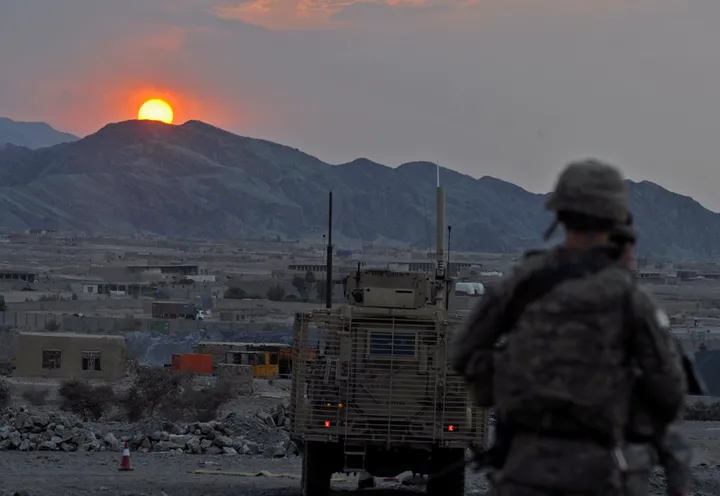
This week marks the 10th anniversary of the 2001 U.S.-led war in Afghanistan. With the assassination of the head of the Afghan Peace Council Berhanuddin Rabbani a few weeks ago, and data showing increased violence against civilians in 2011, it is hard to be optimistic. The tribes of NATO have a long way to go before they do more good than harm for the tribes of Afghanistan.
Chaos among the Tribes of NATO
The international presence in Afghanistan is chaotic. Italians and Germans, British and Americans line rows of desks inside the International Security Assistance Force (ISAF) offices in downtown Kabul. Many of them have good intentions to help, but don't know where to start. It is hard enough just to figure out how to get something done within the walls of ISAF, much less figure out how to help people on the outside of those walls. It is a monumental task just to get food and water to the troops, much less figure out how to support democracy or build security in a country where you don't know the languages, the cultures, the political history or the way to drive a car even if you were allowed outside the cement walls of your bunker. To this day, there remains no coherent goal, policy, or strategy in one gigantic experiment in international cooperation.
Like dumping toxic chemicals into the ocean in hopes of breaking up an oil spill, the international community's solutions to the problems of Afghanistan have made the problem worse. Afghanistan had lots of problems before the U.S. and NATO entered the picture. But the tribes of NATO and the international community at large could do a great deal more to support peace in Afghanistan with a little more humility, a much smaller number of security forces, and many more diplomats in the region.
The Problems and Potentials of a Comprehensive Peace Process
While negotiations between the Taliban and the Karzai Administration may be over for now, there is much more work that can be done to support a peace process in Afghanistan among other key stakeholders. Before Rabbani's death, negotiations were focusing on a narrow agenda controlled by the Karzai government and one of the many groups of insurgents. This approach leaves out any hope of real structural reforms in Afghanistan. It also fails to build on lessons learned from peace processes in other countries. Exclusion of key stakeholders, especially diverse sectors of civil society, and exclusion of key issues underlying the current conflict create a recipe for failure. Given the track record of failed peace agreements, it is extremely important to learn lessons from past failures of ending wars through exclusive high level peace talks that fail to address the root causes of the conflicts.
Government corruption and ethnic tensions within Afghanistan accompanied by larger regional tensions between India and Pakistan need more attention. As detailed in a longer report I published with the U.S. Institute of Peace entitled Designing a Comprehensive Peace Process for Afghanistan, the process requires international and Afghan leadership to structure layers of negotiation tables and problem-solving forums for dialogue on the many root causes of the war among diverse sectors of Afghan society.
Time for a Diplomatic Surge
Many Afghans and Pakistanis want peace. But they see the policies of the West as heavily dependent on a military strategy that supports warlords over insurgents rather than supporting a vision of an Afghanistan where neither warlords nor the Taliban are in charge.
Current international military and financial assistance creates obstacles to a successful peace process. The greatest leverage available to the international community is less military and financial investment, not more. Current levels of military and financial investments keep the current dysfunctional system in place, allowing the government to forgo the hard work of earning public legitimacy and consent to govern and creating an atmosphere where business men on all sides of the conflict profit from the war's status quo.
Instead, the international community, going far beyond the Tribes of NATO to include more Muslim and Arab regional organizations and countries, should develop a Group of Friendsor international supporters with teams of mediators and peace process technical support capacity. The region needs more well-trained teams who have specialist knowledge of principled negotiation, experiences working in other countries to support a complex peace process for Afghanistan and the region.
A Peace Process is Difficult, but not Impossible
A peace process is difficult to build, easy to destroy. I compare it to making pottery. When I use a ceramics wheel to make clay pottery, the process is fragile. Slowly I pull up the walls of the pot, the centrifugal force pulling the clay outward. One small mistake and clay goes flying everywhere. The same is true of a peace process.
But like making a bowl out of wet clay, lots of failure doesn't preclude starting over and trying again. In the history of peace processes around the world, we know that it is precisely the relentless persistence of people continuing to figure out a way forward that eventually builds the fragile walls of peace that harden and strengthen with time into a functional society. The international community can help support the fragile peace process, but only by shifting policy away from a military strategy and U.S. command of the process, and doing much more to support a multi-leveled peace process with international support.