iPhone app iPad app Android phone app Android tablet app More

Featuring fresh takes and real-time analysis from HuffPost's signature lineup of contributors
Lloyd I. Sederer, MD

GET UPDATES FROM Lloyd I. Sederer, MD
 

Prescription Drug Abuse: The New Killer on the Block

Posted: 11/ 8/2011 7:56 am

Every 14 minutes a person dies of a drug overdose in the United States. This means more than 35,000 deaths every year, exceeding motor vehicle crashes, homicides and suicides!

The director of the White House Office of National Drug Control Policy (ONDCP), R. Gil Kerlikowske, a former police and justice official, has called the illegal use of prescription drugs, especially narcotic medications in pill form, the nation's "fastest-growing drug problem." What once dominated the world of overdoses in the U.S., namely heroin, has been eclipsed by the prescription painkillers (see below). These drugs are termed opioid analgesics, referring to substances produced from the opium poppy or manufactured synthetically with the same pain killing effects on the human brain (analgesic means lack of pain).
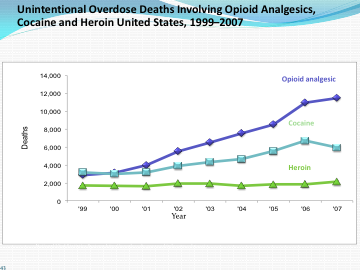
2011-11-04-unintentional_overdose_deaths.png

Where are the drugs coming from? More than 70 percent of those who have abused prescription narcotics got them from a friend's or relative's prescription. In other words, the supplier is no stranger. And the problem starts early: A 2009 national survey done by The Substance Abuse and Mental Health Services Administration (a federal agency) demonstrated that 1 in 3 youth ages 12 and older began their path to drug abuse by using prescription drugs for non-medical purposes, namely to get high. Teens now report, according to a report by the National Center on Addiction and Substance Abuse at Columbia University, that it is easier to get prescription drugs than beer.

In 2009, hydrocodone (Vicodinâ„¢ and generic equivalents) was the most prescribed prescription drug in the U.S. -- twice that of the second most prescribed drug, Lipitorâ„¢. Sales of opioids have increased more than six-fold since 1997, as reported by the Drug Enforcement Administration of the US Department of Justice.

We've learned through experience in drug control that police-like interventions of finding bad guys and locking them up doesn't work. Public health approaches stand a far better chance of reducing abuse, saving lives and even saving money. While no single approach works for the diversity of problems that drive this epidemic, there are a number that have proven effective in states that have implemented them, and that have gathered the support of the Centers for Disease Control and Prevention (CDC) and the ONDCP. Some of these involve you.

For You and Your Family:

Getting rid of unused medications: This involves drop boxes, conveniently located so that families can dispose of medications they no longer need, including opioids. Most people do not know what to do with medications they are no longer using and are concerned about flushing them down the toilet. Drop boxes are a simple solution.

A medicine cabinet inventory: This simple form helps individuals and families keep track of medications they have in the home. If you watch your liquor cabinet you surely should watch your medication cabinet. If you keep an inventory you can tell if pills are missing and, if so, this is an opportunity to talk to your children or other family members about prescription drug abuse. It is an alert that you need to protect your family members from gaining access to dangerous medications.

For Professionals and Government Agencies:

Prescription Monitoring Programs: These are programs run by states in which pharmacies supply the state with information on who is prescribing what medications to which patients in what doses. This may sound like surveillance -- and it is. Thirty-three states, including New York, have a prescription monitoring program (PMP) where pharmacies are required to send data to state health departments about controlled substance prescriptions (which include opioids -- and tranquilizers and sedatives as well). This allows state health departments and drug control agencies to pinpoint their education and intervention efforts at doctors and clinics.

Official Prescription Form: Many states now use special prescription pads that are numbered and very difficult to forge. These are so effective that a blank prescription itself has a significant street value, not just the pills themselves.

Educational Resources for Professionals: Doctors and other medical professionals benefit from bulletins, guidelines and training programs (see the work of the NYS agency for alcohol and substance abuse -- www.oasas.ny.gov -- including its Opiates and Addiction Medication Workbook and Guide for Acute Pain Management for Patients Receiving Maintenance Methadone or Buprenorphine Therapy). More work is needed to better educate doctors about how people with chronic pain are best prescribed analgesics in ways that appreciate their suffering while also offering other means of reducing pain than just high doses of narcotics.

Narcanâ„¢: This medication is an antidote, given by injection, which immediately reverses the respiratory depression that is typically the cause of death in narcotic overdose deaths. It can be given easily by any bystander. Narcanâ„¢ is used as a part of an overall drug abuse strategy called "harm reduction," where instead of "just saying no" there is a recognition that it is important to keep people alive until they themselves can avail themselves of treatment and successfully say no to drugs.

These are a few of the strategies in use and in need of more widespread implementation. The work ahead is not about keeping pain medications from patients in need. It is about good medicine and public health: identifying who needs opioid medications for pain and other disorders, establishing the best practices to meet the needs of these individuals, discovering the service gaps between what people need and what they are getting and promulgating best practices to close this gap (called the "science to practice gap") and monitoring who is doing what needs to be done and intervening in a variety of ways, from education to enforcement, with those who can do better.

Doing all this is hard work. It takes a partnership among patients, families, doctors, clinics, professional associations and government agencies. It takes good communication and sophisticated tracking of what works for whom. It takes ongoing dedication to a needed cause. When those elements of a campaign to reduce opioid abuse and overdose death are in place we will save a lot of lives.

www.askdrlloyd.com

The opinions expressed here are solely my own as a psychiatrist and public health advocate. I receive no support from any pharmaceutical or device company.

Visit Dr. Sederer's website at for questions you want answered, reviews, commentary and stories.

 
Every 14 minutes a person dies of a drug overdose in the United States. This means more than 35,000 deaths every year, exceeding motor vehicle crashes, homicides and suicides! The director of the Wh...
 
 
  • Comments
  • 84
  • Pending Comments
  • 0
  • View FAQ
Comments are closed for this entry
View All
Favorites
Recency  | 
Popularity
Page: 1 2 3  Next ›  Last »  (3 total)
02:42 PM on 11/30/2011
Though it is believed that drug addiction is a brain disease, but that does not mean that it can never be cured. You can easily recover from the ill menace of drug addiction hydrocodone (vicodin or lortab) through proper health treatment. In the beginning you might have taken the just out of curiosity from your friends. But later as the addiction started progressing, getting hold of the drug became almost a compulsion.
News in Findrxonline.com Indican that taking prescription drugs for chronic pain was a voluntary choice. But gradually what was a voluntary choice in the beginning, turned out to be a psychological and physical need later on. Thus constant drug abuse may lead to serious physical and mental changes. But with proper treatment and support, you can get rid of addiction through time and effort. The good news is that drug addiction can be treated easily.
02:09 PM on 11/22/2011
I'm on an opioid pain medication and have been for 20 years now. I likely will be on it the rest of my life. It gives me the ability to live a normal life instead of being in severe unbearable pain all the time. Three decades of untreated pain destroyed my life. I take my meds as prescribed, intended and on schedule. I hate having to act like a paranoid in how I handle my meds. I was staying at a resort and somebody broke into my rental cabin and took about 50 morphine tablets. My vacation wasn't ruined because I had another bottle hidden. The risk of running into a medication thief whike traveling is near 100%. I have no idea what happened to the thief. Maybe he overdosed. I hate being a target. I have to be suspicious of everybody entering the house. When my kids were growing up there were kids I had to ban from the house because pain meds always ended up missing. I am shocked that my entire house or bedroom is searched so thoroughly by people looking to steal from me. Half the kids and adults seem to think it is just fine to steal medications. It's a cultural problem that is only getting worse. Why does our society breed such a bunch of theives and addicts? I used to leave decoy bottles of a senna laxitive or other similar looking pills around marked as morphine. Quite a bit of it was stolen.
06:22 PM on 11/14/2011
Step 1. Protect your family by not allowing them to be abused by their doctor or coerced to take their drugs.
Step 2. Refer to Step 1.
photo
Deep Thinking Man
Always Remember, A Wet Bird Never Flies At Night !
HUFFPOST SUPER USER
Linda P
02:14 PM on 11/11/2011
We were recently the victim of a doctor who knowingly kept prescribing and raising dosages of medications that were known to be contraindicated both when prescribed together and for a patient with a TBI. He was on 9 different prescribed medications when he voluntarily weaned himself off and received no support from his pain doctor at the University of Washington Medical Center, nor his GP. We just found out in the past two weeks from another source that he had Serotonin Syndrome for 8 months and none of his doctors diagnosed it and instead kept prescribing meds that made it worse .... he nearly died both while on these meds and during the withdrawal, for which his GP refused to give him an office appointment after an emergency room visit... beware of doctors who prescribe multiple prescriptions please.. we were too trusting
photo
HUFFPOST SUPER USER
Vajara
vajara
11:53 AM on 11/12/2011
Thank you for this advice. I work with Injured Warriors and their families and they are so over prescribed that their doctors can't know how these chemicals are harming their/our patients. One Warrior brought 20 meds that he was prescribed for several botched back surgeries and for his PTSd. He withdrew from them, and we destroyed them as you suggested.

After several weeks of receiving integrative health practices and while practicing his meditation with a holisitc self-care plan, this Injured Warrior reports that he hasn't felt such clairty and good health for many years. I think everyone should be aware of the dangers & consequences of these chemicals and explore the natural health approaches with a commitment to improve with daily, whole health practices--Reiki, massage, meditation, walkiing, biking, swimming, movement therapies like yoga, tai chi, Kath State Exercises, Acupuncture, therapeutic arts & outings, group trauma processing, etc. See our Alliance Programs that introduce these alternatives to toxic medicine. http://jerryvestinjuredwarrior.com
HUFFPOST SUPER USER
Linda P
01:06 PM on 11/12/2011
Thank you so VERY much for posting this.... if I have saved one life, then there must be many more to come !! It takes a strong person to withdraw and go through those withdrawal symptoms as I have witnessed, your patient was lucky to have support... we did it on our own and were refused doctor appointments for followup from the ER. I do want to say tho, that our doctor was very aware of the drastic decline and many times i told the doctors involved that the patient was dying.. which he/they laughingly denied.. and I do think that clinic was aware at some point of the drug-drug interactions and was hoping he would die and the malpractice would be covered up... despite many many ER visits in which we took his prescriptions with us, we got no diagnosis and were shuffled through and out the ER posthaste ... sometimes he was not allowed into the ER at all.... and spent hours convulsing in the outside waiting room.
11:23 PM on 11/10/2011
To those of you posting self righteous and/or insensitive remarks regarding this issue... please keep in mind this issue has become such a hot topic it is now impossible for those of us with chronic, debilitating pain to get the MEDICATION we need to function in life. May you all experience REAL pain so you gain empathy. If you haven't had it, and most have not, you have no right to even comment on this issue. Would you take insulin away from a diabetic? Beta blockers away from an old man with a bad heart? THIS IS THE SAME THING FOR THOSE OF US WHO NEED PAIN MEDICATION FOR A MEDICAL CONDITION.

Doctors are now either too fearful to prescribe pain medication now or believe the hype because they haven't experienced real pain either. Take responsibility for yourselves, let others make their own choices and decide what they need. Do you really want to live in a nanny state where the government decides for you that you don't need pain medication? If you answered yes, wait until you have unbearable pain and get handed a couple tylenol... then answer again.

I used to be able to work, I had a good career, I put myself through college, I was able to date and socialize a bit. Now, because others have taken it upon themselves to decide for me... this means I either end my life or have no life because I can't move from my bed.
HUFFPOST SUPER USER
Linda P
01:29 PM on 11/12/2011
...and this was also our problem ... it led to drug-drug interactions from prescriptions that were not for pain, except for Tramadol. The other medications, as we found out later were making the tramadol ineffective and contributed to drug interactions for which more medications were prescribed to cover up the dyskenesias, altered mental status, convulsions... which they didn't, and nearly killed him... I sincerely hope you can find the help you need ... we are still searching ourselves...
09:00 AM on 11/10/2011
I really dont know of a way to stop this problem. I personally am a pain patient at a clinic but I dont abuse my prescriptions. I look at them as a way to physically get through my day. My mother in law goes to the same dr I do and she also does not abuse her meds. She was rear ended by a semi truck and has steel rods/pins all up and down her back and can barely walk. This accident ruined her life. It is people like her that really need pain meds. It is sad that people cannot control themselves.

Alot of medications-antidepressants, sedatives, etc are a godsend to many people. Sure, could they get by without them? Yes-but my thoery is that when you have a full time job, kids, other stressors, and on top of that, physical pain, you are not hurting anyone if you take them as prescribed! People need to use some self-control!!
photo
GOODDOC1
"civil war" is an oxymoron
07:49 PM on 11/09/2011
A lot of people here are posting about being in chronic pain and not being to het help. Please go to www.painmanage.org for the American Academy of Pain Management, and click under Patients to find a Pain Management specialist in your area. They can help. These are NOT "pill mill" doctors. Another resource is the American Chronic Pain Association at www.theacpa.org Their mission is to support, edcuate, and assist those with chronic pain and their families. Best of luck.
06:43 PM on 11/09/2011
America has a serious prescription drug problem. This year, more people will die from overdosing on painkillers than from herion and cocaine combined! Americans need to wake up and realize that there are entities that are making A LOT of money from the diseases that afflict this country, and that it within our power to live longer, healthier lives. Educate yourself at http://drjeffschwab.com/2011/11/09/americas-prescription-drug-problem/#.Trry-lZSm48
photo
HUFFPOST SUPER USER
Brandt931
04:57 PM on 11/09/2011
Prescription Drugs have robbed far too many people of their dignity and lives. Big Pharma is the REAL drug cartel in North America. Their overmedicating of the American public through obscene advertising leads to nearly 100,000 deaths per year! Prescription drugs are more dangerous than any felony drug substance in the world including heroin, cocaine and even alcohol combined. Read about this issue and what’s killing people at http://dregstudiosart.blogspot.com/2011/07/illustration-friday-800-milligrams.html
01:52 PM on 11/09/2011
There's no way to get pain meds to the patients that need them AND keep them out of the hands of those who abuse them. Even for those of us who need them, there's abuse. When we're in pain, we want it gone. NOW. We take a pill as prescribed. Wait ten minutes (that feels like an hour to us) and then take two more since one did nothing. Sadly, the cure to this cycle is to give the patient as many pills as they want. If they survive, over time they will tire of the consequences of pain pills. But, that's if they survive. I'm 58 but need my wife treat me like an infant when it comes to pain pills (even aspirin - I'll abuse anything that might stop pain). I get a prescription once a month from my pain management dr. My wife takes them and hides them. And gives me a weeks worth at a time. I can abuse a whole weeks worth, if I want to be without any more for a week. It works. My dosage is high enough that I go through physical withdrawal without them. It's not something even most drug addicts would choose to go through. Reward and punishment. It's built into the pills themselves. My condition is progressive. So, the idea that I will one day be rid of pain and the need for pills doesn't enter my reality. God help those who expect to return to "normal" life.
11:47 PM on 11/08/2011
Today my back is in spasm because of some imprudent lifting over the weekend. I've done the things you're supposed to do, and I feel better - but it would sure help to be able to have a Tylenol 3, or half a Vicodin. But, here's the thing - if I ask for some I will be labeled a 'drug seeker', because I have chronic pain. In fact, I'm just not going to tell future doctors I hurt at all, because "chronic pain patient" and "nutty junkie person" seem to be equivalent terms in the minds of health care providers.

So, what I will do instead of ask for help is grit my teeth and crab-walk through the week until I get better. This is what a lot of us do. I know it's whining to say that it isn't fair, but it isn't. This is medication that makes the lives of people who hurt a lot easier. At least it would if we could get it. But right now people are so wigged out about the irresponsible, emotionally unbalanced few who steal meds and OD on them or sell them are making it awfully tough on the many of us who use pain medication responsibly as prescribed.

I'd love it if we could come up with a medication that would kill pain without making people high. I really think that this is the only way pain will be appropriately and effectively treated.
photo
GOODDOC1
"civil war" is an oxymoron
07:36 PM on 11/09/2011
Find a Pain Management specialist. Look up the American Association of Pain Management for one in your area. The website will also give you an idea of how a pain management specialist can help you.
09:46 PM on 11/09/2011
Honestly, my experience with pain management is that they want to do lots of injections and nerve ablation, which are questionable as far as safety and efficacy are concerned. If you're 'with the program' you'll get a prescription - if you aren't you'll be dropped. Thanks, I'd rather grit my way through, because I honestly don't think all the jabbing and frying does a thing long term aside from make the people doing it a lot of money.
09:57 PM on 11/08/2011
Don't be a victim. if you suffer from chronic pain-tell your doctor. they can refer you to a specialist who can help you.
photo
SLM89
Don't just look outside the box, change the box
09:47 PM on 11/08/2011
I blame this 100% on the Dr's prescribing them..and the ridiculous pain clinics..This Dr. doesn't have a clue from his casual attitude to this huge epidemic of opiate addiciton..people are dropping like flys from it..
09:00 PM on 11/08/2011
This is news ?? Kids were stealing their parents' valium & quaaludes YEARS ago. Nothing has changed. The only good news is that those who experienced/survived the 70's/80's are now better able to recognize what their kids are getting into, and perhaps also able to be better, more involved, parents in that regard.