
Boris Gelfand of Israel won the Final FIDE Candidates Match, defeating GM Alexander Grischuk of Russia 3.5 to 2.5 in Kazan, Russia, on Wednesday. It is a culmination of his successful chess career. With the victory, he earned the right to challenge the world champion Vishy Anand of India for the world title next year.

At 42, Gelfand was the oldest participant in the Candidates matches, but he showed a steady hand and good nerves in difficult positions and prevailed against the American GM Gata Kamsky and Grischuk. His match against Anand, 41, could be interesting. Both players have vast opening knowledge, strive for initiative, can defend well and love to play dynamic chess. It could be the last time players over forty play for the championship. The young players such as Magnus Carlsen of Norway or the American Hikaru Nakamura are knocking on the door. Nakamura defeated the former FIDE world champion Ruslan Ponomariov of Ukraine in an exhibition match in St. Louis. He won the classical match 3.5 to 2.5 and prevailed in the rapid match as well.
Gelfand's match victory came in the sixth game in the Grunfeld Fianchetto. We covered this facinating opening in January. Gelfand stuck with a long-term positional strategy of slowly unleashing his central pawns. Grischuk threw most of his pieces against the white king. Gelfand blunted the attack and his powerful positional pressure decided the game.
Gelfand - Grischuk
Final Candidates Match, sixth game
Kazan, Russia 2011
Fianchetto Grunfeld
1.d4 Nf6 2.c4 g6 3.Nf3 Bg7 4.g3 d5 5.cxd5 Nxd5 6.Bg2 Nb6 7.Nc3 Nc6 8.e3 0-0 (This dynamic line in the Fianchetto Grunfeld, with the black pieces combating white's pawn center, attracted many top grandmasters, including Garry Kasparov.) 9.0-0 Re8 (A high-class waiting move postpones the advance e7-e5, taking advantage of white's inability to develop the queenside smoothly. It has been in the repertoire of the top Czechoslovakian players for several decades and it could be called the Czech variation of the Grunfeld defense.)
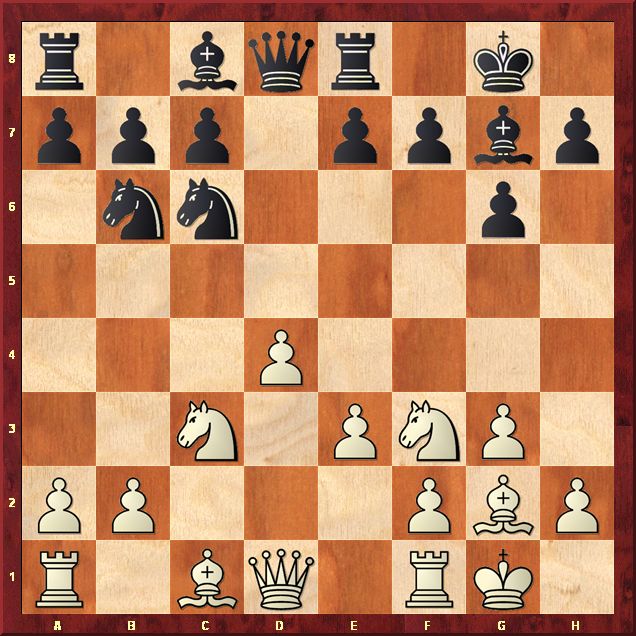
10.Re1 (The main point of black's idea is 10.b3 e5 11.d5 e4! quickly turning the tables.) 10...a5 (The former world champion Vassily Smyslov used this plan in similar positions. Black runs his pawn to a4, moves his rook to a5 and controls the center vertically as Grischuk is about to do.) 11.Qe2 (Reshuffling his heavy pieces and planning 12.Re1-d1.) 11...Bg4 (The idea is to provoke h2-h3. The immediate 11...Be6 has been played more frequently.) 12.h3 Be6 13.b3 (Denying black the square c4.) 13...a4 (So far so good, but Gelfand plays a new idea on his next move.)
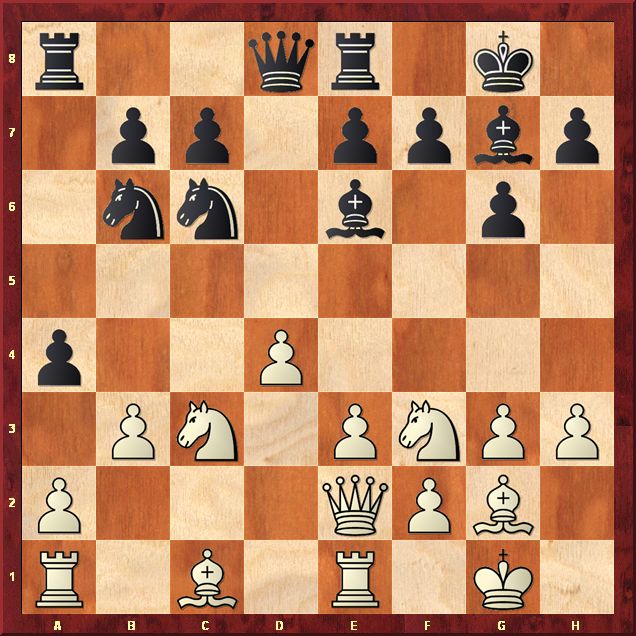
14.Rb1!? (Gelfand gives away the a-file and the square b4, but keeps the tension. He is following a long-term strategy to put his central pawns into motion.) 14...axb3 15.axb3 Qc8 (Hitting the square b4 with 15...Nb4 16.Rd1 [Or16.Bd2 c6.] 16...c6 17.e4 h6 is another way to hold the center.) 16.Kh2 (After16.Ng5 comes 16...Bd7.) 16...Ra5 17.Rd1 Rh5 (Grischuk throws as many pieces as possible against the white king, but Gelfand remains calm.) 18.Nh4 (Gelfand had to play this move. After 18.h4 Bg4 black is ready to strike with e7-e5.) 18...Bf6 19.f4 Rd8 (Sacrificing the exchange 19...Bxh4 20.gxh4 Rxh4 21.Kg3 Rxh3+ [21...Rh5 22.d5+-] 22.Bxh3 Bxh3 does not work. White simply plays 23.d5 with advantage.) 20.Qf2 Bxh4? (Strategically doubtful, but Grischuk has an amazing defensive idea in mind: he wants to sacrifice the exchange and take over the light squares. But he should have kept the dark bishop and retreat with his rook to the queenside: 20...Ra5 21.Nf3 Nd5 with a playable game. Another version of the positional sacrifice is 20...Nd5 21.Nxd5 Rdxd5 [21...Bxd5 is met by 22.e4] 22.Bxd5?! Bxd5.) 21.gxh4 Nd5 22.Nxd5 Rhxd5!?
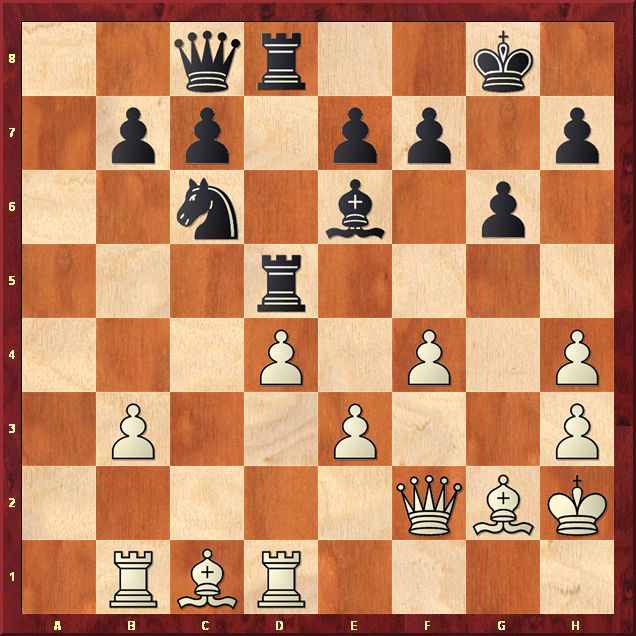
23.Bb2! (Gelfand ignores the sacrifice and is ready to squeeze black by marching the central pawns.) 23...Rb5 24.Qe2 (Chasing the unstable rook.) 24...Rh5 (The rook has to stay on the fifth rank. For example, after 24...Rxb3 25.d5 white wins a piece.) 25.e4! (The pawns are beginning to roll. Black may soon regret the exchange of his dark bishop.) 25...Bxb3 26.Rdc1 Na5 (Black wants to protect his bishop, but his pieces are scattered. It was better to soften the blow with 26...e6 27.Bc3 Ba4.) 27.d5 b6 (After 27...Ba2 28.Ra1 Nb3 29.Rxa2 Nxc1 30.Bxc1 the bishop pair should prevail against the rook.) 28.Be5 c5 (After 28...Rd7 29.Qb5 Ba2 30.Rb2 f6 31.Qxb6 fxe5 32.Qxa5 wins.) 29.dxc6 f6
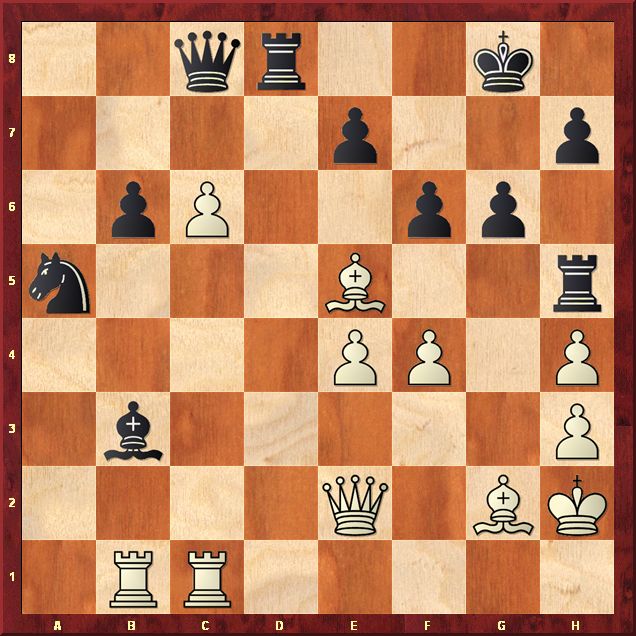
30.Ba1 (White could have included 30.c7! for example 30...Rd7 and now white wins either with 31.Rxb3 Nxb3 32.Qc4+ Kg7 33.Qxb3 fxe5 34.Qxb6 exf4 35.Qb8 ;or with 31.Qg4 fxe5 32.Qxd7! Qxd7 33.c8Q+.) 30...Rc5 (Trying to isolate the pawn on c6, but 30...b5 31.c7 Rd7 32.e5 Rxc7 33.Qxb5] 31.Rxc5 bxc5 32.Qb5
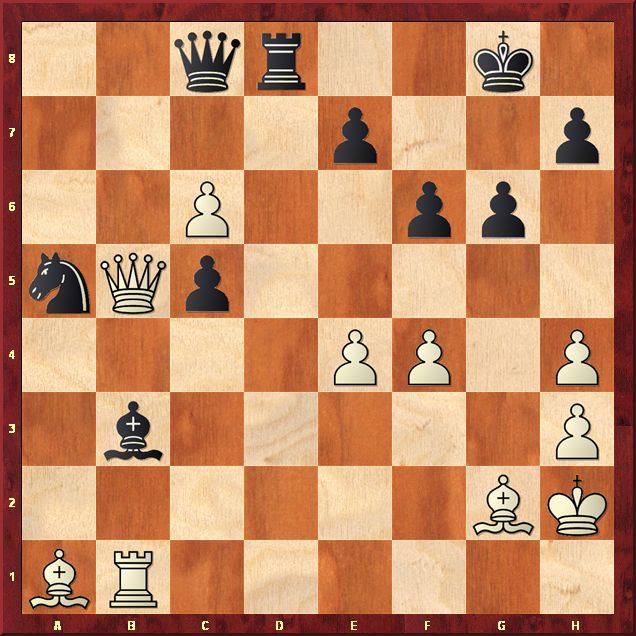
32...Qc7? (Grischuk misses his best chance: 32...Ba2 33.Rb2 Qc7 34.e5! [Not 34.Rxa2? Qxf4+ 35.Kg1 Rd1+ 36.Bf1 c4 and black wins.], although after 34...Be6 35.Qb6 Rc8 36.Qxc7 Rxc7 37.Rb7! white should win.) 33.Rxb3 Nxc6 (Black is a piece down now, but after 33...Nxb3 34.Qxb3+ Kf8 35.e5 white should win anyway.) 34.e5 Nd4 35.Qc4+ Black resigned.
Note that in the replay windows below you can click either on the arrows under the diagram or on the notation to follow the game.