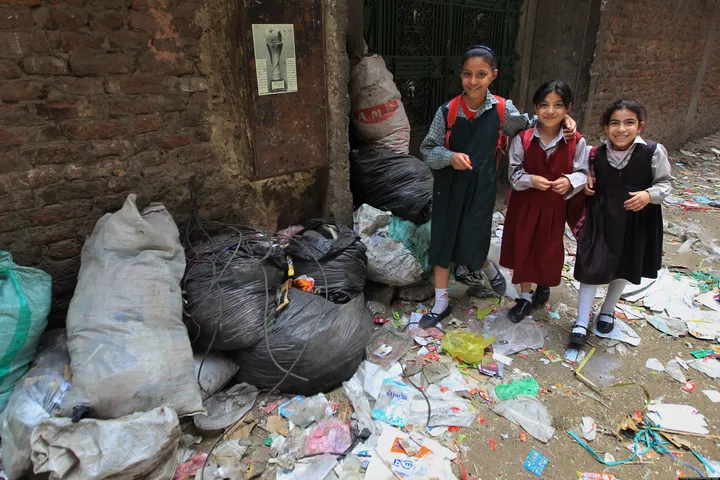
"When Jesus appears somewhere, that changes the whole society." Father Samaan, priest of the St. Simon Coptic Orthodox Church in Cairo, Egypt, is not speaking theoretically. He's describing what he's seen.
Nearly a century ago, thousands of Egyptians from the rural villages of Upper Egypt moved as economic migrants to Cairo. Unskilled and illiterate, many of them became garbage collectors, gathering trash from homes and apartments and receiving a small tip in return. To supplement their meager income, the zabaleen, as the trash collectors are called, began to separate the organic waste, which they fed to their pigs, from the glass, paper, and metal they could recycle.
In 1970 the zabaleen, marginalized by their unsavory image and considered the bottom rung of society, were forced to settle in a collection of tin shacks in the shadow of Cairo's Muqattam Mountain. The poorest, filthiest and most dangerous area of the capital, the Garbage Village of Muqattam was a jumbled rubble of garbage, people and pigs. There were no churches, schools, electricity, water, medical care or markets. Disease was rampant. Drugs and alcohol dulled the senses and fueled the violence.
But in 1974, a young zabaleen asked a Christian businessman whose trash he collected to explain the Gospel to him. Most residents of Garbage Village were nominal Christians, but they knew little about true faith. After hearing the Gospel, the young trash collector convinced the businessman to teach a Bible study in his shack in the village. To people at the bottom of the social scale, the message of a loving Father was captivating. Within a few years, there thousands of sincere believers in the village, so the Coptic Orthodox Church built a church in the village. Free to select their own priest, the villagers selected a layman -- the businessman who had brought God's love to them -- who was subsequently ordained by the Coptics under the name of Father Samaan.
Just days ago I walked through the streets of Garbage Village, where 50,000 people live and work, sorting through 60,000 tons of Cairo's rubbish per day and recycling it in their homes.
It is one of the most stunning places I've ever seen. Stunning because there is trash everywhere. You look down allies and into warehouses, in the shadows and in sunlit empty lots, and everywhere there is trash -- piles of trash, bags of trash. Men delivering trash. Women and children sorting trash. And everyone recycling, recycling, recycling.
It is stunning, too, because in the midst of all this trash there is such a sense of industry, a palpable positive energy, a vital economy. In the last quarter century tin shacks have given way to brick buildings. On the lower level are the trash sorting centers, but also markets with fresh produce, auto repair shops, tea shops, clothing stores. The families live in the upper floors of the buildings. Their apartments are modest, but at least the zabaleen no longer sleep and cook in the filth of the trash.
Each morning the men tour parts of the city in their donkey carts or small trucks, collecting waste. They then drop it off at their homes, where the women and children sort it. Because the zabaleen do not use large trucks, which compact the waste and make much of it unusable, 90 percent of the material the zabaleen collet is recycled and used to make quilts, rugs and paper products -- or bagged and shipped outside the country for use by multinational corporations. It is one of the most ecologically efficient operations in the world. Stunning.
Rebecca Atallah, who oversees a variety of ministries in the village, gave us a tour, starting with the original Coptic church. It's a small building filled with icons, paintings of religious scenes. "All Orthodox churches have icons," explained Rebecca, "but this church has more than usual. When the church was built, most people in the village were illiterate. The paintings were the only stories they could read."
We then visited a well-run Montesorri school, funded by the Finnish government. "Welcome, welcome, welcome," sang the three- and four-year-olds. "We're so glad that you are here." Their miniature backpacks hung in a straight line on pegs on the wall. Their blue and white checked uniforms were made by older girls who learned sewing skills at the school. Later we watched the girls cutting patterns, stitching seams, and operating a knitting machine that produces the navy blue sweaters the kids wear on cool day. We also saw village women chopping produce and deboning chicken in the learning kitchen.
"It's hard for the women to come to classes because they're so busy with the trash," explained Rebecca. "But they're so motivated to learn!"
In the paper "factory" we watched a laughing group of women and girls shred discarded office paper, soak it in water dyed an icy blue by a pair of old jeans, and then strain and squeeze the soggy pulp until it's ready to hang in thin sheets to dry. In a tiny shop we bought beautiful recycled stationary decorated with pressed pink bougainvillea blossoms and pale green leaves from vines growing outside the paper-making factory.
An entire community deals in transformation, turning what is useless, unwanted, discarded into beautiful products and a vibrant economy.
The smell of garbage is still overwhelming in the village, and it continues to be disconcerting to walk down litter-strewn streets and see women and children sitting among piles of garbage hand-sorting refuse. And despite the vaccinations that now protect against some diseases, there is still a high level of chronic illness in the community, the inevitable result of toxic materials and filth.
But parents who can neither read nor write are now sending their kids to school. The despair that led many to drugs, alcohol and violence, has been replaced by the energy of productive work and hope. Families who used to sleep and cook and eat on the street in the midst of the garbage piles, now live on the second, or third, or fourth floors of the brick buildings which rise above the trash.
In fact, in a strange twist, as housing prices skyrocket in Cairo, increasing numbers of people who don't work with trash are renting apartments in Garbage Village. And even young people from the village who go away to college or university, come back to settle in Garage Village. It is now one of the safest places in the country. Three schools and a hospital have been built. Their families are there. And for many, their church is there.
For there is one more amazing twist of fate in Garbage Village. Some years ago, excavators discovered massive caves hidden under the rubble surrounding Muqattam Mountain. Leaders of the church in Muqattam claimed the land as holy ground and the government deeded the caves to the church. With the financial help of Egyptian businessmen the caves have been converted into cathedrals to serve Christians in peril. In one cave, nearly 6,000 people gather each week to worship. Another cave has been transformed into an amphitheater that seats 15,000 people. Christians from all over Cairo visit the amphitheater for special events. Rebecca explains that "it is the only place, other than the Coptic Orthodox Cathedral, where Christians can meet in large numbers in Egypt."
So Father Samaan, the businessman turned priest out of love for the zabaleen, now pastors the largest church in the Middle East. And just as the church became a refuge for the zabaleen, it now welcomes another vulnerable population: Sudanese refugees fleeing the violence of their own country. At the suggestion of an Egyptian friend, I traveled to Cairo with a suitcase filled with children's clothes for the Sudanese refugees, and returned home with a suitcase filled with lovely Christmas gifts for family and friends purchased from the recyclers and artisans of Garbage Village.
I visited the Garbage Village just days after the grand opening of the Center of Love, an eight-story structure of polished limestone that serves the disabled and chronically ill population of the village. Looking out one of the upper windows, we looked down on a trash-strewn lot. "That," said Rebecca," is where we will plant a garden with local produce and beautiful flowers." For days after our visit I continually misspoke, inadvertently telling people I had visited the "Garden Village." Perhaps that was my heart speaking.
I traveled to Egypt with the hope of finding an Advent story. The name of this season is taken from the Latin adventus, which means "coming," and was used in the early church for the coming of the Son of God into the world. In the Garbage Village I found my Advent story. "When Jesus comes to a place, it changes the whole society," said Father Samaan. And so it does.