iPhone app iPad app Android phone app Android tablet app More

Featuring fresh takes and real-time analysis from HuffPost's signature lineup of contributors
M. Sanjayan

GET UPDATES FROM M. Sanjayan
 

This Reef May Save Your Life

Posted: 05/24/11 04:35 PM ET

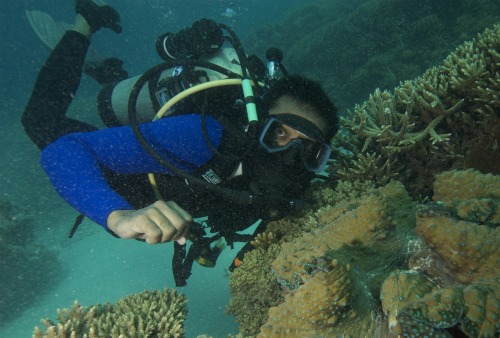
2011-05-23-sanjayancoral1.jpg
The author diving in the Coral Sea, off the Australian Coast.

A coral reef may save your life one day. Why have we done so little to return the favor?

The vast majority of medicines, from powerful narcotics to common headache pills, were derived originally from nature -- that's up to 70% of new drugs in the past couple of decades in the United States alone.

This is hardly surprising. Many animals, from chimpanzees to parrots, have been seen to search for favorite plants or mineral deposits during times of stress. Even our pet dog gets in the act, nibbling on grass perhaps to ward off tummy trouble. Perhaps our early ancestors watched and emulated.

Our earliest records of written history prescribe natural remedies for various ailments, and some have even made it into modern prescriptions. Best known is the common aspirin, a derivative of salicylic acid. Hippocrates, the father of modern medicine, knew this, and as far back as 400 BC. willow bark -- which contains salicin -- was prescribed for a host of aliments.

More recently, scientists have been turning their attention to a vast, relatively untapped storehouse of promising new drugs: tropical coral reefs.

There is good reason for this attention:

  1. Coral reefs are amongst the most biologically rich and densely packed habitats on the planet.
  2. Underwater warfare reigns with extreme competition for space and nutrients intense amongst reefs organisms pack into a narrow band of suitability. Critters use chemicals to defend and attack invaders- exactly what you might need to ward off something nasty.
  3. Coral reefs have until recently been effectively inaccessible to humans -- and bio-prospectors. This means lots of species waiting to be discovered.

Indeed, in the last few years, some important new drugs have been discovered and isolated from coral reefs. Those that show the most promise have been synthesized (essentially replicated) in the lab, tested and used in life-saving therapy. For example, Ara-C, isolated from Caribbean sea-sponge, is essential in chemotherapy. According to researchers at Stanford University, the sea squirt, an otherwise unremarkable blob of an animal, is providing huge breakthroughs in organ regeneration and bone marrow transplant. The cone shell, one of the most venomous animals on the reef (1,000 times more potent than morphine!), is being used as a painkiller, while marine derived SGN-35 is on the verge of FDA approval for non-Hodgkins lymphoma.

In fact, coral reefs have already saved Arden O'Connor's life:

Unfortunately, we are also well on our way to wrecking our best new drug store. The World Resources Institute bluntly warns that over 75% of coral reefs are under threat.

There is no doubt that with careful collecting and testing, new cures will emerge from coral reefs.

As Dr. Bruce Chabner, an oncologist at Massachusetts General in Boston puts it, "the sea could well hold the building blocks of drugs that could treat, or even cure, cancer. We don't know. But if we lose the reefs we'll never find out."

The trick may be to link drug development and sales to conservation efforts. There is a terrestrial precedent. A couple of decades ago, the government of Costa Rica collaborated with the pharmaceutical giant Merck to develop a bio-prospecting scheme for its rainforests. Through INBio, a research institute, Merck paid for prospecting and promised to share in future revenues should any drugs from the forest prove to be a commercial success.

Implementing a similar system for coral reefs, often shared amongst several countries and scattered across millions of kilometers of ocean, will no doubt be trickier. Still, given that we extract fisheries and tourism revenues from reefs globally, it's not unreasonable to create a payment scheme for bio-prospecting particular reefs. The key, of course, is to ensure that the payment goes to reef conservation.

We can also as a society support increased government funding for coral reefs. One such bill, the National Endowment for the Oceans, sponsored by Senators Sheldon Whitehouse and Olympia Snowe and enjoying bi-partisan support, will (if passed) focus conservation attention onto reefs in U.S. waters. A similar effort, the Global Conservation Act, should it be introduced, will support reefs around the world.

Coral reefs offer us food, blunt storms and waves and bring in billions of dollars in recreation revenue. We now know that they also offer life-saving medicines.

In an era of spiraling health care costs, nature's most promising pharmacy is the only thing that is still free. We ought to take better care of it.


Follow M. Sanjayan on Twitter: www.twitter.com/msanjayan

The author diving in the Coral Sea, off the Australian Coast. A coral reef may save your life one day. Why have we done so little to return the favor? The vast majority of medicines, from powerf...
 
 
  • Comments
  • 7
  • Pending Comments
  • 0
  • View FAQ
Comments are closed for this entry
View All
Favorites
Recency  | 
Popularity
09:51 AM on 06/14/2011
It's not that I have anything against the deserts, but life and diversity in deserts tends to be rather sparse. On the other hand, coral reefs contain the most dense biodiversity on the planet. That extreme level of density makes the reefs a place where evolution has flourished. I'm not suggesting we need not look in the deserts for new medicinal agents, but the reefs offer many more...orders of magnitude more opportunities for finding valuable biochemicals.

In addition, coral reefs are much more threatened than deserts. It's not to say deserts are completely safe...but they certainly have a better future than coral reefs. Hate to say this, but coral reefs will be decimated by ocean acidification. As carbon dioxide levels increase, the corals will no longer be able to form skeletons. As that occurs, the reefs will die. I'm disappointed that the author of this article chose not to mention that fact. Maybe he didn't want to scare off interest...but time is of the essence. Whatever we do about coral reefs...we need to do soon, before they are gone. Before the turn of this century, all that will be left of the coral reef environment will be remnants in aquaria. Deserts are in no such danger.

Providing underwater structures for corals is a good idea. However, global warming will overwhelm those efforts. It's time to see the forest...instead of concentrating on a few trees.
05:40 PM on 05/26/2011
reef's are delicate systems that are highly sensitive to changes in temperature and salinity. they are directly related to carbon emissions and climate change.

ironically, as reefs provide more innovations, more people are saved through medicine, leading to ever higher human population grow, which in turn leads to more fishery exploitation and carbon release, and cycle of envionmental damage continues.....
This user has chosen to opt out of the Badges program
04:30 PM on 05/26/2011
Can't coral reefs be generated through interventions, by deliberately planting firm emplacements on otherwise sandy ocean bottoms.

Don't shipwrecks, and even oil platforms, become hotbed activities of coral life? Scuba divers seem to know this, and I've seen it with my own eyes many, many times while diving.
This user has chosen to opt out of the Badges program
12:47 PM on 05/25/2011
All true, but the same could be said of the Mojave, where fungi, plants, and animals have adapted to extreme conditions, similar to those we may face in the coming century thanks to climate change. There is even research hinting at deserts as incredible carbon sinks. Why, then, has the Nature Conservancy been leading the charge to kill our healthy desert ecosystems for Big Solar and Big Wind, then?

Rooftops, brownfields and Superfund sites could produce about 10,000 times the amount of energy we need using PV, but still, the Big Enviros snuggle up to Chevron, BP, and Goldman Sachs to hand over healthy thriving ecosystems that we NEED so they can make even more money by monopolizing our sunshine and wind on our public land, building destructive infrastructure with our money then overcharging us! There is not a single "win" in any part of the equation - not for the planet, the economy, democracy or energy - only huge undeserved profits for Big Energy.

Thanks for calling attention to the dire need to leave healthy places intact so that we can study them - please include our fragile deserts in this category.
photo
HUFFPOST SUPER USER
Malcolm Hensley
Last of the Reagan Republicans
08:06 PM on 05/24/2011
Corals of Florida:

http://www.flmnh.ufl.edu/fish/southflorida/coral/Profiles.html

Technology to grow more:

http://www.treehugger.com/files/2007/09/biorock_coral.php

By adding a little electricity you can get coral growth rates of 2 inches per year! For coral growth this is WARP SPEED! This is by far the best sequestering scheme I've seen, this helps form CaCO3.

Now imagine a series of giant collapsible wind turbines suppling electricity to the reefs and the grid!

Now think of the new habitat, the bio diversity, the snorkeling, the diving, the sport fishing, the tourism dollars.

Generating electricity can be more than Green it can be made multi-tasking undoing past harm not just limiting current harm!

We need to think bigger!

One day a Southern Senator will stand up there and say he invented it! And that will be cool!
This user has chosen to opt out of the Badges program
09:13 PM on 05/27/2011
Wow! That is seriously cool!

The energy requirements here are small, the electrical bill could be paid for tourist fees.

Thanks Malcolm.
photo
HUFFPOST SUPER USER
Milwaukeetj1
Keep your $$ in your neighborhood.
06:42 PM on 05/24/2011
I hope we can save a good majority of the reefs considering all of the damage already done