
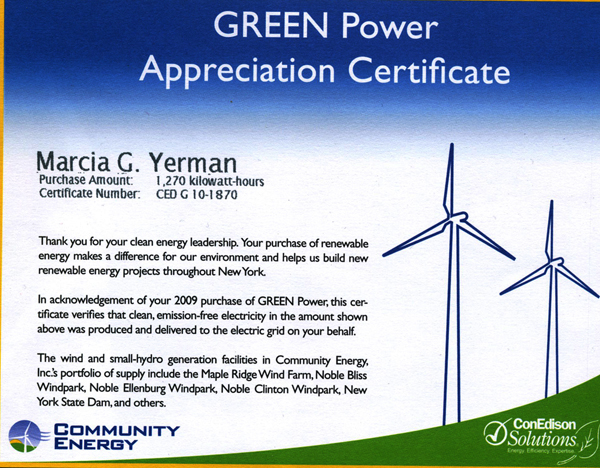
At a recent event, I was seated at a table with well-informed New Yorkers, when the conversation turned to energy issues. I mentioned that although it was costing me a bit more, I had signed up for a green energy package. The man to my left stated flatly that he would never do that, adding, "How do I know that it's really green energy -- and why should I pay more?" I responded, "Well, I have a 16-year-old son, and I want to guarantee that the planet is around for awhile." I turned my attention back to my salad, and multiplied his attitude times all the other citizens who were either unaware or unwilling to commit to such a program.
When the electricity market in New York State was deregulated in 1997, it opened up the field to competition. Yet navigating the system can be challenging, particularly if you are not motivated. I first investigated the green choice when I got an insert with my monthly statement, which laid out other options. I made calls to a number of different companies on the list. After picking a supplier based on the lowest price, I found myself dissatisfied with the service. An independent contractor, who was not particularly knowledgeable, handled my calls.
As a person who is always looking for a break on my bills, I continually questioned the pricing structure of the alternate energy suppliers. Instead of charging more to those who were supporting the initiatives, why weren't they rewarding them by charging them less? My rationale seemed obvious to me, until I learned that it cost more for suppliers to bring green energy to the consumer. The analogy was that buying wind power was like buying organic food. The capital costs to build it were higher.
I finally decided to switch to ConEdison Solutions, a sister company to Con Edison of New York, and a subsidiary of Consolidated Edison, Inc. I had originally met a customer rep at my local farmers' market when I was still debating which service to use. He had explained the difference between Con Edison and ConEdison Solutions by clarifying that the former is the regulated utility mandated to deliver electricity to my door, and the latter is the electricity supplier. In actuality, ConEdison Solutions is a competitor to Con Edison, who doesn't supply green power. My services are certified by Green-e, a third party organization that maintains industry standards for the sale of green power.
I recently spoke by telephone with Michael Forese, the National Sales Director for Renewable Power at ConEdison Solutions, to clarify my nagging questions about expense. "It's a new form of energy," he told me. "The initial cost creates a higher priced per kilowatt hour. With any new technology, you will have advances over time. More companies will get involved. As improvements are made, costs will go down." It's like a chain. The more money that goes to new technology for renewable energy, the more renewable energy can be developed.
When my new contract arrived last summer, it showed that my green power was "composed of 65 percent run-of-the-river hydro power and 35 percent wind power." Bottom line -- "No air emissions result from generating the electricity I purchase." That means no coal, nuclear, oil or natural gas were used. All my energy is "renewable," which in plain speak translates to "it renews itself, it can be reused, and it will not run out."
Currently, the use of wind is growing in New York State. The largest wind farm is located near Flat Rock, a large plateau west of the Adirondacks. Wind is a zero percent emissions electricity source. The more people that use it, the less air pollution there will be.
I signed a twelve-month contract for 11.8 cents per kWh (exclusive of sales tax), choosing the fixed rate, so that the price remained locked in. Anyone seeking green options can check with their local utility to learn if they have a list of alternative green electricity suppliers.
When I asked the ConEdison Solutions team if they could send me some up to date stats that would make my actions more tangible, they provided me with a recent press release with the following numbers for 2010. Measurements are in "equivalent" categories:
•Green power from ConEdison Solutions reduced carbon dioxide emissions
by 197,195 tons
•The renewable energy impact was equivalent to cutting annual oil consumption by
379,410 barrels
•The total amount of renewable green power used by ConEdison Solutions
customers was equal to preserving 1330 acres of forest from deforestation
The amount of green energy being supplied to consumers in New York State now stands at just over 1 percent. Either people don't know about their options, don't understand them, or don't want to spend the extra money on their bill per month (approximately equivalent to the tab for two cups of designer coffee). During the period from 2003 through 2010, ConEdison Solutions sold more than 485,000 megawatt-hours (MWH) of "Green Power" to New York State customers. Based upon average emissions data for the state, this is equivalent to a reduction of 353,000 tons of carbon emissions. This carbon reduction impact is equal to removing more than 67,000 cars from the road for a year, or saving 2,650 acres of forest from deforestation.
Right now, in our national dialogue, there seems to be a predisposition toward favoring the short-term solution over the choice that helps to secure and build the future. In the interest of our children and the environment, I hope that prevailing point of view changes.
This article was written for the Moms Clean Air Force blog.