iPhone app iPad app Android phone app Android tablet app

: The Power of Crowds

Do We Want An Efficient Economy?

  • Posted: 11/23/2012 11:30 AM
  • Updated: 11/26/2012

Watch the TEDTalk that inspired this post.

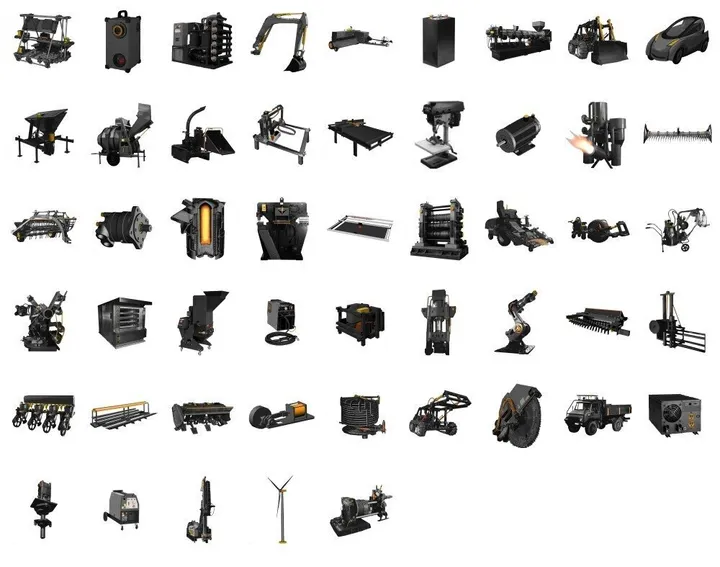
In 2008, I dropped my theoretical physicist's chalkboard and began developing the Global Village Construction Set (GVCS) -- an open source, collaborative project. The GVCS is a modular, DIY, low-cost, high-performance platform that allows for the easy fabrication of the 50 different industrial machines that it takes to build a small, sustainable civilization with modern comforts. Our tools are designed to be simple, modular and last a lifetime. We started from raw land six years ago and built a 4,000 square foot fabrication facility -- where we build tractors and compressed earth brick (CEB) presses, which we then used to build ourselves a 3,000 square foot house. (here is a short video of our story.)

Today, we continue to optimize production, such that even with an inexperienced team, we built a complete brick press in four days. In my 2011 TEDTalk I said, "... I've built a tractor in 6 days." Two years later, it appeared even better than that; our goal is to streamline production down to one day. This is extreme manufacturing, on a small scale.

Our work is about regenerating the world around us. It's about cleaning up our own economies so we are not forced to steal from others -- by producing locally, within our own communities. - Marcin Jakubowski

We are showing the results that come from having zero competitive waste. Our approach is collaborative. Our business model is helping others replicate our enterprise. So, we freely publish online all our machine designs so that anyone can learn and replicate our technologies, development methods, even our organizational model. This collaborative platform gives farmers, producers, social entrepreneurs -- anyone -- a chance to design, build, test, improvise, improve, document, teach, contribute, replicate and aggregate. The goal is to allow people to build while learning -- and sharing -- all the best practices.

One of the very early demonstrations of the power of the open collaborative model was the development of the Cornish Steam Engine. The fiercely enforced patent on Watt and Boulton's steam engine meant that not only the cost of licensing was too high for the Cornwall tin miners, but also that they could not improve nor adapt the design to their specific needs. For this reason, given that the original creators had no incentive to improve it and everyone else was prevented from doing so, innovation on this model stalled. Shortly after, Trevithick and Woolf introduced a new design that was not patented and allowed the community to freely install, adapt and improve it. Miners quickly began exchanging knowledge and collaboratively developing improvements. As a result, the Trevithick and Woolf steam engine became the industry's standard and the community of miners that gathered around it produced near continuous innovation for more than 30 years. It's worth noting that during this period, the rate of innovation was proven quantitatively to be inversely proportional to the rate of patenting.

Is it then useful that in the modern age, spending by Apple and Google on patents exceeds spending on research and development of new products? Imagine instead Google, Apple, Exxon, Caterpillar, JCB, and a flock of other corporations, sharing knowledge and spending the billions of dollars on positive work; each doing their part and cooperating without ego, to create an exquisite symphony like in Eric Whitacre's video? Imagine problems being solved faster than they are created, and the rate of innovation raised a hundred fold. Could we then as a society move on to concerns other than material survival?

As Eric Von Hippel, a leading open technology proponent, suggests, products are best designed and modified by those who actually use them, and user-centered innovation offers great advantages over the manufacturer-centric development systems that were the mainstay of the last century. Users who innovate cannot only develop exactly what they want but also benefit from innovations developed and freely shared by others. This open model ensures that the best technologies become the standard, through a process akin to natural selection. This propels innovation and ensures that the knowledge needed to build, repair and adapt hardware is available where and when it's needed.

The question is not whether open or proprietary will triumph. The real question is: do we want an efficient economy? I claim that collaboration is the route to such efficiency. And if this efficiency indeed holds true -- is it possible that cost of Open Source GVCS machines is on average five times lower compared to industry standards -- and if lifetime design is considered -- that they are 50 times more cost effective over their life-cycle? Our results indicate that this is so. To date, 62 prototypes from the GVCS have been built in four countries from open plans.
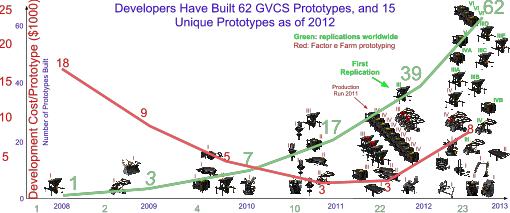

2012-11-26-GVCSprototypes.jpg

History of GVCS prototyping starting in 2008. In 2011, the first ever replication took place, followed by 13 more in 2012.


James Slade, the first replicator, quit his IT job to build GVCS machines full time. Two high school students in LA, Daniel and Hayden, built the Lifetrac (tractor), to donate to a Farmers' Cooperative. And now, the CEB Press is being made in China. These are just a few of the ongoing success stories of everyday people -- with little to no training in metal fabrication or building -- taking on machine production, with the support of a growing community of users who freely contribute their expertise and learning online, in the spirit of true cooperation. They start off merely building machines, slowly but surely finding themselves regaining control of their communities and lives.

Our work is about regenerating the world around us. It's about cleaning up our own economies so we are not forced to steal from others -- by producing locally, within our own communities. We are working towards an efficient and ethical open economy that furthers innovation and creates a sustainable future, by giving as many people as possible access to know-how and the right tools, so they can convert their environment's abundant natural resources into personal good and freedom.

Ideas are not set in stone. When exposed to thoughtful people, they morph and adapt into their most potent form. TEDWeekends will highlight some of today's most intriguing ideas and allow them to develop in real time through your voice! Tweet #TEDWeekends to share your perspective or email tedweekends@huffingtonpost.com to learn about future weekend's ideas to contribute as a writer.

 
Watch the TEDTalk that inspired this post. In 2008, I dropped my theoretical physicist's chalkboard and began developing the Global Village Construction Set (GVCS) -- an open source, collaborative pr...
 
 
  • Comments
  • 138
  • Pending Comments
  • 0
  • View FAQ
Comments are closed for this entry
View All
Favorites
Recency  | 
Popularity
Page: 1 2 3 4  Next ›  Last »  (4 total)
This user has chosen to opt out of the Badges program
09:43 PM on 11/24/2012
There is an operative that matters. When you find it, Life becomes a masterful and marvelous walk in real time.
garystartswithg
el sueno de la razon produce republicans
06:39 PM on 11/24/2012
no! we want a crazy economy! just ask anyone with a 401k! its all about me! me! me!
photo
HUFFPOST SUPER USER
Tb40
Gimme more sunshine please!
06:07 PM on 11/24/2012
I have seen and heard of this concept before. When I was in college many of my philosophy and social science classes touched on "theoretical" ways of approaching ideas that would serve the "greater good" in the future. Back then, many of us didn't see the way the internet would be able to make such a thing happen. The internet was being invented and tweaked back then. I know for me, I felt that the internet would cause more and more people to be glued to their computer screens instead of seeing the world outside. I still feel that way to an extent. However, seeing the ideas and concepts come to fruition that back then were seen as living in "an ideal world" and unrealistic, is phenomenal. So I wouldn't be surprised if much of what we share on here in regards to global concepts and ideas that will benefit our collective humanity will also come to fruition. Sooner THAN later. What a positive spin to see. I can't wait to see what ultimately can become the GV. Global Village. Imagine the concept of so many people of so many different cultures coming together to bring about the most efficient and balanced way of living our lives. Now don't just imagine it. Just wait. Or choose to be a part of it.
HUFFPOST SUPER USER
emanonecafon
05:59 PM on 11/24/2012
Water, electricity, plants and animals take the path of least resistance. Water will not flow up hill and people in general will only work hard at for personal incentive. Maybe the progressive dream is of a world without hard work, where technology and progressive government provide all people a life a leisure and luxury without doing any work at all. But until we arrive at that utopia, I say that success is achieved through hard work, and people will only work hard for personal incentive. Open collaboration is great as long as the contributors are motivated by realizing that their contributions satisfy some form of personal incentive. Working your butt off at a group project in which everyone else drags their feet is the height of frustration. For example, I've changed jobs a couple times and transited from groups using poor teamwork to groups using excellent teamwork. I'm delighted to leave the poor team players behind. What would the world be like if leaving poor team players behind is not an option? What if everybody is in one big team? The name of the game will no longer be to be the best team but to do the least and benefit the most at the expense of the huge team who are mostly all dragging their feet. Without personal incentive included in teamwork, loss of motivation and sugnificant reduction in production and quality will be the result.
Joel Smithis
Small business owner
08:02 PM on 11/24/2012
I guess you do not understand progress, or just talking to yourself. No one liberal I know says incentives should not be there, though fox is telling everyone that.. It is just to have them combined with good work ethic in a fair way. I know poeple who have modest aspirations but are really hard working and proud of it. These kind of people are nowdays kicked in a butt and taken advantage off.
04:21 PM on 11/24/2012
The ultimate form of efficiency will be reached when it will become economically viable to grow food in greenhouses. Our energy dollars are being consumed by automobiles and poorly designed buildings. If smart guys can find ways to break open the water molecule cheaply, then we can all talk turkey about efficiency. Growing food out in a harsh environment will not be able to keep up with the needs of humankind. The Canadians build greenhouses next to power stations and the excess energy is annexed over to the greenhouses. But, hey, Americans believe that this is socialism so that won't fly.
photo
HUFFPOST SUPER USER
Tb40
Gimme more sunshine please!
05:08 PM on 11/24/2012
But that's just it. He's saying that anyone can do it. It's all there in instructions and a community of people that can give advice and even more input. Maybe some Americans believe that it's socialism and that won't fly, he's not saying to force anyone into making it that way. He's offering ways to make it better for anyone to start with and go with. To add their own vision to and have it be heard or seen. Americans, Canadians, Mexicans, Chinese, tribes in Africa with little access can learn from and utilize their model.
03:34 PM on 11/24/2012
One of the requirements for an efficient economic system is specialization of labor. This is a move away from that and will decrease efficiency.

I disagree that somehow having farmers make their own tractors and prospective homeowners making their own block machines is a step forward. I understand that there is some lure of being able to make the 'tools of production', but in reality, this is just an illusion. Your tractor is essentially a kit assembled from the mass production of others. For the cash required to buy the purchased components, you could buy a used tractor that would actually be useful.

Secondly, I disagree that protecting ideas limits ideas. In fact, the opposite is true. Companies only invest in R&D for a competitive advantage. I ideas cannot be protected, there is no economic incentive to innovate.
10:54 PM on 11/25/2012
I question the absolute wisdom that you assume regarding specialization of labor. That is one of the reasons so many people are out of work...work has become too specialized, not necessarily because that's the best thing for the economy...but because it is presumed to be the best thing for investors.
In my field (architecture) we learn about buildings and systems and are trained as generalists...yet today to do a school, fire station, office building, etc...clients expect you to have experience in JUST their area. School projects tend to be done by huge firms that do so many schools they simply assemble the next one from parts of the last...not the best way to design-but the cheapest.
Specialization of labor just gives the cheapest...that may be the best economic system in your mind...but in mind the best is usually the most recently discovered...specialization limits discovery.
HUFFPOST SUPER USER
DarrylP
03:28 PM on 11/24/2012
I have three patents gathered over half a century, so I feel I have some insight on the matter.

There are four reasons for getting a patent. 1) Personal satisfaction - some people collect college degrees with no intent of putting them to productive use, some collect patents. 2) an attempt to convert the knowledge directly into monetary worth i.e. sell the patent rather than form a manufacturing company etc. 3) Produce the item for profit, and 4) prevent others from using the knowledge.

Consider this scenario: A fine upstanding company takes investor money and installs a whole new production facility to make one dollar widgets. They invest lots of money and time and the venture begins to make money. Then one of their engineers comes up with a different way to make a better widget for 50 cents, But it would take a whole new bunch of money, time, etc, and the present investment would be rendered worthless, the investors money would be lost.

So what to do? Patent the new idea and lock it in the safe, or just ignore it and hope all the competitors are too stupid to think of it? Clearly the former, thus the practice of sitting on patents.

Is this right or wrong? I honestly do not know, one discourages investors from making a return, the other discourages advancement in the state of the art.

Ideas anyone?
This user has chosen to opt out of the Badges program
01:15 PM on 11/24/2012
No amount efficiency in the economy through labor, costs, and production will make up for dumb management mistakes, greedy CEOs, and permanent support of capital through unnatural tax breaks and deregulations.
HUFFPOST SUPER USER
DarrylP
03:30 PM on 11/24/2012
Agreed.
photo
laymancanuck
IGNORANCE has used up its quota of TOLERANCE
01:03 PM on 11/24/2012
I believe we would have a more efficient economic system if it wasn't for hoarding.If Wealth was reinvested into real world assets instead of being pushed around the planet seeking returns and not creating anything tangible. Corporations and the wealthy have sucked trillions out of the economic system into their hoards.
HUFFPOST SUPER USER
tomdavis
04:23 PM on 11/24/2012
I used to think like you until I funded a couple of seemingly "good ideas" developed by well-intentioned entrepreneurs. I lost a lot of money. Now I "hoard" my money and just try to get the best returns I can in hopes of making up for the heavy losses caused by my naive idealism. At least I learned something -- there's a huge differnece between a good idea and a good investment.
photo
laymancanuck
IGNORANCE has used up its quota of TOLERANCE
11:39 AM on 11/25/2012
Good ideas still need good execation
photo
HUFFPOST SUPER USER
CupOHemlock
Socrates was pushed
04:41 PM on 11/24/2012
So what would be the incentive to make money, if only to have it taken and "reinvested" by others?
photo
laymancanuck
IGNORANCE has used up its quota of TOLERANCE
11:37 AM on 11/25/2012
When the top tax rate was 90% people still had an incentive, your argument is propaganda.
12:24 PM on 11/24/2012
Thanks, Marcin for the article and the energy! Always glad to see Open source promoted. While patents are useful in theory, and can be in practice, the patent infrastructure has become so corrupt as to be an onerous burden on innovation. Patents have become a weapon to kill competition, rather than foster innovation. Collaboration, not exclusivity is the way forward. In these days of Patent squatting, we need (and thankfully have) workarounds. Open source and Creative Commons licenses are two of those. These are NOT about stealing and copying, they are about preventing theft by profiteers.

To give an example of how far off the rails the patent process has gone, in 2000 a patent was granted for making toast. More about Patent squatting:
http://articles.cnn.com/2000-04-12/tech/patent.squatter.idg_1_patent-infringement-small-companies-big-companies?_s=PM:TECH
photo
RollaJones
Is there a Robespierre in the house?
12:14 PM on 11/24/2012
'Competitive waste' is a necessary byproduct of competition. Competition is the engine of progress.
This user has chosen to opt out of the Badges program
01:00 PM on 11/24/2012
So why does Apple spend more on patenting than on R&D?
01:19 PM on 11/24/2012
To protect their innovations. Do you think that Apple would command the premium that they get if everyone else freely copied them?
photo
RollaJones
Is there a Robespierre in the house?
02:39 PM on 11/24/2012
How much would Apple spend on R&D if there was no competition?
This user has chosen to opt out of the Badges program
photo
Craig2
Living in the great State of Jefferson
11:43 AM on 11/24/2012
Good morning, One question. Does Free Enterprise Economics provide a model for the future? I find the reliance on the individual extreme. There is a need for the Commons. And, Labor must be organized. These are particularily necessary in a rapidly changing environment. New industrial models of local robotic manufacturing will allow communities to be more autonomous, yet more connected.
photo
HUFFPOST SUPER USER
Daniel Kauwe
i like stuff except when i do not
11:31 AM on 11/24/2012
i kind of wonder, theoretically is a free market economy intrinsically efficient...?
This user has chosen to opt out of the Badges program
photo
BuckCarson
Life outside the ObamaSphere
11:46 AM on 11/24/2012
" free market economy intrinsically efficient" = tautologies.
photo
HUFFPOST SUPER USER
Daniel Kauwe
i like stuff except when i do not
11:48 AM on 11/24/2012
care to elaborate?
exmate
Life is about playing a poor hand well.
03:20 PM on 11/24/2012
What is a free market economy depends upon who is defining it and is usually beneficial to whatever greedy person is defining it and is far from being efficient. Tautology? Not even close.
photo
HUFFPOST SUPER USER
Djabout Mauren
Shameless huffjunky
12:39 PM on 11/24/2012
Not necessarily. Here's but one of many reasons why: marketing. In a free market system of competion, how many jillions of dollars are spent just to get us to buy a product? I don't know for certain, but it wouldn't surprise me if Nike spent about as much on marketing and sponsorships as it did on production.
photo
HUFFPOST SUPER USER
Daniel Kauwe
i like stuff except when i do not
12:44 PM on 11/24/2012
interesting...i'm not sure i agree or disagree...
This user has chosen to opt out of the Badges program
11:16 AM on 11/24/2012
Do We Want An Efficient Economy?

Of course we do. Let's start with the obvious inefficiencies of CEO salaries, tax breaks, and other financial tricks that keep inefficient businesses afloat. These businesses tie up capital and other resources from being used more efficiently.
11:07 AM on 11/24/2012
What I am reading here is a description of what the Japanese innovated in the early 1980's. If this country is ever going to be innovative and efficient, then we need to cast off the tired old top down dictatorial management style. Are CEO's the smartest guys in a company? What is a CEO's job?
To maximize profits for a few well-healed investors. How does that improve efficiency? Every American worker wants to do the best job that they can and to feel valued by their company. I mean, even a gallon of milk is not about the farmer but about an investor. If you order a strawberry shortcake from your local diner and they just bring out a glob of whipped cream, then that will leave you wanting more. That's exactly what the middle class has in this economy, a glob of whipped cream with no substance.