
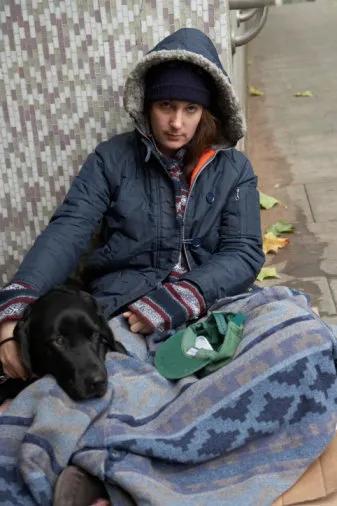
Foreclosures and unemployment are pushing middle class and low-income Americans out of their homes, and emergency shelters and food pantries are seeing record increases in demand for their services. Yet some recent reports suggest that homelessness is not increasing significantly. This is due to both flaws in the data they rely on and the narrow way they define homelessness. The result is confusion and misguided policies.
The data at issue are collected each year by the U.S. Department of Housing and Urban Development from communities across the country on a single night in January. HUD asks these communities to conduct two kinds of counts. The first, known as the "sheltered population" count, is a report from shelters and other emergency housing providers of the number of people sleeping in their facilities on that particular night.
Of course, that number reflects a given community's capacity to provide shelter, not the number of people who need it. In most places, need exceeds capacity. According to the 2011 Hunger and Homelessness Survey, published by the U.S. Conference of Mayors, cities reported that emergency shelters turned away, on average, 18 percent of requests due to lack of resources.
That's why HUD's second count is of "unsheltered" homeless people, defined as those living in places "not fit for human habitation." HUD lists a wide range of examples that fit this category, offering a disturbing glimpse into the deprivation in which some Americans are now living:
"Streets, parks, alleys, parking ramps, parts of the highway system, transportation depots and other parts of transportation systems (e.g., subway tunnels, railroad cars), all-night commercial establishments (e.g., movie theaters, laundromats, restaurants), abandoned buildings, building roofs or stairwells, chicken coops and other farm outbuildings, caves, campgrounds, vehicles, and other similar places."
Searching all these places -- and others not included -- would be an impossible task, and it's up to each community to decide which ones to include. Community volunteers are mobilized to help and, once they're told where to go, are ultimately the ones to decide who to count as homeless. HUD offers guidance ranging from simply counting those they "judge" to be homeless at a glance to conducting brief "screening" interviews. The process is subjective at best. Moreover, HUD cautions communities to avoid sending volunteers to "unsafe locations," such as abandoned buildings.
Of course, these are exactly the locations that people living outdoors often favor. In many cities, sleeping outside is illegal, leaving those out in the open at risk of arrest. It can also be dangerous; some homeless people hide to avoid theft or violence. In suburban and rural areas, people may be in remote locations that are difficult to identify or see. Taken together, these factors lead to data that significantly undercounts the total homeless population.
Even more important, both the sheltered and unsheltered counts exclude people who are living "doubled-up" due to economic need. Sometimes called the hidden homeless, these are individuals or families -- and sometimes unaccompanied children or youth -- who are sleeping on other people's couches or floors, because they cannot pay for their own housing. According to a recent report, almost 7 million Americans now fit this category, an increase of 13 percent over the past year and more than 50 percent over the past five.
But these millions of people do not fit the HUD definition of homelessness, and are thus omitted from its official count, which put the total at 636,017 in 2011, a 2.1 percent decrease from 2010. According to many organizations -- including the Law Center, other federal agencies, and international human rights monitors -- people living doubled-up due to economic need are homeless. The definition is a matter of semantics; the reality is that these people have no home of their own.
Understanding the reality of the crisis and the numbers behind it is essential to formulating solutions. Currently, HUD's narrow approach excludes many doubled-up families and children from housing assistance. Legislation to expand the definition and open eligibility for these families is now pending in Congress. Opponents argue that expanding eligibility will further strain resources that are already inadequately funded, and they have a point: funding to help poor and homeless people afford housing is terribly inadequate.
But telling the truth about the need is essential to building the political support necessary to increasing that funding. To its credit, the Obama Administration has set an ambitious goal of ending and preventing homelessness. Just as important, it's shown that the goal is achievable: funded at $1.5 billion as part of the 2009 Stimulus, the Homelessness Prevention and Rapid Re-housing Program helped over 1 million people avoid or leave homelessness. That's an impressive record of success for a relatively small investment.
In many communities, however, these funds have long since been spent, and more funding is urgently needed to protect the gains that have been made and to help more people. At a time when so many Americans are suffering, and experiencing first hand the pain of losing their homes, making the case to our elected representatives in government for resources to address it should be possible.
But first we have to admit the depth of the crisis.