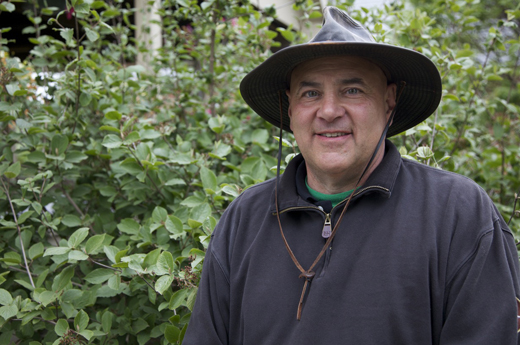
by guest blogger Coach Mark Smallwood, Executive Director of the Rodale Institute.
Buying organic is a powerful change-making action, but it's also a relatively easy one. You put the organic food in your cart, hand over the cash, and head home with a bag full of food you can feel good about. Defending your choice to support organic can sometimes be a little trickier. Early on, the trend was to attack the quality of organically grown food--bug-eaten lettuce and scabby apples. In just 20 years, the criticism has become the polar opposite, that organic food is gourmet and only for the rich.
The latest "feed the world" scare tactic has been a really good way for Big Ag folks to shut down arguments for any agricultural path other than the one they promote. And we're now seeing it repeated verbatim as a fact over the dining room table, across the kitchen counter, and in the grocery store aisles.
- Chemical farming isn't "feeding the world" now. Despite more than 70 years of chemical- and petroleum-reliant farming practices, about 1 billion people are malnourished or starving in today's world.
- It takes three calories of energy to create one calorie of edible food with conventional farming.These facts from a report from Johns Hopkins Bloomberg School of Public Health don't even include the energy used in transportation or processing. Our current system relies on practices that actually diminish the resource base that is needed to sustain it.
- Biotech crops falter and fail without expensive herbicides, pesticides, fertilizers, and irrigation. While enormously productive in ideal conditions, biotech crops gobble up incredible amounts of resources to produce that yield.
- Organic methods can produce harvests 180 percent larger than chemical farming in communities that struggle to feed themselves. Although global population is on the rise, population in the developed world is actually on the downturn. Most of the growth is in the developing world, where organics have been shown to have the most beneficial effects.
- We could double food production in just 10 years using organic practices and other agroecological farming methods, according to a report from the United Nations. Agroecological practices, such as organic farming, attempt to mimic natural processes and rely on the biology of the soil and environment rather than synthetic sprays and other inputs.
- Organic farming creates more of the resources on which our food supply relies, while conventional farming destroys them. Conventional farming leeches nutrients from the soil, puts a strain on our water supplies, and relies heavily on fossil fuels to make it work; organic farming builds better, more self-sufficient land, creates cleaner water, recycles nutrients, and leaves us with a cleaner atmosphere.
In our 30-year research trial at Rodale Institute we found that for corn and soybeans, organic yields matched conventional yields, organic outperformed conventional in years of drought, and organic farming systems built rather than depleted soil organic matter, used 45% less energy, and were more efficient. Organic fields were more profitable than conventional, and while conventional growers battle herbicide-resistant superweeds with bigger, badder chemicals, the organic crops held their own against weeds, producing just as much food as the conventional fields without the assistance of herbicide.
Even in the face of a rising global population, organic techniques provide a more secure, more stable, and more sustainable food system. A food-production system based on organic principles is the only hope the world has, according to a global study produced by the United Nations World Food and Agriculture Organization. We like to say, "Organic has the strength to not only feed the world, but feed the world well."
Coach Mark Smallwood has been dedicated to environmental sustainability, efficiency and conservation for decades. Since joining Rodale Institute in December 2010, he has brought heritage livestock back to Rodale Institute's 333-acre farm, expanded and enhanced Rodale Institute's research efforts, as well as launched "Your 2 Cents," a national campaign to support and promote new organic farmers. In recognition for his sustainability efforts, Coach was chosen as a messenger for Al Gore's Climate Project presenting to over 15,000 people on the effects of Global Warming. Last, but certainly not least, as a long-time organic farmer and biodynamic gardener, Coach has raised chickens, goats, sheep, pigs, and driven a team of oxen.
For more from Maria Rodale, go to www.mariasfarmcountrykitchen.com