Musharraf's Emergency Rule Illegal, Pakistan Court Rules

digg Share this on Facebook Huffpost - stumble reddit del.ico.us RSS

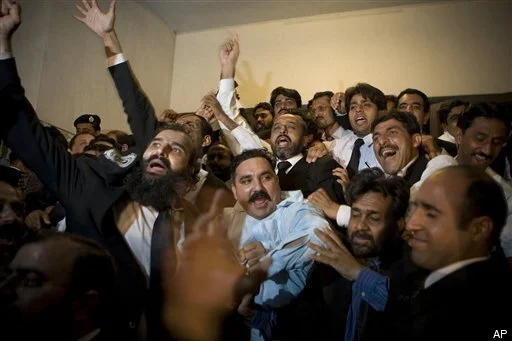
All across the country, black-suited lawyers congregated around television sets. The decision they were waiting for was still being argued, but the air was already bustling with celebration. Victory signs were being waved. Sweetmeats were placed close by. Everyone's expectations were pinned on the proceedings in Courtroom 1.

The minutes stretched, turning into hours. News anchors struggled to fill in gaps between coverage that was heavily focused on the anticipated breaking news. Four hours after the expected time, a visibly excited TV host made the announcement.

"The Supreme Court of Pakistan has declared the November 3rd, 2007 actions of former president Pervez Musharraf extra-judicial, illegal and unconstitutional."

The lawyers broke into revelry.

When Pervez Musharraf used his power as an army chief to suspend the constitution in November 2007, he probably could not have imagined this day would ever come. The reason was simple. Others before him had done the same, and had never had to answer for it. Just seven years into Pakistan's creation, the military had dismissed nine provincial governments. Between 1951 and 1958, Pakistan had seven prime ministers. A famous joke was that the government in Pakistan changes as often as one changes clothes. Each time, the Supreme Court played along.

One of the rationales provided for this frequent army intervention so early into Pakistan's creation was that the country's survival was at stake against neighboring India. A weak, corrupt, and squabbling civilian government, it was said, could place the country at risk. Overtime, a culture of military supremacy developed. And like a self-fulfilling prophecy, democratic parties were never able to deliver even when given a chance. At the brink of each failure, the army lurked, ready to shove the government off the stage, ready to impose Martial Law.

This is the first time the Supreme Court, headed by Chief Justice Iftikhar Chaudhary, decided to put an end to this cycle.

It is still early to predict the ramifications of the court's decision, announced this Friday evening. Some analysts shrug it off as a non-news, something Musharraf had himself long acknowledged. Others hope it could lead to a trial of high treason against the former president as a case in point for future military adventurists. It is also said that the decision could lead to political drama for the current president, Asif Ali Zardari, by reopening the National Reconciliation Ordinance for review before the parliament--the NRO, which grants indemnity to Zardari against corruption cases, was issued by Musharraf, suspended by Chaudhary and revived by the new post-Nov 3rd chief justice.

Musharraf did not appear in court to defend his actions, and neither did he send a counsel. In an interview to a TV channel, Aaj, aired a couple of days before the court's decision, he was asked about the possibility of a trial against him. "My heart and mind are very clear. I have done nothing wrong for my sake, so I would face the trial, as it is part of the legal system of Pakistan," he said.

In another interview to an Indian channel CNN-IBN, he said, "One has to face realities on (the) ground and I will face them. I am not a man who runs away from realities. Let them bring law suits and (try to) prove anything against me."

There is certainly no dearth of people who want to do just that. As Musharraf sits in London, a Pandora's Box of accusations and grievances has opened up in Pakistan against him.

"We will mobilize all constitutional, legal, parliamentary and political forums to get Musharraf tried," said one PML-N Senator, Pervez Rashid, to The News, a national newspaper. "We will not let him off the hook."

The grandson of slain Baloch leader Nawab Akbar Khan Bugti is also seething, ready to register a police report against Musharraf for his grandfather's death. Meanwhile, a team of UK lawyers has approached a human rights law firm that "previously acted in the prosecution of Chile's military dictator General Pinochet" to give advice on the "legality of Musharraf's actions," Dawn News reported.

Anyone who follows Pakistani politics knows that there are as many twists as the number of political pundits out there, so it is hard to say what course these events and statements will take.

But one thing is for sure. The court decision is an epic symbolic gesture. It has restored the institution's relevancy after decades of subjugation. It has raised the common man's hope in seeking justice for his own causes. It has given the constitution of Pakistan some semblance of respect, a constitution that one military dictator, General Zia-ul-Haq, famously called "nothing more than a piece of paper he could rip whenever he wished."

This is part of HuffPost's Spotlight On Pakistan. Eyes & Ears and HuffPost World are building a network of people living in Pakistan who can help us understand what is happening there. These individuals will send us reports -- either snippets of information or full-length stories -- about how the political crisis affects life in Pakistan. This is an opportunity to have a continued conversation with Americans about what's happening in your country. If you would like to participate, please sign up here.

Get HuffPost World On Facebook and Twitter!

All across the country, black-suited lawyers congregated around television sets. The decision they were waiting for was still being argued, but the air was already bustling with celebration. Victory s...
 
Comments
8
Pending Comments
0
iPhone App Promo

Want to reply to a comment? Hint: Click "Reply" at the bottom of the comment; after being approved your comment will appear directly underneath the comment you replied to

View Comments:

SC decision against Musharraf and subsequent rhetoric by Nawaz Leage and PPP leadership proves that Musharraf was not a dictator and is still popular in Pakistan. Newspapers dont write about politically dead people. Political leaders talk against only those people who are capable of attracting popular support. Yes, this proves that Musharraf is not only politically alive but actually is ready for comeback.

The fact remains that in 2008 elections, Musharraf supporting parties got majority of popular votes. Neither PPP nor Nawaz League could win the majority of NA seats despite PPP riding on the sympathy wave after Benazir assassination and despite Nawaz League exploiting punjabi nationalism.

After recent military onslaught in Swat valley, an action against Musharraf became necessary because both Nawaz League and PPP have recently lost popularity as, in order to please their American paymasters, they openly supported military action The Swat operation has only vindicated Musharraf policies, who for 6 years, successfully resisted American pressure to launch swat-like military operation, although threatened by Armitage to bomb Pakistan to stoneage.

Now take role of so-called elected government . There was already a peace deal effective in Swat valley and Pakistani government had all the popular international & national support to resist American pressure, but still Government ordered military action, merely to get loans, to be repaid by nation, but actually to support the lavish lifestyle of PPP- Nawaz -League leaders- ministers whose number is ever increasing although popular support for PPP-N-league has consederably decreased.

    Favorite    Flag as abusive Posted 09:53 PM on 08/02/2009
- pfrogger I'm a Fan of pfrogger 61 fans permalink

Nice article. Very informative.

Sorry, but it's very naive. At one point you begin to point out the number of times that military power has so easily brushed aside the government and constitution. And then you go on to say somehow, some purely symbolic, and essentially powerless decree from a court, that as you say has shown to be quite ineffectual, will somehow make a substantial difference in the real world.
I don't buy the logic. We would all like it to be so, but it is quite plainly NOT.
This is,as you say, symbolic. And I would bet money that it is ONLY that. There is no logical reason to believe a one time court ruling would have a lasting and substantial effect when all the other examples in history have shown it not to be a case.
But it's a nice fairy tale.

    Favorite    Flag as abusive Posted 08:18 AM on 08/02/2009
- Hisham Wyne - Huffpost Blogger I'm a Fan of Hisham Wyne permalink

ahh, pfroger but you see:

As i argue on http://www.huffingtonpost.com/hisham-wyne/a-landmark-ruling-beats-b_b_251488.html, the ruling may be symbolic but it also means that the judicairy + civil society + public are for the first time standing up to military rule. In years gone by, military dictators were welcomed with garlands as an alternative to corrupt democratic governments. And they were ratified de facto by the judiciary. Yes, this ruling is symbolic. But for pro-democracy fighters, it means a lot, because a supine judiciary has come into its own. The trinity of legislative, judiciary and executive is finally being established.

    Favorite    Flag as abusive Posted 03:10 PM on 08/05/2009
- Khirad I'm a Fan of Khirad 263 fans permalink
photo

Pakistan Zindabad! Good for the rule of law. As Frank said, I'm hoping we get down to it soon as well.

    Favorite    Flag as abusive Posted 08:26 PM on 08/01/2009
- frankg3400 I'm a Fan of frankg3400 2 fans permalink

It seems that every other country other than the Unites States has the guts to condemn their leaders for crimes against their constitutions so it will NEVER happen again. Yes, we must look back, condemn, try and prosecute.

    Favorite    Flag as abusive Posted 04:05 AM on 08/01/2009

Nice article...very interesting to see what happens..also, Nawaz Sharif and Zardari were much worse leaders and I only wish they were actually sentenced tp jail time

    Favorite    Flag as abusive Posted 02:37 AM on 08/01/2009
- Hisham Wyne - Huffpost Blogger I'm a Fan of Hisham Wyne permalink

Much worse is open to debate. But here's the key point - that it's open to debate. The problem with military rule is that it chooses to operate outside of the framework of checks and balances. de jure becomes norm. With Nawaz and Zardari, there is an option to remove them come next election, just as you voted them in. But removing the Apocalyptic Four, http://www.huffingtonpost.com/hisham-wyne/a-landmark-ruling-beats-b_b_251488.html, is usually beyond the public's power. Hence our angst about military rule.

    Favorite    Flag as abusive Posted 03:13 PM on 08/05/2009
Comments are closed for this entry

 You must be logged in to comment. Log in  or connect with 

Connect