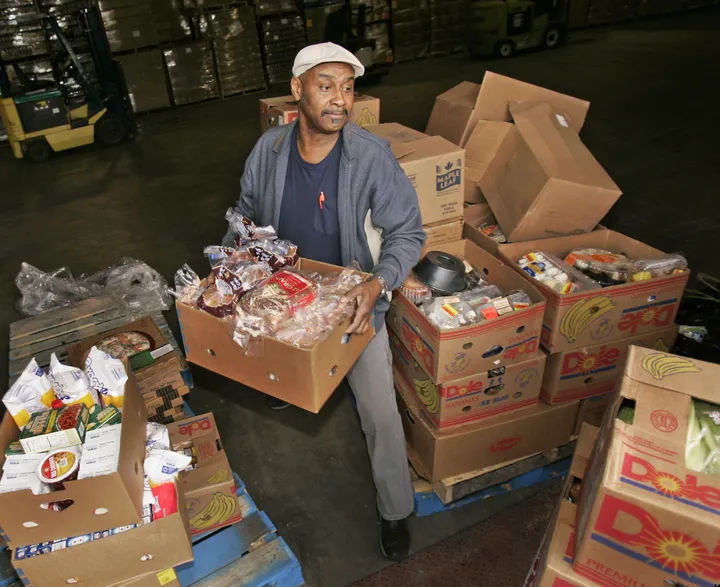
As you sit down for Thanksgiving dinner with friends and family this year, imagine looking across the table and not seeing a turkey. It may be hard to fathom, but it is a reality too many Americans face this year. A story in the Manteca Bulletin earlier this month tells the sad story of the Second Harvest Food Bank in the Central Valley of California, which distributes Thanksgiving baskets to nearly 3,000 local families -- and likely won't have the resources to serve all those in need.
In these hard economic times, the combination of unemployment and high food prices means many American families are struggling to put food on the table.
Our biofuels policies are a big cause of the rising cost of food in recent years, and it just feels wrong to use food for fuel with so many families struggling to feed their families. Yet due to federal ethanol subsidies, almost half the corn grown in the United States will be diverted to biofuel production this year, leaving little for food and feed. These wasteful subsidies are driving up the price of everything from eggs to milk to -- yes, turkeys -- and undoubtedly, some families will just have to go without. Second Harvest Food Bank will have to pay 99 cents a pound for turkey, 37 cents a pound higher than last year.
The impacts aren't limited to the U.S. either. As global corn prices hit record highs, people in developing countries all over the world faced food insecurity, hunger, and uncertainty. The November World Bank's Food Price Watch calculates that the price of corn rose 43 percent globally last year, and as a result at least 44 million people were pushed into extreme poverty. Developing countries were hit especially hard. In Uganda, for example, where the average family spends well over half of their income on food, the price of corn rose 86 percent.
And let's not forget the cost of the subsidies themselves. The biggest corn ethanol subsidy, the Volumetric Ethanol Excise Tax Credit (VEETC), costs us over $6 billion per year. In these tough economic times, American taxpayers shouldn't be footing the bill for the ethanol industry, which has been on the public dole for three decades.
It isn't worth the cost. Long have we supported corn ethanol production under the assumption that it is a greener alternative to fossil fuels, but the jig is up.
Even if we used every single bushel of corn in the US for ethanol production, we'd only replace 2 percent of our fossil fuel use. Cradle to grave carbon emission analyses have found that corn ethanol provides little, if any, improvement over regular gasoline. In fact, the EPA's own data shows that right now, corn ethanol is actually worse for the environment than regular gasoline.
Yet this is the time of year when we reflect and give thanks for what we have. The good news is that VEETC is set to expire at the end of the year. If you're getting déjà vu, it's because VEETC was also set to expire at the end of 2010, but the corn ethanol and agribusiness industries and their Congressional supporters renewed it at the last second.
Let's be sure that does not happen again this year. It's our responsibility to let our Congressional representatives know how we feel. Please call your Congresspeople today and tell them the time has come to end taxpayer support for corn ethanol. We should not be taking food off our tables to put it in our gas tanks.
This piece was co-authored by Marie Brill of ActionAid and Michal Rosenoer of Friends of the Earth.
Corn represents about 15% of the retail price of food so 4% of 15% would mean ethanol's impact on the price of food - through it's affect on corn prices - was .6% (that's six tenths of one percent) .
But ethanol also reduced the price of petroleum about 15%. Energy (mostly petroleum costs) represents about 6% of the retail price of food so -.15 x .06 = - .9% (minus nine tenths of one percent).
So the net impact of ethanol on the retail price of food is to LOWER IT ABOUT .3% (+.006 - .009 = -.003).
While ethanol's impact on food prices (through increased demand for corn) has been given a lot of attention very little attention has been given to the fact that ethanol has also LOWERED THE PRICE OF PETROLEUM - DUE TO SUPPLYING ADDITIONAL FUEL TO DRIVERS.
So how much has ethanol reduced the price of gas? Francisco Blanch, Chief Market Strategist for Merrill Lynch, said it has reduced the price of gas about 15% (Wall Street Journal, May 2008). Of course we are making quite a bit more ethanol now than we were in 2007-2008 time-frame. In 2010 we produced ethanol in a volume that was about 10% of the fuel supply.
(to be continued)
It seems like eating such a poor, mistreated creature is an exclamation point to our pathetic--conspicuous consumption habits that I cannot stomach. Raise one for yourself. It will die withint 14 months, too fat to support it's own weight, no matter what you feed the poor bird. :(
Very sad.
traditional here at our home.
I have some pumpkin bought cheaply durring halloween.
Flour and lard for the pie crust.
I will bake half an .89 per lb. turkey on its side in the roaster pan.
because 10 people won't eat a whole turkey at one sitting.
The drippings fron the turkey, some stale bread crumbs,
celery and onions will make tasty dressing.
Four eggs, two cups of flour and a few saved chicken backs
will make some good chicken and noodles.
One head of cabbage ans a small bottle of cheap ranch dressing
will make great cole slaw
Two large sliced sweet potatoes baked in margarine and brown
sugar will be fine.
Two lbs of cranberry's with one pacKage of cherry jello is plenty good.
You have to eat something anyhow. There will be leftovers for Fri, Sat and Sun.
when I will cook the other half of the turkey for creamed turkey over toast.
This sounds to me to be cheaper than most any other weekends food.
I buy turkey periodicaly year 'round because it is cheaper
than beef or pork in most cases and better for you.
I will not have a serloin roast which would be my choice,
however, turkey will be on the table. A couple of roasted
chickens would not disapoint me very much either.
It has been nice 'talking turkey' with you
They were hoping I suppose to bribe their version of the Huns. Keeping them at bay with tribute.
If your weekly food budget is fifteen or so dollars, you don't waste it on things that are not absolutely necessary.
Not only that, but getting to the grocery store takes a working car, gas to put in it, or a bus system and money to pay the fare. You also would need the time to get there, which may not exist if you are working poor.
Next, you need to be able to pay your electricity bill to cook the turkey. And a pan for it. And whatever (butter, some spices). And maybe you'd want some other food to go with your turkey so that it doesn't sit there alone on the table.
Add all that up and a Thanksgiving dinner is out of reach if you're out of work or you are working poor.
I know people who have been too poor for Thanksgiving. It's humiliating and painful.
Now, college is a prerequisite to moving out your parent's house unless you're willing to roommate with six other people. College has become less of a pursuit of higher learning in itself and more of a mere specialized form of vocational training.
Yet it's the GOP who would cut funding for public universities, or heck, eliminate public universities altogether, claiming that "the private sector can do it better."
The bridge to self-sufficiency is much longer today than 60 years ago, and one certain party is doing its best to make that bridge increasingly impassable to anyone whose parents aren't already well-heeled.
Now with college as the panacea--it is offered as a way out of poverty, but with tracking in schools, and ridiculously high tuition, many blue collar children are priced right out of that all healing social salve of College.
And then we are told to take a bath and get a job.
But as you say, no living wage is offered to one without the magic piece of paper. And that is all it is anymore.
Higher education has been corrupted.
Get off your butt and support your local food bank.
But I doubt they will. I'm sure Corn and Ethanol contribute to much to their war chests.
It does not go to the ethanol company. It goes to the oil company that blends the ethanol into its gasoline. We are now exporting a significant amount of our corn ethanol to other countries. This obviously has nothing to do with energy independence. Google the term "corn ethanol exports"
However, the tax credit makes little difference. The real problem is that our government is forcing its citizens to buy corn ethanol by mandating that all gasoline contain a 10% blend of it. You are being forced to starve children by your own government and support of ethanol is a rare bipartisan debacle. Google the term "The Corn Ethanol Debacle"
Biodiversivist