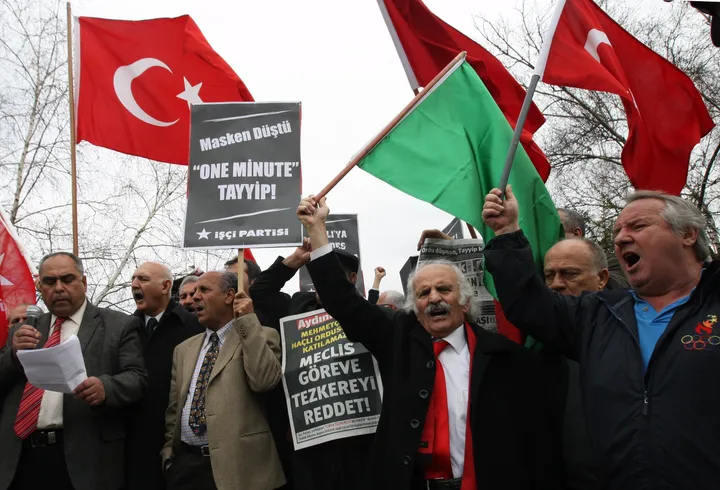
A polarized debate on fundamental freedoms is waging in Turkey. Thisdebate further intensified after the recent arrests of journalists following a court order that criminalizes the possession of a yet unpublished book. Soon after the arrest of the book's author, journalist Ahmet Şık, Turkish police have raided publishing homes and newspapers in search of draft copies of Imam's Army, with a warrant that stated that spreading the manuscript -- dealing with the infiltration of a religious group within the police -- was tantamountto aiding and abetting terrorists. The draft will be published online shortly.
The arrests are the last wave in Turkey's Ergenekon case whereprosecutors accused hundreds of conspiring to overthrow the governmentor, as is the case with dissident journalists, creating a 'psychological environment' for a coup.
When the Ergenekon case started in 2007, many in Europe supported theeffort believing it was aimed at dealing with Turkey's anti-democraticpast -- especially the role of the military which has staged threecoups since the republic was founded in 1923 and continued to meddlein politics. But our optimism soon made way for concern as noconvictions followed and pre-trial detention periods kept extending.Our concern has turned into alarm as we witnessed the fear,polarization and mistrust the recent arrests caused in a large part ofTurkish society.
This is why European Union officials joined by their Americancolleagues called upon the Government of Turkey to safeguardfundamental rights and the freedom of press. Prime Minister Erdoganreacted saying Europe "should look at itself" before criticizingothers. It is suggested his planned trip to Brussels was cancelled toavoid critical talks about the state of freedom in Turkey.
In Europe, we have had our share of experiences on banning and burningbooks. These were the preludes to the darkest days of our history. The efforts lead by European Parliament to change the restrictive Hungarian media laws and to promote media pluralism in Italy, are reflective of our ongoing work to improve press freedom in the EU as well.
In most cases, Europe goes quite far in protecting free expression. When in 2006 cartoons picturing the Prophet Mohammed led to riots and grave national security risks, they were not banned, nor was the cartoonist arrested. One of the few banned books in some European countries is Hitler's book, Mein Kampf, which coincidentally was a bestseller in Turkey in 2005
Protecting fundamental freedoms is a responsibility of any government. Being elected into office or the principle of judicial independence does not absolve the government of Turkey from this basic duty from which it derives its own legitimacy.
Democracy is not limited to free elections and the separation ofpowers does not exist in a vacuum either. When Americans assessed thatpublications on WikiLeaks posed a grave threat to nationalsecurity, not a single news desk was raided as it is understood that the constitution favors the freedom of speech beyond a single legal case. Meanwhile, we continue to monitor and criticize, any violations of civil liberties in the ongoing WikiLeaks investigation.
A popular Turkish saying, 'dost aci soyler', means friends tell thenaked truth. Today's most outspoken critics of Turkey's fundamental rights standards are also among the staunchest defenders of Turkey´s accession to the EU, despite obvious electoral benefits in doing the opposite. We have no interest in bashing Turkey or directing undeserved criticism at a country whose candidacy we firmly support.
However, to seek to destroy an unpublished book, raiding newspapers insearch of electronic copies, is unprecedented and unacceptable byany measure. The prosecutors' argument that the journalists werearrested not for their journalistic work but for their allegedaffiliation with a terrorist organization (namely Ergenekon) fails tojustify such a blatant violation of individual freedoms, especiallysince the court is yet to decide whether or not Ergenekon exists.
We believe Turkey's accession to the EU will benefit both. Mostof all, it will enhance the freedoms, rights and opportunities ofpeople in Turkey. If the Turkish government is serious about joiningthe EU it would be wise to show sympathy to the words of its strongest allies in Europe. It is those Europeans that have both advocated and defended Turkey´s EU accession who are now speaking out. This is not about singling out Turkey, but about defending the fundamental value of press freedom, in the EU and outside. Prime Minister Erdogan should seek and not avoid conversations with his European friends on this important topic.