
iPhone app iPad app Android phone app Android tablet app More

Featuring fresh takes and real-time analysis from HuffPost's signature lineup of contributors
Mario Livio

GET UPDATES FROM Mario Livio
 

Science and Religion: The Views of Two Religious Scientists

Posted: 08/01/2012 6:01 pm

Jacob Bekenstein and David Eichler are both world-renowned astrophysicists. Bekenstein, winner of the 2012 Wolf Prize, is best known for his work on black hole thermodynamics, and for the formulation of a theory known as TeVeS, that attempted to explain galactic observations without a need for dark matter. Eichler is known for numerous works on gamma-ray bursts, cosmic rays, and pulsars. They are also religious Jews. I have known Bekenstein and Eichler for decades, but I suddenly realized that I had never actually talked to them about whether they see any conflict between their religious beliefs and their scientific views. I was happy to discover that neither of them had any objections to openly discussing their opinions.

Eichler explained to me right away that he believed that the universe is governed by the laws of physics.

"What is God's role, then?" I asked.

"For all we know, God created the laws of nature," he replied, "so religion in this sense does not contradict science at all."

"But," I insisted, "did God's work end, then, with formulating the laws?"

"No," Eichler explained. "As you know from quantum mechanics, the laws of physics proclaim their own incompleteness, and that leaves, as one logical possibility, plenty of room for God to intervene."

"And what is God's role in ethics?" I inquired.

Eichler did not hesitate: "The God-created laws of nature have led to humans that are hard-wired with concepts of ethics. Put differently, ethics arose through Darwinian evolution, which in itself was the consequence of the God-created laws on nature."

Bekenstein's ideas are similar in some respects, somewhat different in others. He explained to me that being a cosmologist, at first he had some problems with the question of how to reconcile the extremely short biblical age of the universe (less than 6,000 years) with the cosmological age of approximately 13.7 billion years. Eventually, however, he found a satisfactory explanation.

"Clearly," he said, "the age of the universe is 13.7 billion years. The age scale mentioned in the Bible," he explained, "is simply the age of human memory." That is, the biblical age should be taken as approximately representing the length of human-documented history. "The Bible does not deal with physics," he clarified, "but with the human condition, to which the cosmological timescale is not particularly relevant."

Concerning the theory of evolution, Bekenstein added that while he has no doubt that some form of evolution has taken place (as seen, for example, in bacteria developing resistance to antibiotics), he has not devoted much time to attempting to understand all the issues involved in detail.

Like Eichler, Bekenstein also believes that the universe behaves according to the laws of physics, but he pointed out that no one knows where those laws come from. "Either the laws are what they are because that is the only self-consistent way for them to exist (but even then we don't know why the laws exist in the first place) or God created them."

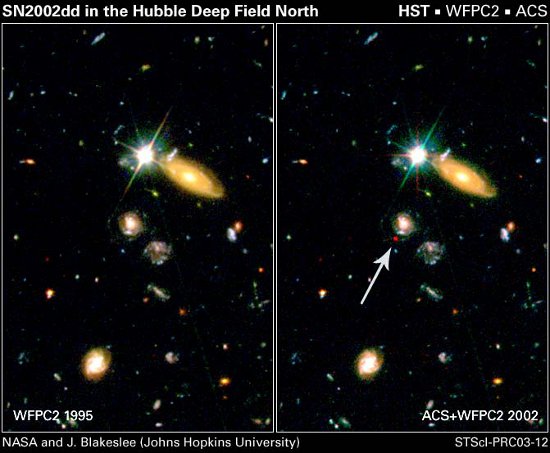
Both Bekenstein and Eichler agree with the statement made by Galileo 400 years ago that the scriptures were not meant to be viewed as scientific theory. Galileo, in fact, famously pronounced that the universe (a small portion of which is shown in Figure 1) "is written in the language of mathematics." Bekenstein added that we should refrain from dogma, even when it comes to the scientific enterprise. "Science itself evolves very rapidly," he said, "and we should allow our views to evolve with the changing landscape."
2012-07-31-hs200312asm.jpg
Figure 1. Part of the Hubble Deep Field-1995, showing Supernova SN 2002dd.


Follow Mario Livio on Twitter: www.twitter.com/Mario_Livio

FOLLOW SCIENCE
Jacob Bekenstein and David Eichler are both world-renowned astrophysicists. Bekenstein, winner of the 2012 Wolf Prize, is best known for his work on black hole thermodynamics, and for the formulation ...
 
 
  • Comments
  • 539
  • Pending Comments
  • 0
  • View FAQ
Comments are closed for this entry
View All
Favorites
Bloggers
Recency  | 
Popularity
Page: 1 2 3 4  Next ›  Last »  (4 total)
02:36 AM on 08/15/2012
The universe was created all at once in the Holy Moment we know as Now--not in 6000 years--and from our limited perspective it took billions of years of evolution for us to arrive at this point.

There's no such thing as right and wrong. We're making it all up. Right and wrong vary, depending on time, place, and circumstance.

There's one ethical law: "whatsoever a man sows, that shall he also reap." It is the unfailing law of retribution, which delivers justice, if not in this life, then in the next, and the one after that. It's not a law of punishment, so much, but one of revelation, revealing the futility of certain actions, and certain behaviors: You can't kill; you can't steal; you can't bear false witness; you can't covet what belongs to your neighbor.

"Either the laws are what they are because that is the only self-consistent way for them to exist (but even then we don't know why the laws exist in the first place) or God created them."

Socrates/Plato had it right about "correspondence" in the formation of our universe, where things seen are the result of things not seen, including our bodies.

The "laws" don't exist here in the material realm, but in a non-material, non-physical realm, governed entirely by that which is not seen. What we're seeing is a manifestation of what's not seen, not the actual thing itself, which is non-material, and eternal.
02:08 PM on 08/08/2012
I believe that Science and Religion are compatible. Truth is truth, whether it is in science or religion, but at this stage of our understanding, we may not be able to reconcile the two to each other. There are rules that exist, God uses those rules to make the planets rotate, the seasons to come and go, and in the miracle of birth and life. That's why he is God. When you look at the entire picture, all kinds of life on this planet, the universe and everything in it; I believe that it testifies that there is a God.
05:42 PM on 08/07/2012
The real tragedy of religion is that all it had to do was to look up, into the sky, to get all the answers. Instead it looked down, at the ground, more often than not in search of a suitable stone to stone someone to death it didn't agree with.

What a waste of human life and talent religion has been and continues to be. Just sad...

:-(
This user has chosen to opt out of the Badges program
photo
02:00 PM on 08/07/2012
Religious scientist + scientific method = cognitive dissonance.
05:04 PM on 08/07/2012
I can support that with evidence. I have met only two fundamentalist Christian physicists. One openly admitted that he never mixes how beliefs with his work (and he is a rather gifted theories) and that the only way he can make it work is by keeping the two completely separate.

The other person told to me that he was going to an Evangelical church but begged me not to tell anyone at work as he feared the reaction of his environment (which, I believe, would have been rather benign, I certainly didn't give him a hard time for his beliefs).

There is, for sure, quite some tension in people who are not willing to give up the myths that they have been taught as kids for the reality they objectively know.
This user has chosen to opt out of the Badges program
photo
12:50 AM on 08/15/2012
the two can and do go together.
12:18 PM on 08/07/2012
Science carries no ethics. The language of science comes with no signposts about good and bad. Science textbooks tell us how to create a nuclear reaction, and yet they contain no chapter asking us if it is a good or a bad idea. Who is more ignorant? The man who cannot define lightning, or the man who does not respect its awesome power?
05:12 PM on 08/07/2012
Actually... science does not tell you how to create anything, either. It merely describes the things that are already here. Engineering, on the other hand, tells you how to use the things that are already here most efficiently.

What you want to use the things that are already here for, is completely up to you. Neither science nor engineering take any responsibility for the ways in which you decide to mess things up with them.

:-)
photo
HUFFPOST SUPER USER
Jarrod Putnam
And so long as men die, liberty will never perish
07:05 PM on 08/07/2012
That is such an absurd argument against science. Religion has nothing to do with "ethics" whatsoever.
sjaent2001
Change gets Challenged, changer gets Cross/poison
08:01 AM on 08/07/2012
Part II Conclusion:
So the whole purpose is yes there has to be time between what was inscribed in the Tablet as God was there before First, then the creation started, first with the Angels and the Arch Angel Gabriel was the First who has till today maintained his position of the deliverer of All Knowledge and order of things, as time and the things unfolded from that inscribed Tablet of God.

There is more to it but I thought there has to be some explanation as to the assumption of 13.7 billions years and the Biblical Record of 7000 years. Things happened in stages too but God was First and He will be the LAST. God KNows BEST. But Science and Religion can work togather to explain more as to the Nature of Laws and the GUIDANCE for HUMANITY AT LARGE.
sjaent2001
Change gets Challenged, changer gets Cross/poison
07:58 AM on 08/07/2012
""""at first he had some problems with the question of how to reconcile the extremely short biblical age of the universe (less than 6,000 years) with the cosmological age of approximately 13.7 billion years. Eventually, however, he found a satisfactory explanation. "Clearly," he said, "the age of the universe is 13.7 billion years. The age scale mentioned in the Bible," he explained, "is simply the age of human memory." That is, the biblical age should be taken as approximately representing the length of human-documented history. "The Bible does not deal with physics," he clarified, "but with the human condition, to which the cosmological timescale is not particularly relevant."--------------

Coincidently, from Koran here are three references that may also help in understanding the divide between Science and Koran about the creation 13.7 billions years and the 7000 Biblical Record.

85:22 (Inscribed) in a Tablet Preserved! --- everything to happen was inscribed by God in his Tablet.
Way Long before the creation of the UNIVERSE.

As is evident from this verse --- that HE is the First and the Last
57:3 He is the First and the Last, the Evident and the Immanent: and He has full knowledge of all things.
Then He Created all the Knowledge of all things and then created the laws of things as is evident from this next verse.

87:3 Who hath ordained laws. And granted guidance;

Continued part II
07:39 PM on 08/06/2012
Sorry regardless of their brillance they can NOT lay claim to be a scientist, who follows the rules of the Scientific Method, and still bow to any form of THEISM. They are fools if they believe that, anything but science, has brought Homo sapiens one inch out of prehistoric existence.
06:27 PM on 08/06/2012
I don't think the answer is as complicated as different time scales between God and humans. If God is omnipotent, he exists outside time as well as space. From our perspective he could have, 6000 years ago or any other time, created a world that was 5 billion years old in a universe 15 billion years old, extends 5-10 billion years into the future.

He could have created Adam and Eve first, from his point of view, and at the same time retroactively created a world populated by humans who evolved from simpler life forms as science suggests. Among these were the people that Adam and Eve's children married into and procreated with. The bible says nothing about these people, or people in Asia or North America, or the Cro-Magon man, or Neanderthal man because none of them interacted with God until they came into contact with Adam, Eve and their descendants.

The bible is not a handbook about quantum physics, astronomy, relativity or evolution. It's the story about God's interaction with a specific line of human beings beginning with Adam and Eve which is meticulously detailed through the generations leading up to Jesus of Nazareth. The story of what was going on at the same time in the ancient Americas, or China, or southern Africa were also outside the scope of the bible and irrelevant to it's message.
04:59 PM on 08/06/2012
Johnisn'tsoswift---"The most religion has achieved in the past 5000 years was to build giant tombs for the dead and cathedrals to celebrate itself."

Answer--The temptations that science creates are too great for man to resist. All the warnings are there, look around yourselves. The promises of science have not been kept. Promises of efficiency and simplicity have bred nothing but pollution and chaos. We are a fractured and frantic species… moving down a path of destruction.
06:37 PM on 08/06/2012
Of course, unlike religion, which promises an infinity and hasn't delivered anything but war and misery, science does not make any promises, at all. Therefor it has under-promised and vastly over-delivered.

Sounds like a good deal to me.

:-)
sjaent2001
Change gets Challenged, changer gets Cross/poison
02:33 PM on 08/07/2012
SoswiftJonathan:
You may be young or very young that you have not yet read about
Hiroshima and Nagasaki, and yet you would not know that the Most Precious Gift of science bestowed on the global Humanity, by none other then the genius, Albert Einstein who discovered something that you should read about. He was religious, but he was a super Scientist, and discovered something that has the third middle East war on the plate of Mitt Romney as soon as he takes office.
Rethink your position after reading a little more----- about what you wrote::

"""religion, which promises an infinity and hasn't delivered anything but war and misery, science does not make any promises.------that religion through its infinity has salvation in it and Science through it FINITE VALUES has destruction also as to what has been delivered so far.

You have to have a second opinion after the suggested reading about the OLD RELIGION and the LATEST DAY SCIENCE of creating and discovering WEAPONS OF MASS DESTRUCTION AND FEAR AMONG SOME ON THE GLOBE FOR ANNIHILATION..
02:14 AM on 08/07/2012
"Promises of efficiency and simplicity have bred nothing but pollution and chaos. We are a fractured and frantic species… moving down a path of destruction." .....Well said
"The genius of Einstein leads to Hiroshima".....Pablo Picasso
"If I had known beforehand, that this would be the outcome of my research, I would have become a watchmaker instead.".....Einstein
01:58 PM on 08/07/2012
The full quote is:

"Every positive value has its price in negative terms... the genius of Einstein leads to Hiroshima."

Pablo Picasso, of course, was an atheist who liked to compare himself with god.

:-)
photo
HUFFPOST SUPER USER
Cole 33
Careful. We don't want to learn from this.
01:33 PM on 08/06/2012
Is Religion and Science compatible, well, religion is made up, a psychological and cultural creation of human beings so YES, you can make-up religion to be compatible with Science.
photo
HUFFPOST SUPER USER
Cole 33
Careful. We don't want to learn from this.
01:23 PM on 08/06/2012
To me everything being tuned and the fact that there are laws of the universe was a big reason why the existence of creator god-beings was so improbable.

If there was a god, then the universe wouldn't need laws, everything would and could work without ANY laws, things would and could just BE, without any identifiable structure, this would actually make me think there is a God, and why I think we created god plausibly, when there really was no known structure.

Why would an all powerful God need physics and laws of biology for anything it creates to exist,God would not NEED them, matter wouldn't need to be made of atoms, matter could exist without them, each creation day wouldn't need to be billions of years, it really could be completely spontaneous.

Why would god need Hydrogens mass to be 1.007825? If there was a (creator) God, then hydrogen wouldn't need to be specific, Hydrogen wouldn't even be necessary, none of the chemical elements would be necessary, everything could exist without any explanation or structure.

If gods creates us, then why does god need 300 MILLION sperm in one insemination just to MAYBE, if it's the right time, produce one child? If there was only ONE sperm in every semen, I'd say ok maybe we are all specifically created.

The fact that there IS such structure is an illustration that if there is a god, or gods, they are PRODUCTS OF the universe as we are.
12:56 PM on 08/06/2012
Limitations of the scientific mindset and it's unconscious consequences on society and the 'dominant culture':
"Under the influence of scientific materialism, everything that could not be seen with the eyes or touched with the hands was held in doubt ; such things were even laughed at because of their supposed affinity with metaphysics. Nothing was considered "scientific" or admitted to be true unless it could be perceived by the senses or traced back to physical causes. Belief in the substantiality of
the Spirit yielded more and more to the obtrusive conviction that material things alone have substance, till at last, after nearly four hundred years, the leading European thinkers and investigators came to regard the mind as wholly dependent upon matter and material causation."....Jung
HUFFPOST SUPER USER
archspoiler
my micro-bio is empty
02:20 PM on 08/06/2012
There is an enormous difference betwen "scientific materialism" and a science-centric mindset.

You need to be looking at Materialism, not Science, to find the relevance of the Jung quote...
05:34 AM on 08/07/2012
What limitations were you implying there?
09:23 PM on 08/07/2012
The subject matter of science is matter ( physical), ( like the business of business is business) not metaphysics and therefore any philosophy of science is essentially materialistic - dealing with matter only. The problem arises when this philosophy tries to extend its reach to where it cannot reach, and further compounding the problem by insisting as an axiom that matter is all there is and then concluding that metaphysics is nonsense, religion is pure nonsense, and individual experience beyond the senses counts for nothing, is irrelevant etc....The final insult to humanity is when the propagandists of this type of thinking declare with authority that their view must prevail over and above everyone else’s, Science is limited to the material reality only.
"Poetry is not the proper antithesis to prose, but to science. Poetry is opposed to science, and prose to metre."Samuel Taylor Coleridge
11:04 AM on 08/06/2012
When I read posts like this, I always think two things:

First- Why are such things being posted in the science section?

Second- It's nice that these people have religious beliefs, and that they try to work them into their scientific understanding, but ultimately all such arguments seem to be superfluous. In other words, there doesn't actually appear to be any need to layer these sort of beliefs on top of scientific knowledge. It accomplishes nothing other allowing these people to maintain their religious views. It does nothing for scientific understanding itself.

Adding metaphysics to observable data does nothing but confound our understanding of things.
02:49 AM on 08/06/2012
Another obvious difference between science and religion is this:

The most religion has achieved in the past 5000 years was to build giant tombs for the dead and cathedrals to celebrate itself.

On the other hand, 500 years of modern science have just landed a car sized rover on another planet to satisfy the very intellectual curisity that separates us from ordinary mold. It is absolutely unimaginable what it will achieve in the next 4500!
04:34 PM on 08/06/2012
All scientific colleges 500 years ago and up to 100 years ago were all religiously based. Even today some of our best universities are still scientifically based. And even today over 50% of all scientists believe in God....that has changed in 100 years.
01:59 AM on 08/07/2012
"All scientific colleges 500 years ago and up to 100 years ago were all religiously based."

Except, of course, that most of the serious science at the time was conducted by individuals like Copernicus, Galileo without support from religious institutions and by people who more or less openly violated the religious codes of the time, which, for instance, prohibited to perform anatomic studies on corpses. Religion can not be credited with what these people did, very often against pressure from their environment.

"And even today over 50% of all scientists believe in God....that has changed in 100 years. "

I would doubt that number. Among all the physicsts I know, only two hold strong literal beliefs that I know about, most everybody else is either a de-facto atheist or more or less a deist or, at most, a weak theist. I will identify myself as a Catholic atheist. And I mean that quite seriously.

:-)
05:40 AM on 08/07/2012
In my experience at two major research universities, I have yet to meet a faculty member or even graduate student in the sciences with any real religious beliefs. The more you learn about the world, the more you realize a God just doesn't make any sense.