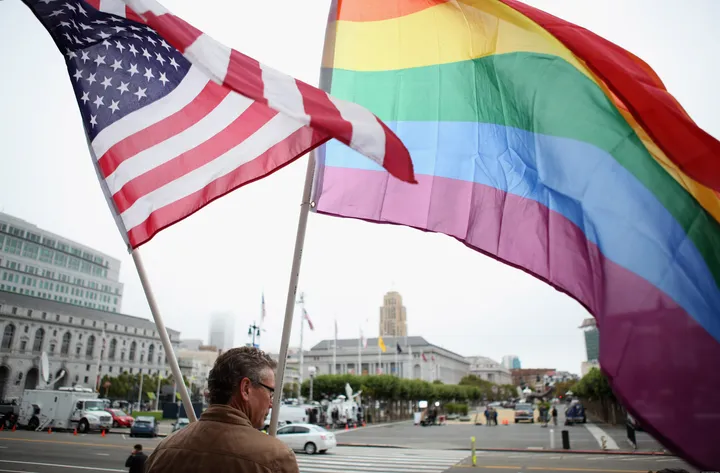
In the wake of several suicides of gay teenagers, one response has been through the "It Gets Better" project, which tells the story of gay and lesbians who have a story of hope -- one in which things, over time, got better for them.
That is not my story. I am straight, and though everyone gets made fun of for something, I never faced the relentless teasing, bullying and violence that gay and lesbian kids did and do. In fact, I was a bigot. I didn't take part in violence, but I probably did bully and tease other kids in school, given my attitude toward gays and lesbians when I was young. I know for certain that I did not do anything to stop others from bullying and in that way was complicit with what happened around me.
These actions and inactions were a failure of my faith, both personally and in the failure of the church to teach me anything else. In short, I thought that gays and lesbians (I doubt I knew about bisexuals or transgendered people) were deviant and to be condemned. My bigotry was consistent with what the culture, the church and my friends thought and said, and it was not countered by those who knew better. When I used the word "gay," it was pejorative, and if I thought someone was gay, I kept my distance or worse.
But I got better. I'm not perfect, but better.
What changed? That is simple: A handful of brave men and women changed me, people who were willing to challenge my bigotry through leadership, friendship and warmth.
I went to college at William and Mary, and while I was there I received my first challenge from a brave man that I still have never met. His name is George Greenia, and he is a professor of Hispanic Studies. At that time (1981-1985), William and Mary was a very different place. Despite a significant gay population and underground, it was generally a homophobic culture, which was maintained largely through a lack of public discussion of anything remotely related to the topic of homosexuality. Bigotry, including my own, loves dark places.
This changed because of Prof. Greenia. He, very publicly, began a support group for gays and lesbians despite vicious personal attacks. It was a brave, bold and risky thing to do in Williamsburg, which was essentially a small conservative southern town. I never went to Prof. Greenia's group, but his bold move began to change the way I thought. It was the first time I had ever been part of a community that in any way whatsoever reflected a positive view of gays and lesbians. I began to reexamine my beliefs, and to realize that perhaps they might be wrong.
That process continued when I was in law school at Yale. There, I had a small number of friends who were gay and out. I didn't become friends with them because they were gay. I probably did not even realize that they were gay until after that friendship had been formed. The shape of their kindness was subtle and powerful. At the time, they must have realized that I was a bigot, but they befriended me anyways. This was undeserved grace. Though some of them were not Christian, it was one of the more Christ-like acts I have experienced.
It was these friendships that shook my religious beliefs not only about homosexuality, but my own relationship with God. I had been taught to judge, reject and condemn these friends, but found myself unable to do so. In time, I replaced those teachings with beliefs that reflect the gospels I came to embrace. In those gospels, Christ directs us to harshly judge our own sins, but does not command us to go out into the world and judge those we think are sinners, to change people or to push people away. His command was to love. Are gays and lesbians sinners? It doesn't seem that way to me (other than the way in which we are all sinners), but at some level I really don't care. If it is a sin, it is not my sin. The sin that I need to discern, root out and identify is my own. One of those sins has been bigotry and senseless cruelty. I atone for and seek forgiveness for that now and here.
Mental Health America: Bullying and Gay Youth
Behind the anti-gay bullying : The New Yorker
Schools Battle Suicide Surge, Anti-Gay Bullying - Health Blog ...
'The View' Discusses Gay Bullying - ABC News
YouTube - Joel Burns tells gay teens "it gets better" http://www ...
My Take: Christianity not to blame for anti-gay bullying – CNN ...
Bishop Gene Robinson: How Religion Is Killing Our Most Vulnerable ...
I think this black/white interpretation is close-minded. I respect a Christian who's religious beliefs have led to tolerance. Thank you for sharing your story with us.
---
While I appreciate your personal evolution, you're still part of the problem.
The real point - the point that needs to be hammered home again and again - is that homosexuality is NOT sin. It is NOT a moral issue.
Anyone who says "if it is sin" is still re-upping his membership in the Flat Earth Society.
Really, as a person of good will, you just have to be willing to allow your memes to shift here. You have to be willing to acknowledge the obvious: Our current knowledge from science, as well as our empirical observation of responsible homsexual individuals and couples, make the conclusion obvious and inescapable to any thinking person. Homosexuality is not now, nor ever was, a sin, a moral evil or an abomination - any more than the sun ever revolved around the earth.
---
I'm not missing his point at all. He's come to think that Christians are supposed to deal with the log in their own eye, not the splinter in the other guy's eye, to borrow the words of Jesus.
And I'm telling him that the very fact that he calls what he sees, when he looks at a homosexual, a splinter means that he's still part of the problem.
My neighbor's homosexuality isn't a splinter in his eye. It's not a moral defect, much less an abomination. It's his natural gender attraction, just like my natural sexual attraction is heterosexuality.
The science at this point is conclusive. And so is the empirical evidence of countless homosexuals, whose lives as partners and parents is as good, or better, then their hetero counterparts.
So anyone who sees the homosexual through the moral lens of the Bible, as the blogger still does, hasn't yet completed the journey away from anti-homosexual bigotry. He's merely substituted a soft version for his previous hard version.
And that's exactly where I am challenging him. He says that he USED to be a bigot. I say he hasn't yet gotten off the bigotry bus.
God bless.
-Brandon
When Christ walked the earth, at that time, anyone who committed, adultry, one was stone to death, by those who also called themselves believers (Christians). No different then what so called Christians are trying to do to others, who call themselves anti-gay? Christ taught us all, with the woman of adultry, that those who professed, such righteousness, were not righteous themselves also. Nor that sinners, can judge sinners, for all were sinners.
Christ said: Those without sin, throw the first stone. No one could, for all knew in their very hearts, Christ knew all their own sins. Sin is sin and all sins separate us from God. Adultry then is like what others are trying to do now, for those who have the right to choose, in ones own personal life. t
This isn't bashing, it's pointing out the flaw in their belief, that it is based on making the world resemble what they believe than what it actually is.
What is Truth? Anti-gay "christians", do you remember that question? Do you remember the answer? You better not answer that except to say it was silence. Jesus did not answer it. Ever wonder why?
Perhaps because it was standing before the face of a man blinded by his own "truth"; standing there in reality, not coming from a book of ancient writings written by MEN (!) who, by today's standards would be considered ignorant, essentially illiterate, superstitious and mentally suspect.
Is your answer to the question The Bible, or Jesus? Regardless of what you may wish to think, they are not the same.
I know the professor said this with sincerity and respect. Thank you, but it's misplaced.
Some gay kids handle this dissonance differently than I did. Some of them put more value on their respect for loved ones, and try to agree with them, internalizing their homophobia. "I trust my mom, my mom says gays are abominable, I'm gay, so I must be abominable." Convinced of that, they commit suicide.
If you're looking for Christ-like behavior, it's right there. They didn't just love those who hated them -- their loved ones (unwittingly) emotionally *crucified* them. When these poor kids died it was for the sins of others.
Homosexuality is not a choice anymore than heterosexuality is a choice. I'm sorry if this fact does not make sense to you.
As an atheist, I offer that the Gordian knot is best cut by understanding there is no God, just people who claim to represent him. Good people like the author experience cognitive dissonance over the bigotry in the Bible, and they know it doesn't seem like something God would care about. They're entirely correct, though their faith makes it hard for them to understand why.
As a gay man, I appreciate this phenomenon on deeper level. Every gay person has had to learn how to love homophobes. In our youth, as we were discovering that we were gay, we also learned that the people we love -- parents, siblings, or friends -- hated gay people. But love and trust go together; how do you handle it when someone you trust says you're despicable?
So I feel some connection with the author, trying to reconcile his trust in God with evidence that God is a bigot.
I got by by realizing that people don't always mean what they say, and also that people could be dead wrong on one issue but still be good people. Bigots were actually good people acting on bad information, and I could love them despite their mistake. Unfortunately, that excuse won't work for God.