A few weeks ago, I drove about an hour from my home in Upstate New York to Dimock, Pennsylvania. Dimock is a tiny town in the midst of green fields and sloping ridgelines--the kind of bucolic countryside that drew me to this region over a decade ago. But now Dimock represents a future I dread.
More than 60 natural gas wells have been drilled into Dimock's fields and dozens more are on their way. In the meantime, wells have exploded, drinking water has been contaminated, and radioactive water sits in holding ponds on farmers' land.
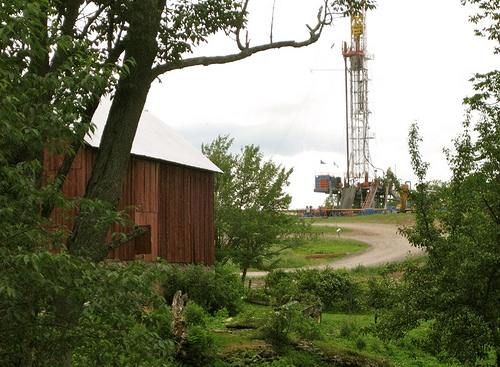
This industrialization of Pennsylvania's rural countryside is part of a natural gas gold rush that has descended on the Marcellus Shale--a formation that stretches from West Virginia all the way to New York State.
To get to the natural gas buried in the shale, companies do something called hydraulic fracturing, known as fracking. They drill down and inject fracking fluid--a mixture of water and some of those 590 chemicals--into the well at high pressure to blast the rock apart and release the gas.
Like most gold rushes, this fracking boom is pretty lawless. A loophole in the Safe Drinking Water Act exempts it from all regulation. This isn't even a case like the Deepwater Horizon disaster in which BP disregarded the rules. There simply aren't any fracking rules for companies to follow. The results speak for themselves.
When I traveled to Dimock--along with some experts from NRDC, Riverkeeper, and Catskill Mountainkeeper--we visited one farmer who had three wells on his property. Each well head had one or more giant pieces of equipment used to bring up fracking fluid, big feeder pipelines, and huge wastewater tanks. I couldn't believe how loud the whole operation was. What used to be a quiet farm was now an industrial site.
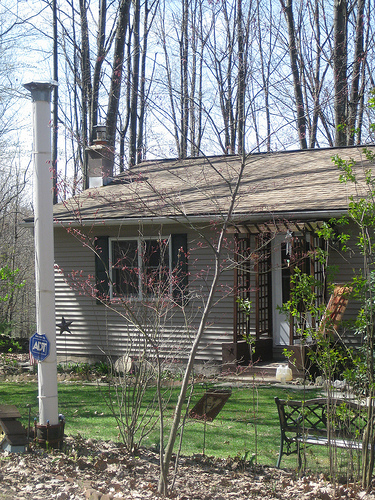
I visited one of the residents downhill from one of these wells. His drinking water is now contaminated. The gas company had to install a huge filtration system in his basement, but still his water isn't safe, so the company trucks it in.
I asked the guy how the deliveries work, and he said, "They come whenever they want to. They open my garage door without asking and fill the tank up." This man has a little boy who is afraid of the methane gas coming from the wells. He asks his father, "Are we going to wake up tomorrow?"
People like this family have nowhere to turn. The state agency supposed to oversee the drilling is what you call a captured agency: the people regulating energy companies are also supposed to promote gas permits. You can't do both at the same time.
We all know how well that worked in the Gulf.
It would be easy to lose hope. Especially after regulators failed to protect Americans from BP, from mortgage meltdowns, and here in my corner of the world, from fracking. But I am not ready to give up the fight, and here is why. I have traveled to Albany to talk to elected officials. It has taken many trips, many conversations, many citizen activists, but I have seen the tide slowly turning. Some politicians are starting to realize that letting industry run roughshod over the state may not be good for New York. There is increasing support from both political parties for a bill pending in the statehouse that would place a moratorium on natural gas drilling in New York until May 15, 2011. Our representatives must protect New Yorkers and pass it this week while we're in special session. We must learn from what happened to Dimock, and all of us have to keep the pressure on until we get the safeguards we need.
But this fight isn't just about what happens to Dimock or even New York State. It's about how we want to live for the next 30 years. Do we take the dirty-energy money and run and screw the consequences? Or do we build something more sustainable that doesn't hurt the people around us? Which do you choose?
This blogger also appears on NRDC's OnEarth.org.
Follow Mark Ruffalo on Twitter: www.twitter.com/mruff221
http://shahzebelahi.wordpress.com/
Sure we all took the money...but that was two years ago and stories like these were not as plentiful then. Or maybe just not as visible. There were a lot of people bringing issues to the attention of property owners, but the bottom line was that enough people would grant leases to the O&G companies (hey, free money!) and those who refused would just not have gotten the money. The companies were going to get the gas even if you didn't sign...it's not like there are property boundaries one mile down. So the reality is that everyone signed, some reluctantly, some enthusiastically, but everyone signed.
Now that the wells are going in (there are already 14 operational in Fort Worth, along with benzene releases, etc.) many of the true believers are looking a little sick at the thought of what they've (we've) done, all for a few thousand dollars. It wasn't worth it. The health concerns, the environmental damage, the visual damage. It so wasn't worth it. Good luck in NY.
For health and environmental science, action links, and radio interviews (including an upcoming program with Mark Ruffalo) please sign up for my free ezine at: www.healthjournalistblog.com
Organic Hemp Clothing - LoveToKnow Organic
May 3, 2010 ... Great for the environment – hemp is literally a weed, requiring very little water or fertilizer to grow well. This makes it much easier to ...
organic.lovetoknow.com
Yeah, that was the result of the George Bush 2005 energy act which exempted fraking from the Safe Drinking Water Act.
"We've got to get it right," said Sen. Bob Casey, D-Pa., a sponsor of the so-called FRAC Act, which would repeal the 2005 exemption and require regulation of fracking by the EPA under the federal Safe Drinking Water Act.
http://www.awwa.org/publications/StreamlinesArticle.cfm?itemnumber=54927
Weld County (Colorado) commissioner Barbara Kirkmyer said she prefers that local authorities regulate fracking, and added, “To my knowledge, we have not had one incident of groundwater contaminating caused by hydraulic fracturing” of 20,000 producing wells in the county.
Several regulators supported the safety arguments. David Neslin, director of the Colorado Oil and Gas Conservation Commission, and Richard Marble of the Wyoming Oil and Gas Conservation Commission, said there have been no verified incidents of water contamination related to fracking. Both agencies have tightened regulations in the last two years.
A well blowout in Clearfield County, PA on June 3, 2010 sent more than 35,000 gallons of hydraulic fracturing fluids into the air and onto the surrounding landscape in a forested area. Campers were evacuated and the company EOG Resources and the well completion company C.C. Forbes have been ordered to cease all operations in the state of Pennsylvania pending investigation. The Pennsylvania Department of Environmental Protection has called this a "serious incident"………….
It has been reported that the hydraulic fracturing industry has refused to publicly disclose, allegedly due to intellectual property concerns, the specific contents of the fluids employed in the fracturing process. A "NOW on PBS" episode aired in March, 2010 introduces the documentary film Gasland. The filmmaker claims that the chemicals include toxins, known carcinogens and heavy metals which may have polluted the ground water near well sites in Pennsylvania and Colorado. The film also makes a case for explosive gases entering private wells, causing "flammable water." A 2008 newspaper report states that medical personnel were inhibited in their treatment of workers injured in a fracturing accident because they did not know which specific chemicals were used. In the article, a nurse claimed she may have been exposed to the unknown chemicals on the patient’s clothes.[23]
Your generalization makes it sound like each case of drilling carries a death sentence for the population. If that is true then it seems strange that there is not more outrage at the gas roots level.