
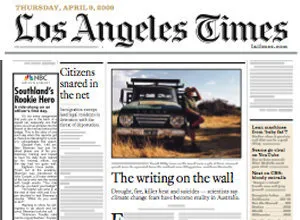
Much has been made of the fact that, within two weeks, we have two movies that deal - if only indirectly - with the crisis in newspapers that is threatening contemporary journalism as we know it.
In last week's State of Play, Helen Mirren, as the editor of the Washington, D.C., newspaper where Russell Crowe and Rachel McAdams work, admonishes them about the fact that the paper has new owners - and they want stories that sell copies. The implication is that the bottom-line-oriented business people who have taken over the nation's print media are more interested in profits than truth, in making money than serving the public trust.
In this week's The Soloist, Robert Downey Jr., as real-life L.A. Times columnist Steve Lopez, watches as one colleague after another packs his belongings into boxes and is escorted from the building by security guards after being downsized. Lopez himself - and his ex-wife/editor, played by Catherine Keener - never seem in danger of a similar fate, but it's still disconcerting to see it happen to friends.
Still, as canary-in-the-coalmine moments go, these movies are pretty tepid, because movies have such a long lead time. It's one thing for Law & Order to pull plots from the news and rewrite them as crime drama - and even then, there's a lag time of months. With movies, however, the lag is measured in years.
Which means that whatever these movies are showing about what's happening to newspapers, it's much, much worse at the moment. Indeed, if you read the headlines, print media is pretty much on life support.
This seeming death spiral has been in the works, in fact, since the turn of the century. I remember hearing, when I still worked for a daily paper - and it's been five years since I left - that newspapers were losing 10 percent of their circulation per year. In fact, that figure has snowballed.
What these movies don't show - what they don't seem to get - is how much of this has been brought on by newspapers themselves. Yes, part of it is the Internet and newspapers' blindness to what it represented, both as competition and as a business opportunity. Newspapers shot themselves in the foot by ignoring the web until it had all but swallowed print media's business model whole and spit out the pieces.
Another part, of course, is that newspapers - once considered a public trust, the way network TV news once was - have fallen into the Wall Street trap. Live by the profit margin, die by the profit margin. TV news is no longer about news; it's about ratings. So are newspapers, at this point, the ratings system being the daily Dow Jones figure.
But even before I left newspapers (for magazines, then for free-lancing), it was apparent that they had lost their sense of who the audience was, why it read a newspaper and how to continue to attract it.
And they're still making the same mistake.
For the rest of this post, click here to reach my website: www.hollywoodandfine.com.