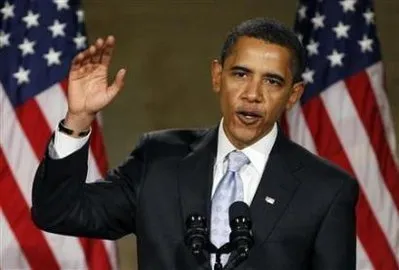
"We will restore science to its rightful place." That's the line I didn't see coming.
Anyone watching the backgrounders leading up to the inaugural knew that the incoming President would call for "a new era of responsibility." His call to service, to find meaning in something greater than ourselves, was telegraphed by the day of voluntarism he declared in memory of Dr. Martin Luther King, Jr.; and foreshadowed by two years of reminding crowds that government can only do so much; and made inevitable on the day that his predecessor, instead of asking for sacrifice in the wake of September 11th, told the nation to go shopping.
We rightly suspected, too, that he would declare "that the stale political arguments that have consumed us for so long no longer apply," that he would "proclaim an end to the petty grievances and false promises, the recriminations and worn out dogmas, that for far too long have strangled our politics." We might not have known that he would use First Corinthians to drive the point home - "the time has come to set aside childish things" - but to hear the political-media industry nailed as infantilizing was to situate the bloviators and bullies right in the middle-school playground where they belong.
We also knew, going in, that he would acknowledge the real and serious and many crises facing the nation, the "gathering clouds and raging storms" temporarily masked by the sunshine and celebration on the Mall. And though we couldn't guess the words he would use, we knew that, like FDR and Lincoln before him, he would say about those challenges, "Know this, America: they will be met."
Less easy to predict was how he would handle the human rights disgrace his predecessor bequeathed him. As it turned out, he did not mince his words, nor did the cameras hesitate to focus tightly on George W. Bush's face, when the new President said, "We reject as false the choice between our safety and our ideals.... Those ideals still light the world, and we will not give them up for expedience's sake." True, he did not use the word "torture," but no one listening - at the Capitol, across the country, and around the world - could miss the rebuke.
But the jab that really took me by surprise was the repudiation of eight years of know-nothingism. The politicization of science at the behest of corporate despoilers of our land, air and water, and in the service of religious fundamentalism, constitutes a shameful legacy of greed and anti-intellectualism. On issues from stem cell research to climate change, from abstinence education to mercury pollution, the Republican war on science, as author Chris Mooney aptly names it, has spun the facts to fit the agenda.
It was bad enough that George W. Bush, as part of his effort to leave no child behind, wanted schools to teach the phony controversy between evolution and creationism. It was worse that the scientific method itself - an epistemology that puts evidence above ideology - was under assault. Worst of all is the cost to society of precious time lost, of medical discoveries not made, of scarce natural resources not conserved, of reproductive rights not protected, of planetary damage not contained.
There was another, related line in the inaugural address, that came after the promise to restore science to its rightful place, which I found, in a quiet way, breathtaking. "Our patchwork heritage is a strength," it began, and what I expected would follow was a list of faiths. But the line's punch did not come from the inclusion of Islam. It came from how it ended: "We are a nation of Christians and Muslims, Jews and Hindus - and non-believers."
Non-believers! For eight years, the now-departed Administration's media enablers on cable and talk radio have spat out the phrase "secular humanists" as if it denoted a species worse than communists, a traitorous fifth column of un-American doubters determined to destroy our Republic. And now, finally, we have a President unafraid to declare that skepticism and rationalism have just as legitimate a claim on the public sphere, and just as privileged a place in private hearts, as any other approach to the mysteries of the cosmos.
I would like to think, though I am sure I am entirely imagining it, that the Chief Justice of the Supreme Court feared that something like this was coming when he flubbed the oath of office. "I, Barack Hussein Obama": he got that part right, and when he said it, and the new President repeated it, an electrifying message of change was delivered to billions around the globe.
But Chief Justice Roberts, when his big moment came, just couldn't get right the words prescribed in Article II, Section 1 of the Constitution. "I will faithfully execute the office of President of the United States," the document says, but that word "faithfully" gave him a whole heap o' trouble. He tacked it on at the end, and you could see on his face that he knew he was messing up, and you could see on President Obama's face, too, that he knew full well that "faithfully" was not where it belonged, but he graciously followed the Chief Justice along and repeated the error.
George W. Bush did not faithfully execute the office of President of the United States. He spurned the checks and balances of the Constitution; he sanctioned torture; he criminalized dissent. My saying so is, I know, not an entirely forward-looking post-partisan sentiment. But there will be something deficient in this new era of responsibility if it abandons that old value, accountability. This is not about score-settling; it is about distinguishing true from false. It is comforting to know that in the years to come, the difference between right and wrong will not be based entirely on faith.
(This is my column from The Jewish Journal of Greater Los Angeles. You can read more of my columns here, and e-mail me there if you'd like.)
Really? Do you have some examples of this?
MONTGOMERY, Ala. — The former governor of Alabama, Don Siegelman, was ordered Thursday to be released from prison on bond by a federal appeals court, pending his broader appeal in a bribery conviction last June.
http://www.nytimes.com/2008/03/27/us/27cnd-alabama.html?hp
Rove did it, and the prosecutor admitted it.
Time and time again the war on our citizens remains unsounded, because it is not politically correct. Few people are armed with facts, and few could argue that the effect this war has on our society cuts deep into the core of all the other issues brought up today.
America holds more people in prison then any other nation.
1 in 100 Americans are in jail or prison, up from 1 in 184 in 1998.
The private prison industry now boasts trade on the stock market, based on inmate numbers.
Millions of mentally ill roam the streets, fill our prisons, clog our courts. Non-violent drug offenders take up almost half our prison funds.
All the technology in the world means nothing if our citizens are in prisons instead of hospitals or classrooms. All the great jobs mean nothing if you must lock your doors for fear of addicts coming to steal your silver.
There has been a battle against science, education, common sense and intelligence. But failing to address our criminal justice system and ancient views on drug policy has a far greater consequence than many other issues that seem so pressing. Our failure to even discuss the issue shows how deep the influence ignorance has had on our society.
It's outrageous and needs to be addressed.
I couldn't agree more.
I was glued to the TV most of the day and loved every minute of it. It is fantastic to have hope again, be proud of the country again, and for once have a loving family in the White House.
No. Agnostics simply ask for proof to spike everyone (we have a wicked sense of humor), but as an agnostic I wouldn't expect to ever be presented one. The difference to an Atheist is simply one of insight: the concept of God falls outside of the realm of logic and can therefor neither be proven nor dis-proven. The Atheist statement that "There is no God." therefor ends up in our GIGO can just like any religion that posits some higher form of being (not all religions do that, so one has to be careful not to throw all belief systems into the same category).
Wiccan, far out! How's the holy couple doing and what's cooking in the pot today?
There's a way to talk to people of faith about science and get them engaged without insulting them, because once you do that, they aren't going to listen to anything else you have to say, and may even come to the conclusion that supporting science makes people condescending and unfeeling, which of course isn't true. But you've insulted almost everyone of faith who you've debated with here, and what good do you think that does if promoting support from the public for science is an important goal for you?
I'm not implying that you should sacrifice the truth for politics, but rather to try to keep the superciliousness out of your rhetoric when you're talking about science with people who you know are reasonable, but simply are not familiar with the architecture of the scientific establishment or the processes of science because their backgrounds were different than yours. Science doesn't ask to be defended thusly, and knowing the best means to the truth that we've found so far doesn't make other people who are not yet versed in that structure lesser beings.
http://books.google.com/books?id=7utk9yd_NZYC&dq=The+Republican+War+on+Science&printsec=frontcover&source=bn&hl=en&sa=X&oi=book_result&resnum=4&ct=result#PPA26,M1
Maybe we should be rising to the call instead of hauling out the usual insults and cliches. A chance to discuss the issue of science and society in an intelligent and reasonable way doesn't come along very often. At least not in cyberspace.
http://video.google.com/videosearch?q=%22President%27s+Guide+To+Science%22&emb=0&aq=f#
Oh.
We will go though the motions, as we do with other misconceptions of reality like a flat earth. It took 14 years after the law was enacted to desegregate the last public school.
It will take another 25 before a President can stand up and proclaim humanity as his faith, rather than religion.
Finally we have a president who sees the importance of coming together in common purpose, not just here at home, but all around the world. Finally we have a leader that recognizes, as we can see in extreme parts of the muslim world, for example, the consequences of succumbing to extremism and suppressing progress. Finally!
For those who don't know, Dispensationalists are Christians who want to "precipitate" Armageddon thereby preciptating the "Rapture" in their life time.
Known Dispensationalists are Hagee, Pat Robertson, Warren, Dobson, and the like. These guys sssssoooooo fear death that they live in a fear-induced dream world. Their fear was manifest for all of us to see from their rejection of science, to their embrace of torture and the patriot act, Intelligent Design, the list goes on and on.
Well guys, death is going to get you no matter what you believe, there is no escape, no salvation via the rapture. All you have is TODAY.
To think that some bronze age myths of an enslaved people (The Jews) could create so many problems even today. The three Abrahmic Religions, Judaism, Christianity, and Islam are the single biggest obstacle to our future welfare as a species.
Clearly it is time for humanity to "GROW UP" and face the music, religion is the unneeded organ, like your appendix, that was made obsolete by evolution. Science and the truth about our human condition is by far the greater story and will inspire greater humanity in all of us.
But to get there we have to give up the feather, the crutch, the Santa Claus, and live in TRUTH.
Lets start today.
Anyway, I thank all who express themselves here. And who help me to think my way to something positive to say about my stand--and not just be against something (atheist, for example). I offer this: I like the term "free," as in "this clinic is smoke free." Thus I am church free and religion free.
I do believe in enchantment. I may not believe in god, but I do believe in gosh.
Space Exploration & Astronomy are NOT science? Could have fooled me!
Thomas Jefferson said "Question with boldness even the existence of a god -- for if he exists, he would more approve of the homage of reason than that of blindfolded fear." No evangelist today would recognize that as an American sentiment -- but it is.
Jefferson was not an atheist, true, but he was something just as bad in the eyes of modern evangelicals: Someone who denied the divinity of Jesus and felt that god was a remote presence with little actual effect here on earth.
Have you not heard of the Jefferson Bible? He took out all of the miracle bits as he regarded them as stuff and nonsense. Jesus in this version is nothing more than a wise man.
No evangelist today would recognize Jefferson as a Christian. They probably would declare him to be an atheist.