I love being an American mom, but guess what, being a mom is even better for women in several other countries around the world. In the world's best place to be a mother, I could expect an extra year of life and I would have enjoyed a year of paid maternity leave after the birth of each of my children. Plus, my own daughter would be expected to complete an extra year of school -- for a total of 18.
What is this top-ranked country I'm talking about, where 40 percent of national elected officials are women (as compared to 17 percent here) and maternal and child mortality rates are among the very lowest in the world?
If you guessed it's somewhere in Scandinavia, you'd be right. According to the State of the World's Mothers 2011 report, released today by Save the Children, Norway ranks as the world's best place to be a mother.
On the other hand, in the world's toughest place to be a mother, I am far better off than the typical mother there. Frankly, there's a good chance I'd be dead; I've already outlived this particular country's female life expectancy of 45. And as the mother of four, it's very likely that one of my kids would have died from a preventable cause, like pneumonia or diarrhea. One in five children there dies before turning five.
In this bottom-ranked country, girls only complete an average of five years of school, and access to the most basic health care is extremely limited. Imagine giving birth alone or with only a neighbor or relative at your side. In the country I'm talking about, 86 percent of mothers deliver this way. As a result, pregnancy complications kill one of every 11 women.
Any guesses where this country might be? Eight of the 10 worst places to be a mother in the rankings are in Africa, but not this one. It's a country that's been at war for almost a decade, and civilian casualties are rising. Even so, women in this country -- Afghanistan -- are 200 times more likely to die during childbirth than from bombs or bullets.
Here's a snapshot of the 2011 rankings of 164 countries analyzed in the Mother's Index:
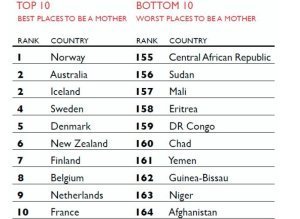
The United States not only didn't make it into the top 10 -- again -- it actually dropped three spots from last year. We come in at 31st place, a rather embarrassing finish for the wealthiest nation in the world. Although American women face significantly lower health risks than their counterparts in developing nations, the U.S. maternal mortality rate is the highest of any industrialized nation. Indeed, one in 2,100 women die from pregnancy-related causes here. One reason for this is that many American women don't get proper care for pre-existing conditions like diabetes and high blood pressure that increase the risk of complications.
(You can find the full rankings, the complete State of the World's Mothers report, and a ViewChange.org TV special about the report here.)
While the situation for moms in the bottom-ranked countries is quite dismal, there is good news to report. Death rates from preventable causes are dropping. The United States has been both a scientific and financial leader in the global movement to improve maternal and child health, playing a major role in reducing global child deaths from more than 12 million to 8 million a year in the last two decades. Around the world, maternal deaths have also dropped by more than a third since 1990 -- to about 350,000 a year.
Having visited both the best and worst countries on the list, I'm among those asking Congress not to slash the measly 0.5 percent of the soon-to-be debated 2012 federal budget that goes to poverty-focused development and humanitarian assistance. The rewards are enormous in terms of lives saved and benefits to the United States itself.
But don't take my word for it, check the economic case for investing in moms and kids as made by in the State of the World's Mother's report by former Xerox CEO Anne Mulcahy. Or read the national security case as laid out by a U.S. military leader who until recently directed counterinsurgency training in Afghanistan. Best-selling authors Rick and Kay Warren, famed bioethicist Peter Singer, actress Jennifer Garner, political leaders, public health experts and a Texas mom with an inspiring personal story are also among those speaking up for mothers around the world.
Let's hope next year's Mother's Index reflects a continuing improvement in conditions for motherhood at home and abroad. It's no time to give up on mothers and their children!
Check out this public service ad Save the Children created in partnership with the Ad Council: