Featuring fresh takes and real-time analysis from HuffPost's signature lineup of contributors
Mary Ellen Biery

GET UPDATES FROM Mary Ellen Biery
 

Slow Payers Hurting Companies' Cash Flow, Hiring

Posted: 06/08/2012 3:38 pm

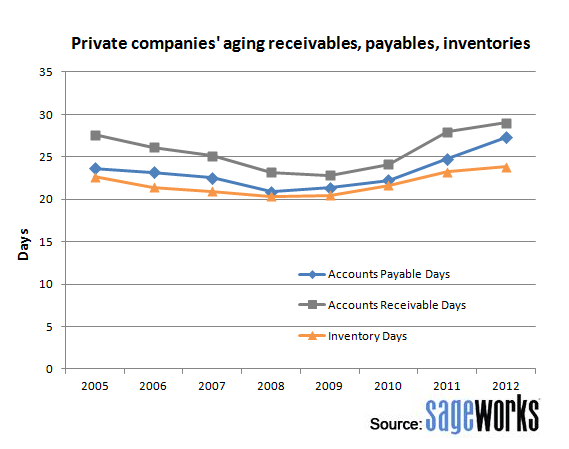
Later customer payments and slower moving inventory have combined to tie up private-companies' cash 16 percent longer than just three years ago, according to new data from Sageworks Inc., a financial information company. That's money companies don't have in the bank to hire or buy new equipment, even though sales and profit margins this year are up.

Sageworks conducted a financial statement analysis of private companies across all industries and found that the average age of companies' accounts receivable has increased to 29.02 days this year from 22.83 days in 2009, a 27 percent increase.

Meanwhile, the number of days inventory stays in the system has risen 16 percent, to an average of 23.82 from 20.49 in 2009. Inventory days is a ratio showing the length of time between the purchase of raw materials and the sale of finished goods.

"Their cash is tied up in inventory as well as receivables, and that has a significant effect on cash flow and consequently, a significant effect on how much they can use for capital expenditures or new jobs," said Michael W. McNeilly, Sageworks' director of advisory services.

To be fair, companies in Sageworks' analysis have slowed their own payments to vendors. The average age of private companies' accounts payable examined by Sageworks is 27.32 days this year, compared with 21.33 in 2009. That 28 percent increase could be a result of the longer cycle for receivables, McNeilly said.

"Payables have jumped in the last three years," he said. "This tends to be a natural step for business owners to maintain some level of liquidity when struggling to pay their bills."

Taking all three metrics into account, private companies have cash tied up for an average of 25.52 days, compared with 21.99 days in 2009. That's a difference in the cash conversion cycle of 3.5 days, or 16 percent.

Obviously, cash trends can vary by industry and other factors. And the average accounts receivable days and the average inventory days have each increased to a smaller degree this year than in 2011. Nevertheless, these follow sizable jumps in 2010 and 2011.

"So far this year, companies on average have seen a smaller increase in accounts receivable days, which is hopefully a positive sign that business owners are getting a handle on the receivables," McNeilly said.
2012-06-08-agingreceivables.png

It's unclear what effect the longer operating cycle has had on employment at private companies, which drive more than 50 percent of GDP and more than 65 percent of new jobs. Accountants, bankers and other professionals who work closely with private companies say their clients aren't hiring more quickly because they're too nervous about the future, according to a recent Sageworks survey.

But McNeilly noted that a longer operating cycle can make business owners more conservative about future spending, even when sales and profit margins are improving.

"Regardless of how much revenues increase, if cash is tied up, that's going to influence how one is willing to grow a business," he said. "In this scenario, a business owner might not have the same cash in the bank that's reflective of the revenue growth."


Follow Mary Ellen Biery on Twitter: www.twitter.com/@sageworksdata

FOLLOW SMALL BUSINESS
Later customer payments and slower moving inventory have combined to tie up private-companies' cash 16 percent longer than just three years ago, according to new data from Sageworks Inc., a financial ...
 
 
  • Comments
  • 20
  • Pending Comments
  • 0
  • View FAQ
Comments are closed for this entry
View All
Favorites
Recency  | 
Popularity
07:43 PM on 06/11/2012
Apparently the author has never dealt with the gov't. Their pay cycle is about six months. Our gov't has broken more small companies than all the recessions combined. Wish she had researched that.
04:39 PM on 06/11/2012
WE CERTAINLY ARE A 'SMALL' BUSINESS; HOWEVER, WE DID SERVICE FOR ONE OF THE LARGEST COMPANIES IN THE COUNTRY AND WORTH MILLIONS; BUT, IT TOOK THEM 101 DAYS TO PAY US, AND THEN THE AMOUNT WAS NOT THE FULL AMOUNT AGREED ON.

WHAT A MESS!! WE JUST ASSUMED THAT THE $150.00 THE COMPANY DEDUCTED REPRESENTS THEIR GUESSTIMATION OF 'OVERTIME' CREATED BY THEIR COMPANY'S STAFF DECISION. WE TOOK THE MONEY AND RAN. IT WILL BE A COLD DAY IN H#@L BEFORE WE WORK WITH THIS COMPANY EVER AGAIN ~

AND, THAT IS THE PROBLEM WITH WORKING WITH MULTI-MILLION DOLLAR COMPANIES. THE SMALLER BUSINESS GUY DOESN'T SAY TOO MUCH AS HE WANTS THE CONTINUING BUSINESS OF THE BIGGER GUY, SO HE CHOKES DOWN A LOT OF CRAP.

FIRST, WE GOT THE EXCUSE OF - "OH, WE DON'T HAVE YOUR S.S.#" (30+ DAYS OUT); THEN, WE GOT A PHONE CALL - "WE'RE GOING TO PAY YOU IN ANOTHER 30 DAYS" (60 DAYS OUT). THE CHECK FINALLY ARRIVED AT 101 DAYS OUT. . . . . . .
photo
HUFFPOST SUPER USER
MarshallTalk
An Independent Internet Radio Talk Show Host.
12:33 PM on 06/11/2012
More excuses, lets stop playing games. We need to stimulate New Business and increase demand, which was proposed in the "MarshallTalk Economic Rejuvenation Plan" Google it! Existing companies are not going to hire until demand increases, so we need to give them a reason to hire, and we need to stimute the creation of new businesses. If we just keep accepting these BOGUS reasons for companies not hiring, etc., etc., it will just get worst.

Basically we bailed out the Banks, and we got NOTHING in return. Actually in my opinion we got worst than nothing, because they did the opposite of what they would normally do after they got the taxpayers money. NOW we need to bail out the people, the Bank Bailout didn't work, but the people bailout always works, and will always work, and that is the FACTS!
photo
HUFFPOST SUPER USER
sjser
08:23 AM on 06/11/2012
I was visiting at a prominent university some years ago and I heard this told to a classroom of accountants, and this is close to verbatim: "The way you make money is by using other businesses, particularly suppliers, as your bank. Pay your payables no sooner than 90 days, and try to stretch it out more." I was aghast. And yet, this is what is done, and the small suppliers are carrying large corporations.
photo
HUFFPOST SUPER USER
MarshallTalk
An Independent Internet Radio Talk Show Host.
12:34 PM on 06/11/2012
That is right, however the talking heads don't understand that companies are always playing head games, they only care about one thing, and they complain about everything!
HUFFPOST SUPER USER
irishnbflo
04:28 PM on 06/11/2012
While the Ceo's of the large corporations, still make their bonuses.....
HUFFPOST SUPER USER
frank1946
Tell the Truth
06:31 AM on 06/11/2012
This is a very old Story !

Centuries in fact.
HUFFPOST SUPER USER
cdecisneros
my micro bio is empty because I went to the micro
04:24 PM on 06/10/2012
When they decide to pay us we will pay them. It is that simple. With what do they expect us to pay them with? When Ford opened his car plant he paid his workers enough so that they could afford to buy the car thus creating his own market. Maybe they should try that?
photo
KarmaPatrol
Riverboat Gambler, satellite whisperer. Independe
01:12 PM on 06/10/2012
Accounts payable is the "dirty little secret" of corporate America. Maybe there will be a "50 shades of account receivable" book?
photo
o0oooooo0o
I snowboard in a bikini, so, yeah.. I'm important.
01:04 AM on 06/10/2012
30 days.. what a treat! I own a small business with a good 90% of my clientele being corporate.. and not a single one of them is even CLOSE to being 30 days out. When we get paid in 60 days we feel as if things are zipping right along. Some have gone into 90 or even 120 days.

It's always a handly little trick for companies to not pay their bills for a few months, which leaves them a big stack of cash to point at to impress investors.. all the while hiding the accounts payable side of the books. Happens all the time. And some just tell you flat out.. "We are rolling our accounts payable back another 30 days. Take it or leave it." This, after already rolling it back an extra 30 or 60 before that.

Now, for fellow business people to read this, it's no big news... but for John Q. Consumer.. they have no clue. Nada. They just figure that since they are forced to kiss a boss's butt all day long for a wage (that the law requires is paid on time) that those of us who are self-employed are just rolling in hefty cash and fat times. LOL.. yeah.. right. They are clueless... totally and completely clueless.
photo
HUFFPOST SUPER USER
DomainDiva
Aviation SaaS Entrepreneur and Technical SME
08:46 AM on 06/11/2012
I totally agree. I have been self employed for 18 years, the larger the company, the more well known, the worse the payment schedule. There are a few exceptions but not many.
07:45 PM on 06/11/2012
Man are you right on point. What we need is a mandatory payment law. Good luck with that, huh?
This user has chosen to opt out of the Badges program
10:36 PM on 06/09/2012
Its the "circle of life" baby.
This user has chosen to opt out of the Badges program
photo
06:59 PM on 06/09/2012
Pay as you go. Save up a nest egg for retirement. Those who do not have a pension, buy only the absolute necessities. Pay off debt. Save, Save, Save. Personally, I can't keep the economy going NOW and later to support myself on SSI into the future any other way. The chart above shows inventory remains in warehouses longer than necessary. Could the corporations be buying more than necessary to avoid paying a higher price a few months later? It just appears to me that there are two separate engines running, dependent on each other but yet, running in opposite directions.
01:07 PM on 06/09/2012
Mary you seem to be an intelligent person so I need some sound advise...I owe doctors and hospitals over $300,000 since I could not afford to continue my COBRA insurance after being laid off from a great job that went overseas..
How would you handle paying this debt along with my fuel oil bill from this past winter when a person is on unemployment and took his SS at 62 ??? Now this should come pretty easy for you Mary and I look forward to your response asap...And please tell me how to run my car on water since I am a little short on the real struff..Thanks again Mary and keep-up the insanity....
This user has chosen to opt out of the Badges program
10:37 PM on 06/09/2012
I'll be #1
mlp7595
sequester Marxism
12:35 PM on 06/09/2012
If Mary can get Obama and his greedy 50% who Zero, Nada, Zip in taxes and the hell out of my pocket, that alone would speed payers considerably. Many of us are sick and tired of pulling the wagon with a whole bunch of Obama freeloaders watching us work. Time for everybody to get out and pull...
01:12 PM on 06/09/2012
Mary also said the "Private Sector Is Doing Fine" like Obama said yesterday...Add her to the wagon also and I'll bring a back-brace for the both of us.
photo
HUFFPOST SUPER USER
Rochelle MacDonald
Living life at the legally accepted maxium speed
03:55 PM on 06/08/2012
This could be the result of wider adoption of software such as Quickbooks by small businesses. It just makes fiscal sense to pay later rather than sooner.
photo
HUFFPOST SUPER USER
Rochelle MacDonald
Living life at the legally accepted maxium speed
03:54 PM on 06/08/2012
It is good business practice to pay a net/30 account as close to the due date as possible, leaving cash available to the debtor to use in other areas. If this is such a big deal, perhaps big businesses should consider offering more attractive terms to encourage early payment or just reduce the terms to net/25 instead of net/30.