
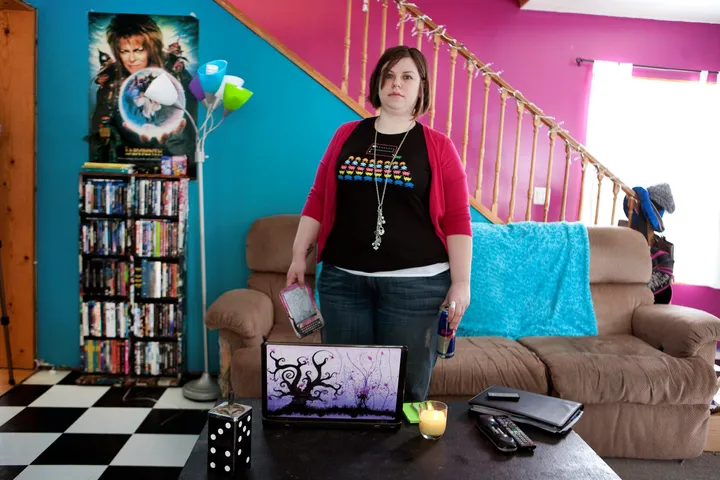
Amanda Hocking, self-published, prolific author of young adult paranormal novels, recently became the 14th writer to join the "Kindle Million Club," having sold over 1 million copies of her e-books in the Amazon.com Kindle Store.
Hocking is seen as a trailblazer and inspiration for struggling writers unable to acquire book deals with traditional publishing companies.
After Hawking sold hundreds of thousands of copies of her self-published e-books, the same New York publishing companies that had originally rejected her joined in a "heated auction" to purchase her next series, which eventually sold to St. Martin's last March for over $2 million.
Hocking explained her decision to sell her work to a traditional publisher on her blog (which itself has received 1,724,535 page views).
I want to be a writer," she said. "I do not want to spend 40 hours a week handling e-mails, formatting covers, finding editors, etc. Right now, being me is a full-time corporation.
Hocking doesn't see herself as enemy #1 of traditional publishing houses, which have brought her the work of most of her favorite writers, such as Kurt Vonnegut, J.D. Salinger, and Jane Austen. She doesn't believe her stunning success sounds the death knell of the publishing industry, either.
On her blog she writes,
Ebooks will continue to gain ground, but I would say that we have at least 5-10 years before ebooks make up the majority. And all ebooks aren't self-published. Even if ebooks end up being 80% of the market, at least half of those sales will probably come from traditionally published ebooks. So publishers will still control the majority of the market.
While this may be true, Hocking's stunning Do-It-Yourself success -- which involved years of writing and countless hours marketing her work -- makes it clearer than ever that the introduction of e-readers is changing the publishing industry radically and forever.
Hocking writes,
Here's another thing I don't understand: The way people keep throwing my name around and saying publishers are 'terrified' of me and that I really showed them.
Perhaps what "terrifies" publishers about Hocking is what she represents: a future in publishing in which writers have more agency over their work; and agents and editors no longer stand as gatekeepers between books and their audiences.
Mary Pauline Lowry's novel The Earthquake Machine will be released in February, 2012.
Follow Mary Pauline Lowry on Twitter: www.twitter.com/MaryPLowry
Stacey Barney: Am I Still Digging Publishing?
Mary Pauline Lowry: Art and Adventure: A Manifesto for Women and Grrrls
Martin Perry: The First Step to Becoming an Indie eBook Millionaire
Amanda Hocking ebooks: How an unknown 'indie' authoress made ...
Self-Published Author Amanda Hocking Makes Millions From eBook ...
Authors catch fire with self-published e-books - USATODAY.com
Malcolm
Dr. Michael Provitera, Author of Mastering Self-Motivation
What's terrifying is that there's also no one standing between poorly written books and the audience they shouldn't be foisted upon. Editors and agents DO serve a purpose--convincing those who can't write well to try to improve their writing and make it the best it can be. Some people are natural born writers; most only think they are.
Yes, publishers publish some bad books, mostly motivated by profit. But most self-published books are purchased by family and friends and...no one else. Why? Because they stink to high heaven. Concepts such as point-of-view, grammar, basic storytelling tenets are largely absent in a great many of them.
How do I know? I've judged self-published book contests. Many of the entrants are easily eliminated because of the obvious lack of editing. It's appalling to those of us who do write for a living and take the time to solicit honest feedback and use that feedback to rewrite and polish our work to make it the best it can be.
A million books on Kindle. I've just got to sell about 999,500 to catch up to her,
And on the release date the novel will be available as an ebook for .99 cents.
I'm not trying to be rude. Serious question and respect your answer.
Further, self-publishing doesn't make someone a writer, because they paid someone else money to put it out there rather than convince someone to pay them money for the privilege of putting it out there. The guy who wrote the books that 21 and The Social Network were based on racked up at least 150 rejections before finally selling something, and his first books were X-Files tie-in novels.
Writers like e.e. cummings, Walt Whitman, Marcel Proust and Leo Tolstoy all self-published. Does that mean they weren't really writers?
John Kennedy Toole died unpublished, his work widely rejected. Does that mean he wasn't really a writer, either (even though he post-humously won the Pulitzer Prize for Confederacy of Dunces)? Or did he only "become a writer" after his death because an editor finally recognized the brilliance of his unconventional novel and its anti-hero?
In Steve Hely's How I Became A Famous Novelist there's a bit on how an author's financial success tends to be inversely variable to their works' true literary value. Or didn't you wonder why Jackie Collins was never required reading in school?