iPhone app iPad app Android phone app Android tablet app More

Featuring fresh takes and real-time analysis from HuffPost's signature lineup of contributors
Matt J. Rossano

Matt J. Rossano

GET UPDATES FROM Matt J. Rossano
 

Sacred Brands: Consumerism as Modern Religion

Posted: 12/12/10 07:53 PM ET

The cover of Steve Bruce's book, God is Dead: Secularization in the West, features a busy West Yorkshire street corner where a shuttered church sports the sign "Mike's Carpets." An iconic metaphor for our times: Religion retreating in the face of a relentless consumerist onslaught. With increasing numbers of people being married at Disney World and buried in Harley Davidson coffins, brands as modern religion may not be all that implausible.

In a 2001 Financial Times article, the global advertising firm Young & Rubicam declared that "Brands are the new religion. People turn to them for meaning." They went on to argue that the ad man is the equivalent of a modern missionary. Their pronouncement was not without foundation. Researchers have documented how Macintosh users bear an eerie resemblance to a religious cult: a tight-knit network of emotionally committed adherents, faith in a "savior" figure (Steve Jobs), and a generalized hostility toward an external "evil" (Microsoft, IBM, etc.). At the risk of piling on Apple Inc., another study focusing on Newton users (the now discontinued digital personal assistant) demonstrated how five key religious mythological themes were present among them: tales of persecution, tales of faith being rewarded, tales of survival, tales of miraculous recovery and tales of resurrection. Finally, marketing researchers have noted that relative to the devout, nominally religious people tend to make trendier consumer choices, place greater importance on brand labels and show a greater willingness to try novel products. All of this provides a background suggesting that consumer behavior and brand loyalty may be functioning psychologically in a manner similar to religion.

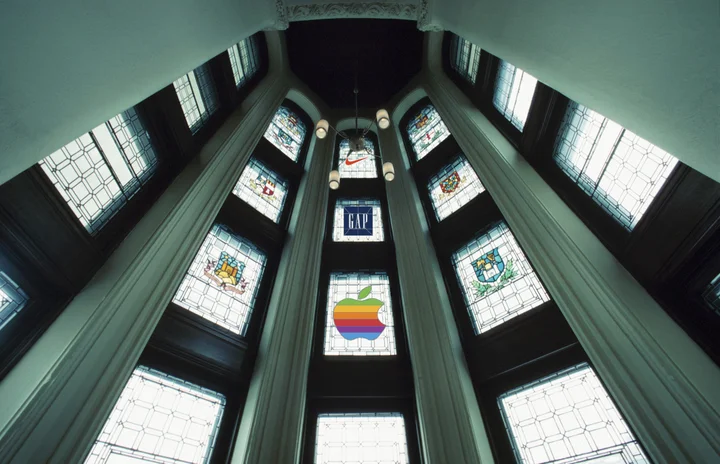
To test this idea, researchers from Tel Aviv University and the Duke University School of Business did a series of studies exploring the idea that religion and brand reliance (investing subjective worth or value in a name brand) serve a similar psychological need -- the need to publically express one's self-worth (Marketing Science). The researchers open with a rough but suggestive field observation: In geographical regions dense in religious congregations and high in self-reported church attendance, the frequency of brand-name stores such as Apple, Macy's or Gap is relatively low. This relationship held even when other demographic variables such as income level, education and degree of urbanization were controlled for statistically. This suggests that where religion is popular, brand names find a smaller market, and vice-versa.

The researchers then did a series of experimental manipulations where they reminded subjects of religious concepts and measured the degree to which this affected their consumer choices. For example, in one study a group of subjects was asked to write an essay on "what your religion means to you personally," while another group was asked to write an essay on "a couple of routine activities that you typically do on an average day." After this, both groups were told to imagine that they were shopping and to pick the product that they would normally buy. They were given a choice between a national name brand product and a store brand product (such as Ralph Lauren vs. Target brand sunglasses). Furthermore, the products represented either self-expressive ones (such as sunglasses) or purely functional ones (Energizer vs. CVS brand batteries). The results showed that subjects who wrote about religion were significantly less likely to choose the prestigious national brand. This difference, however, held only for the self-expressive products, not the functional ones. So if you had religion on your mind while you were choosing between Ralph Lauren sunglasses and Target sunglasses, you chose Target. If you didn't, you chose Ralph Lauren. Religion made no difference, however, if you had to choose between batteries.

This same effect was found when comparing self-reported devoutly religious subjects from those who reported being either less religious or not religious at all. This was done by measuring subjects' religiosity using the Religious Commitment Inventory, a 10-item questionnaire assessing "the degree to which a person adheres to his or her religious values, beliefs, and practices and uses them in daily living." As expected, those high in religiosity were once again significantly less likely to choose name brands but only for "self-expressive" products.

In an attempt to isolate the self-expressive variable, the researchers conducted another manipulation where prior to having subjects make their consumer choices they were asked to think about either the self-worth aspects of religion or the security aspects. In other words, both groups of subjects were thinking about religion, but only one group was thinking about religion's relevance to one's self-worth. The results were as expected: subjects asked to think about religion in terms of self-worth were significantly less likely to choose name brands. Not so for those who thought about religion in terms of personal security. Once again, however, this difference was only found for self-expressive products not functional ones.

I'm sympathetic to the view that humans will, either by design or default, end up worshipping some god, if by god we mean "that to which we willing offer service and sacrifice in exchange for a sense of meaning and purpose." For some, a life without religion is an improvement for them and those around them. Atheists and agnostics can proudly count among their ranks many thoughtful, compassionate people. But human nature being what it is, I suspect that most who drop religion simply move into the ranks of lazy ex-religious people. Sunday mornings formerly spent at church are traded for more sleep or television. The money once earmarked for church coffers now pay green fees. I remain to be convinced that the world is a better place if increasing numbers of people bow at the altar of Gucci, Gap and Lexus rather than Jesus, Allah and Vishnu.


The cover of Steve Bruce's book, God is Dead: Secularization in the West, features a busy West Yorkshire street corner where a shuttered church sports the sign "Mike's Carpets." An iconic metaphor for...
 
 
  • Comments
  • 80
  • Pending Comments
  • 0
  • View FAQ
Comments are closed for this entry
View All
Favorites
Bloggers
Recency  | 
Popularity
Page: 1 2 3  Next ›  Last »  (3 total)
12:59 PM on 12/16/2010
Consumerism is just another genre of false idol worship. It's an attempt by some of those that try to fill their spritual void that can only be truly filled and satisfied by God. There's never enough "stuff" to fill that void.
photo
LintLass
"When you can balance a tackhammer on your head...
09:27 AM on 12/17/2010
As I discussed below, oftentimes religions like that *sells* a 'void' and promises to 'fill it,' ...and that makes it little different. Both in terms of material existence and things like sex, it's a way of creating demand... And selling the idea that people really are inherently-insatiable, and should be ashamed of that, so feel empty, try to fill it, lather, rinse, repeat.....
photo
LintLass
"When you can balance a tackhammer on your head...
09:59 AM on 12/17/2010
...and to add to my other post here, sometimes the best way to not-promote consumerism and power-hungers and jealousies of all kinds is to consider that some things are actually pretty nice. Sometimes the best answer is to realize you really can love what you already have... even what's on your plate before you, instead of thinking ahead to the penitence and or next thing.

To keep saying, 'You're an insatiable void without us, so you want *more of our religion, more self-righteousness, more shame, more control... Because you want more more more of empty sex and things and such, it's your 'fallen human nature,* ...Well, that has a way of becoming self-fulfilling and *making* life empty and unsatisfying, however pliable regarding marketing, both for such religions and for consumerist economic engines.

But the 'material world' and our experience thereof is *not* empty: it's everywhere filled with spirit and soul. One respects it and experiences it, and *then* finds a balance, a fullness, and, not turned in against onesself or into one's own voids and 'holes,' and 'hungers:' *then* finds the Sacred is all around.

And always was.

Of course, in practice, it's not so simple, and there's certainly more to religious experience, but defining 'God' as something found through being insatiable *holes.* Hedonism and greed and related jealousies aren't from *having too much of the 'empty',* they're from never experiencing 'Enough.'
01:15 PM on 12/17/2010
Your points are well taken. While not a perfect analogy, the one that comes to mind is trying to explain the color red to a person that has never had sight. Not only is it impossible to explain, but more importantly the blind person is left wondering, "so what?" "Faith" is difficult to "sell" if the other person (the potential "buyer") is not in the market to buy. That person may not feel any voids at the time and, therefore, is not looking for anything to fill the non-void. The time may come, however, when a "void" is sensed when earthly delights leave the individual wanting for something more meaningful.

Many, thought not all, "earthly delights" are intended to be enjoyed by God. But some are not good for us while others become exercises in excess and futility. Relatively few people will ever sense a spiritual void or come to an awareness and desire to fill it through faith. In the meantime, the world is full of those selling the idols of materiality.

Thanks for your thoughtful response, LintLass.
photo
HUFFPOST SUPER USER
RK Johnston
Good Blood Never Lies...True Love Never Dies!
04:51 PM on 12/15/2010
As a "religion," the Church of Consumerism" isn't all that new.
It's an outgrowth of the Egotistical Eighties, where self was King, money was God, and the twin "Virtues" were avarice and greed.
In fact, many of today's "major labels" (Calvin Klein, for example) were popularized during that time.

Still, I have no loyalty to The Church Of The Brand...for brands, unlike the Truly Holy, have a tendency to much more fickle than any Deity. Plus, the one whom I choose to follow has been around much longer than even Bass Ale (the first trademarked brand, btw).

Still, my beliefs matter much to me, and I do draw comfort from them.
I cannot say the same about Nike, Coca-Cola, or BMW, however.
Oh, well--to each their own!
--RKJ
photo
LintLass
"When you can balance a tackhammer on your head...
11:10 PM on 12/15/2010
Mostly it comes from that Calvinistic sense of American postwar culture (and before) that personal wealth is connected to the Christian God's favor and people's general worth. It goes a lot deeper and further back than just some yupsters coming along. Has a lot to do with class and the like.
05:15 AM on 12/15/2010
"Sunday mornings formerly spent at church are traded for more sleep or television­."

Not for the Athiest with children that's for sure!
11:02 PM on 12/14/2010
I strongly believe that these two "extremes" are VERY related! The people that fall deeply into a brand or a religion, to the point of veritable fanaticism, will tend to choose that over other vices for a reason. They are susceptible to this type of (potentially unhealthy) attachment. Religion could arguably seen as a better attachment than a brand or product, but that isn't necessarily the case. I am very involved in my church and where I have seen this excessive enthusiasm for God, I have also seen a relative "laziness" as it relates to educating and understanding issues on their own merit. The same could be said about brands...if my friends, my peers, people I like happen to like it, then I'm going to like it too. It's easier than taking the time and doing the work to understand it on their own. In both cases....buyer beware! There's no getting around the need to take time to educate yourself and establish your own CONSCIOUS opinion....brands and religions both float an image....an image can be based on fact or fiction!
This user has chosen to opt out of the Badges program
photo
08:42 PM on 12/14/2010
I'm on my way to the bedroom to kneel down and say my 6 hail apples. Later.
photo
Dave24
Without God, life is everything.
03:52 PM on 12/14/2010
It's far lazier to accept what other humans tell you: namely what "God" wants and expects, and that He exists (based on alleged eyewitness accounts, which are just so reliable) in the first place.

It's far lazier to swallow the scriptural BS pushed by scientifically illiterate clergy.

And it's far lazier to accept meaning from some celestial dictator, rather than create meaning for oneself.

The article's premise is factually inverted.
09:52 AM on 12/14/2010
You want people to bow at altars. Why? You have some psychological attachment to social structures in which subordination governs human relations? Helps you feel secure?

Some of us just want to live our lives as equals, our attachments freely chosen, not imposed for prophet or profit.
photo
HUFFPOST SUPER USER
writersbloc
01:29 AM on 12/14/2010
As a non-practicing Catholic (I won't renounce my old faith because my Catholic ID has my best picture on it) I'm of the opinion that Catholicism doesn't have much to offer spiritually, at least not to me. Joseph Campbell and Alan Watts both criticized the Catholic Church for taking the mystery out of the mass. Apparently there was a time when the mass was supposed to take you out of your common experience and place you into center of the divine.

The closest I've come to experiencing this is in the participation of the sacraments, the midnight mass, in the darkness of the confessional, and in the sound of the pipe organ. Otherwise, it seems time spent in mass would be better spent sitting upon the beach watching the ebb and flow.

Plus Catholicism hasn't kept apace very well of social and scientific changes. I guess that's just par for the course when peddling in dogma. How long did it take the Church to accede to Galileo's observations? How long have advanced telescopic optics been around? Rome has all the efficiency of an Italian bureaucracy.

My point is that organized religion may be losing some members because it has nothing spiritually substantial to offer them. Coffee and donuts at mass's end does not count for much in my book, nice as that is. Heck, maybe consumerist religion offers a more profound spiritual experience, which if true indicts organized religion more than the godless masses; It's just a better deal.
photo
LintLass
"When you can balance a tackhammer on your head...
12:50 PM on 12/14/2010
I do suppose that goes back to the question: what form or kind of *religion* is going to see a resemblance between itself and consumerist advertising? :)
photo
HUFFPOST SUPER USER
Smirk
Cake or death.
10:14 PM on 12/13/2010
Perhaps the author will write a companion piece on the overt melding of consumerism and religion (e.g., prosperity preachers).
HUFFPOST SUPER USER
Schweik
09:55 PM on 12/13/2010
My Holy Trinity:

Cartier Tank Americaine.
Hammond B3
Invention of air conditioning.
08:37 PM on 12/13/2010
Making use of the same marketing tactics, will seem to create a link between religion and consumerism but it really is down to using them same psychological manipulations to drive choices that create the similarities between religion and consumerism.
Peer pressure, the repeated message, making the message part of the social environment, creating desirability, creating the fear of losing, targeting the young, using the young to manipulate parents, making it a part family life, making it a part of social life and of course punish those that don't support the product (isolation and ridicule).
So religious zealots and marketing executives, have much in common, both using psychological manipulation to enrich and empower themselves regardless of the consequences for the rest of human society.
This user has chosen to opt out of the Badges program
Larry Motuz
More prayers, fewer preyers.
11:01 AM on 12/14/2010
This is an absolutely excellent comment, worthy of an essay in itself. Thank you.
10:19 PM on 12/14/2010
Excellent comment. I wish that others in our society clearly understood the manipulation that is taking place as well as you've outlined here.
05:07 AM on 12/15/2010
Wait a minute... Religious proselytizers use the bible to recruit new members to their faith and marketing execs use facebook to recruit people to their brands.
Does this mean that Facebook is the new bible? Is Mark Zuckerberg god?
08:07 PM on 12/13/2010
"I suspect that most who drop religion simply move into the ranks of lazy ex-religious people. "

sounds like progress

"Sunday mornings formerly spent at church are traded for more sleep or television."

sounds a lot like progress

"The money once earmarked for church coffers now pay green fees. "

I'm digging it.

"I remain to be convinced that the world is a better place if increasing numbers of people bow at the altar of Gucci, Gap and Lexus rather than Jesus, Allah and Vishnu."

bummer - you were doing so well.
This user has chosen to opt out of the Badges program
Larry Motuz
More prayers, fewer preyers.
11:15 AM on 12/14/2010
"bummer - you were doing so well. " Ditto. Ditto. Ditto. Ditto. Ditto. Ditto. Ditto. Ditto.

The fundamental distinction between good-for-me and good-for-us, with the 'us' grounded within a moral framework which takes both into account, is lost in the consumer versions of 'religion': self-worth/personal security defined in terms of 'goods/commodities" is a shallow, non-binding sense of belonging which brings no sense of fulfillment or authentic belonging. When achievement means 'ability to pay', then those forms of achievement which bolster self-worth, belonging, family, et cetera are lost.
09:26 PM on 12/16/2010
Reminds me of that great line in 'Wall Street.'
"At least I don't measure the worth of a man by the thickness of his wallet."
photo
HUFFPOST SUPER USER
NWBrunette
Blessed Girl
05:52 PM on 12/13/2010
Consumerism is just a distraction from real living. Nothing more. Give it up, breathe, confront your demons, and make some friends. You'll be lot happier. I promise.
This user has chosen to opt out of the Badges program
c-tom
Badges we don't need no stinking badges
05:31 PM on 12/13/2010
So if you drive a BMW you aren't a "good" Christian? Or is this only the case if you drive the BMW because of its brand name rather then because of its qualities as a car?
photo
squat6971
59 *was* divine -- 60? 61? not so much
03:54 PM on 12/13/2010
"I remain to be convinced that the world is a better place if increasing numbers of people bow at the altar of Gucci, Gap and Lexus rather than Jesus, Allah and Vishnu. "

I very much doubt it is an either/or proposition.

I am convinced the world would be a much better place if increasing numbers of people do NOT bow at the altar of imaginary sky-beings.