iPhone app iPad app Android phone app Android tablet app More

Matthew Stein

Matthew Stein

Posted April 7, 2009 | 08:53 PM (EST)

We're Running Our World Like a Ponzi Scheme!


Bernie Madoff sure made a name for himself, didn't he? First he made a name for himself as a "Wall Street Genius" whose coveted firm not only promised, but consistently delivered, extraordinarily high annual returns on investment, even when the economy was down. More recently he made a name for himself as the architect of the largest and most notorious "Ponzi Scheme" in history, bilking investors out of as much as 50 billion dollars!

So what is a Ponzi scheme, anyways? A Ponzi scheme is a fraudulent investment operation that promises, and delivers (at least for a while) exceptionally high and consistent financial returns to investors. These returns are paid to its investors from their own money, and the money paid by subsequent investors, rather than from any actual profit earned by bona fide income generating investments (such as manufacturing, mining, or rental income). In ways similar to "pyramid schemes" or "chain letters", in order for a Ponzi scheme to work, it must continuously attract an ever increasing pool of investment from unsuspecting customers, in order to provide an ever increasing supply of money to draw upon to maintain payments to its ever increasing pool of investors. The trick is to promise such glorious results that the greed factor overcomes its victim's common sense as they turn a blind eye to the fact that the scheme lacks a solid foundation and can't go on forever. It is absolutely critical to the success of all Ponzi schemes that an aura of respectability and impeccability be maintained for as long as possible, for as soon as suspicions spread concerning the fraudulent nature of the business, new investments dry up and the Ponzi scheme collapses, since it has no source of true earned income with which to maintain payments to investors.

So, is it true that we are running our planet like a Ponzi scheme? And if this is true, does it mean that we must inevitably face collapse, as all Ponzi schemes must eventually end in catastrophe?

The illusion that the "Free Market" is the logical savior of our world has been maintained by the promise of riches and an ever increasing standard of living and lifespan that has been demonstrated by the industrialized world for the past several hundred years. On the surface, who can look at the apparent success of America, and not come to that quick conclusion? However, when you look deeper, you will find that this success is built on a business model based upon exponential growth, and that this growth must be fed by a similar exponential growth in consumption of energy, natural resources, raw materials, and in the continuous expansion to new markets. All of this is well and good when the world has an abundant supply of undeveloped lands and unused resources, but it starts coming apart as that same world approaches its natural limits to growth and consumption.

Our world-wide Ponzi scheme got its start with the industrial revolution in Western Europe, and it was colonialism that provided ever increasing sources for the raw materials and markets that kept this giant Ponzi scheme rolling. It spread to America with the colonial takeover of vast untapped resources and huge tracts of lands previously occupied by Native American hunter-gatherers. As America industrialized, its population grew and its resources were drawn down, the giant Ponzi scheme continued to grow through globalization and it continued to feed its ever growing appetite by drawing down the natural resources in the world's oceans, forests, and more remote areas, and by expanding it markets into the farthest reaches of the globe. We are witness to a five hundred year run on this giant ever-expanding global Ponzi scheme, and unless we change the way we are playing this game, that run is now drawing dangerously close to a natural and catastrophic conclusion.

Here is a brief summary of a few current trends that illustrate my point:

1. Trees: About 1/2 of the world's forests are already gone (most were cut in the last 50 years), and a significant percentage of the rest are in trouble. At the current rate of destruction, it has been estimated that the world's rainforests will be completely eliminated within forty years. Trees play a necessary role in stabilizing our planet's weather, atmosphere and soils. A single large mature tree has the evaporative surface area on its needles or leaves equivalent to a 40 acre lake. A process called "desertification" occurs near areas that have been deforested once the trees stop recycling moisture back into the atmosphere to fall as rain somewhere down wind. A recent study shows that deforestation contributes roughly 25% of global greenhouse gas emissions every year.
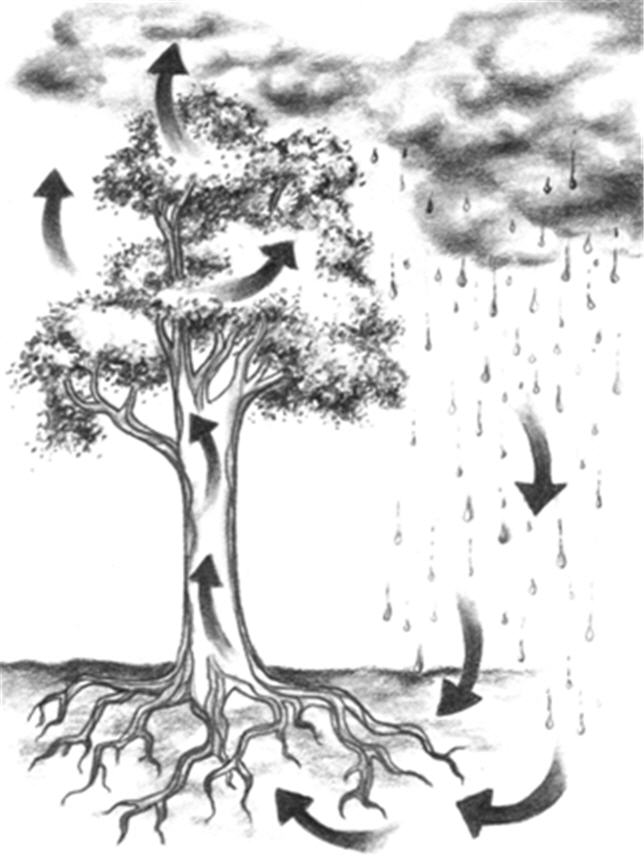
2009-04-05-Treewatercycle.jpg

Figure 1. Trees and their part in the water cycle
(Illustration by Karen Frances)

2. Atmosphere: Global greenhouse gas emissions have increased by a factor of four since 1950. We have been burning fossil fuels for over 500 years, but half of all of those burned fuels have been consumed in the past thirty years! There is a scientific consensus to 90% certainty that these atmospheric changes will result in catastrophic, potentially civilization busting, climate changes within the next 50 years. Even if you do not believe in global warming, data indicates that the increasing concentrations of CO2 in the atmosphere (the primary greenhouse gas) caused by our rapidly increasing consumption of fossil fuels, is increasing the acidity of the oceans, and that if this trend continues much longer, it has the potential to kill most of the planktons, diatoms, and coral reefs of the ocean, knocking out the bottom of the food chain, killing most of the life in the oceans of the world, and destroying one of the legs of our world's oxygen cycle.

3. Oceans: 11 out of 15 of the world's major ocean fisheries are either already in collapse, or are in serious decline and danger of collapse. All large open ocean predatory fish, such as marlin and tuna, are already 90% depleted. By 2004, an estimated 20% of the world's coral reefs had been destroyed (up from just 11% in 2000), an additional 24% were close to collapsing, and another 26% were under long-term threat of collapse. A recent British government report showed a drop in the world's oceanic zooplankton of an astounding 73% since 1960. Zooplankton are a critical element in the bottom of the world's food chain as well as its oxygen cycle.

4. Oil and other fossil fuels: Our modern industrial global machine essentially eats, sleeps, and sh_ts oil. Nearly all of the world's giant oil fields (they produce over half the world's oil) are mature and exhibit declining rates of oil production. In 2008, the International Energy Agency (IEA) shocked the world when it released an authoritative public study revealing that the world's oil fields are declining at an average rate of 9.1%, which is much faster than previously thought. Even with huge capital investments to implement Enhanced Oil Recovery (EOR) methods, this rate of decline would only improve to 6.4%. What does this mean? It means that if our world is to maintain its current rate of oil consumption (our world's recent globalization has been fueled by an annual oil production growth rate of something like 10%), then we would need to find and develop a Saudi Arabia's worth of oil every year for the next year or two from now to eternity--an impossible fantasy!

5. Soil: A third of the original top soil in the United States is now gone. It has been estimated that the world has from 50 to 100 years of farmable soil, using current farming practices. The US has cut soil losses to 18 times the rate of nature's replacement, the developing world averages a soil depletion rate of 36 times natural replacement, and China averages 54 times the rate of replacement.

6. Fresh water: Irrigated land comprises only 16% of the world's croplands, but produces 40% of the world's crop production. Many of the world's major rivers (China's Yellow River, America's Colorado River, the Nile, the Rio Grande, the Ganges, the Indus, the Amu Darya, the Syr Darya, and Africa's Chao Phraya) now run dry, or nearly dry, for significant parts of the year due to expanding irrigation and population demands. Unsustainable over pumping from aquifers is causing increasing salinity, lowering aquifer levels, and failed wells in many of the world's irrigated bread baskets, such as California's Central Valley, the US' giant south central Ogallala aquifer, China's grainbelt middle plains, India's principle breadbasket, North Africa, and the Arabian Peninsula.

If the previous list is not enough to convince yourself that we are operating a giant Ponzi scheme, and that we are running out of new sources of energy, untapped markets, and raw materials to keep it running, then the following two figures should open your eyes.
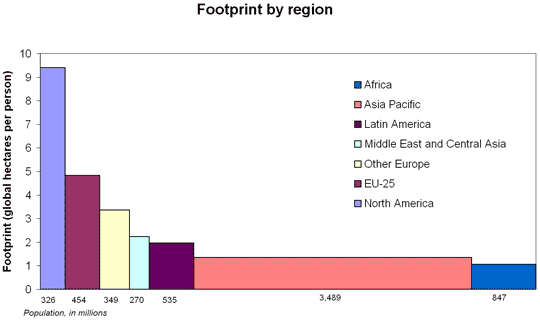
2009-04-03-Footprintbyregion.gif

Figure 2. Ecological footprint by region.
(Illustration courtesy of Global Footprint Network)

Figure 2 depicts a scientifically calculated global footprint by region. What this show us is that if our current planetary population of nearly 7 billion people were to live like we do here in North America, we would need an Earth with 9 1/2 hectares worth of bioproductive land per person to supply us with the necessary raw materials, and to absorb our wastes. Yet we now have only roughly 2.1 global hectares of bioproductive land per person. This means that we would need roughly 4 1/2 earths to support our planet if everyone in the world averaged the consumption levels of North America! Please note that these figures do not account for future productivity losses due to other factors, such as Peak Oil, soil losses, failing aquifers, climate change, etc.
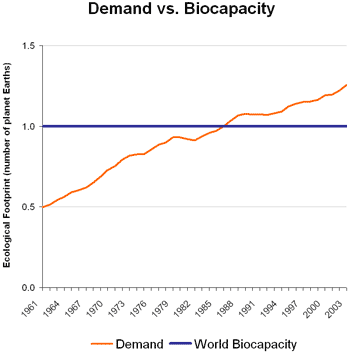
2009-04-04-DemandvsBiocapacity.gif

Figure 2. Ecological footprint of humankind from 1961 to 2003.
(Illustration courtesy of Global Footprint Network)

Figure 3 shows us that back in the mid 1980's, when our world had just over half its current population, we first exceeded the capacity of our planet to continuously supply us with the food and raw materials that we consume, and to process our wastes. What this means, is that we have been consuming our planet's resources faster than they regenerate, and polluting its natural systems faster than they can recover. This "drawing down" of our resources, is essentially spending the money from investors (all of us) in this Ponzi scheme, and when the remaining "money" (the natural resources and ecosystems of our world) can't support the payments anymore, it will most certainly collapse!

Unfortunately, it's going to take more than minor changes in the way we do business to get off this giant Ponzi scheme. It will not be easy, but I do believe it is doable. For a good idea of what it is going to take to make the shift to sustainability and get off this Ponzi scheme, see my prior Huff Post blog, 12 Tips for the Sustainability Shift.

The question to ask ourselves, is do we wish to adopt the attitude of Mr. Madoff, saying essentially, "F__k it! The world will do what the world will do, so I might as well enjoy one hell of a ride while it lasts!" Or do we decide to transform the way we do business, halt and reverse population growth and over-consumption, and collectively work together to nurture and rebuild the natural systems and biodiversity of our planet that are absolutely critical for supporting and maintaining a viable world for generation upon generation?


Matthew Stein is the author of When Technology Fails: A Manual for Self-Reliance, Sustainability, and Surviving the Long Emergency from Chelsea Green. For more information, visit chelseagreen.com and whentechfails.com.


  • Comments
  • 17
  • Pending Comments
  • 0
  • View FAQ
Comments are closed for this entry
View All
Recency  | 
Popularity
02:41 PM on 05/02/2009
Have to agree that creating big buildings, dams, etc and putting them on life support (as Clark Snell would have put it) is not sustainable. There is serious environmental degradation in places like China and India. We at "Fresh Food Web" http://www.freshfoodweb.com provide a information channel that encourage people to shop for fresh produce locally, which we hope (like so many others) will support small farms and crop diversity for a sustainable future.

-FFW
02:13 PM on 04/20/2009
I'm terribly sorry, but it's this kind of hyper-anxious exaggerated fear-mongering that turns off rational people. 30 years ago it was the encroaching ice age. We've had radon scares. Ehrlich predicted death, famine, pestilence due to overpopulation by 2000. Now it's global warming. Observational science has been prostituted by the politicians, and I simply don't believe anything they say anymore.
This user has chosen to opt out of the Badges program
photo
fumes
Midnight Toker
12:20 PM on 04/11/2009
''increasing concentrations of CO2 in the atmosphere (the primary greenhouse gas) caused by our rapidly increasing consumption of fossil fuels, is increasing the acidity of the oceans, and that if this trend continues much longer, it has the potential to kill most of the planktons, diatoms, and coral reefs of the ocean, knocking out the bottom of the food chain, killing most of the life in the oceans of the world, and destroying one of the legs of our world's oxygen cycle.''

say matthew.. .038% of our atmosphere today is the evil CO2 to which you refer. in the beginning - before god created heaven and earth - the atmosphere was 95% CO2 and the oceans weren't too acidic for cyanobacteria.. the same cyanobacteria aka blue-green algae that are right there right now at the bottom of the food chain with your plankton and diatoms.
07:01 PM on 04/11/2009
I somehow knew you would show up. A little obsessed with CO2 are you fumes?
photo
HUFFPOST BLOGGER
Matthew Stein
05:34 PM on 04/23/2009
There are definitely organisms in our oceans, especially around volcanic fumaroles, that are adapted to more acidic environments than the current average oceanic environment. If we kill off what currently comprises most of the bottom of the oceanic food chain, and a large part of our planet's CO2-oxygen cycle, I have my doubts that these more ancient organisms will step in to fill the void in a balanced way that is good for humans and most of the current animal life in the oceans that rely upon these for their daily sustenance.

The planet's atmosphere and oceans were far more acidic in ancient times, before billions of tons of carbon were sequestered from our atmosphere over eons of time, and it is precisely this carbon sequestration that made life on our planet livable for the current set of organism, including human beings. If we continue this process (carbon release) at our current pace, life will most certainly go on, but human life may not....
12:15 PM on 04/09/2009
A 21st century update of the Malthusian Model - well done.

The Native Americans are wise enough to know that their choices need to be thought out for 7 generations. The "leaders of the free world" aka the USA have shown that we as a whole have a tough time looking ahead for 7 years. Actually let's be real - its not 7 years, 7 months, or even 7 weeks. 7 days may even be a stretch.

All of the "crisis" stuff going on is part of a wake up call that rang loudly, but as a whole we've chosen to try to make things the way they were. The systems are broken, and the choice is to try and patch them up instead of looking for more powerful, sustainable ways. The next wake up call will be even louder and the reality is that people only really change when there is no other option. I thought this one would be enough to wake us all up, but outdated ways of living are so ingrained that we haven't done much more than take a rusted out 1976 Gremlin and put a shiny new bumper on it.

But hey, at least we have stories out the wazoo about whether Michelle Obama's arms should be covered or not.
photo
HUFFPOST SUPER USER
Matthew Stein
Author of When Technology Fails
06:43 PM on 04/09/2009
You got me laughing really hard. Now that we have shifted our media's focus from Britney Spears, or Brad and Janet, to a new focus on Michelle Obama's arms, does this mean we have gone from 98% asleep to only 97% unaware?
03:24 PM on 04/08/2009
Excellent post. I noticed that a lot of the naysayer crowd has not signed on yet to blog this to death. Prepare yourself for an onslaught of name calling, pseudo science and downright juvenility.
This user has chosen to opt out of the Badges program
05:55 PM on 04/07/2009
thank you. this is a point i have often made - that our unchecked capitalism and relationships to foreign nations and our environment were total ponzi schemes that rely on rapacious exploitation and unsustainable relationships. i have often fought for living wages, labor reforms and environmental standards in connection with trade treaties, blue sky laws and investor demands, as well as personal behavior.

i hope you are clear that Big Solar, Big Wind and Big Transmission perpetuate this mess, and do NOTHING to relieve the enormous pressure we are placing on the planet out of waste and greed. all they do is shift the pressure from CO2 emissions to SF6 emissions (and destroyed carbon-sequestering ecosystems), from land destroyed by mining to land destroyed by industrial development, from water poisoned by mercury, to water permanently depleted for cooling and rinsing mirrors.

we need to focus on SUSTAINABILITY on a building by building, person by person, region by region and country by country basis. this is NO time to dynamite and bulldoze our open spaces for more centralized, wasteful power production, including solar and wind. we need to think in terms of net-zero and net-exporting for power and water in every home, business and public space, and stop looking to Big Energy to save us. they are the problem, and so far, have refused to be part of the solution. democratic feed in tariffs are the first step...
photo
HUFFPOST SUPER USER
Matthew Stein
Author of When Technology Fails
11:56 AM on 04/08/2009
In my opinion, big wind and big solar must be part of the solution, which is not to say that all big wind and big solar are done right. None of us could make a silicon solar cell on our own, and it is financial incentives that are helping to turn the economies of scale in our favor, eventually bringing solar PV down in cost. If solar PV never gets big enough, it will never become the cost effective player it must be in order to eclipse the existing oil, coal, natural gas and nuclear utilities. I am in favor of putting incentives in place, such as feed-in-tariffs plus carbon caps, along with environmental impact reports and engineering analysis.

There is something to be said in favor of both the benefits of small scale distributed generation and the economies of scale involved with "big wind" and "big solar". I simply care about making sustainability work, and I do not claim to know all the answers, I suspect it will be a combination of a wide variety of technologies, both big and small. If this is to work, I believe we must mandate significant make-or-break incentives (such as feed-in-tariffs, cap-and-trade, etc.) to insure that businesses that do things in sustainable ways are supported and businesses that don't are penalized, making it economic suicide to do business in ways that harm the planet and take us further away from the goal of sustainability.
02:20 PM on 04/07/2009
I agree with a lot of this, except that the world "biocapacity" plot makes no sense. It assumes the same constant resource use per capita which is based on estimates from an extremely wasteful decade of the most wasteful country in the world. The blue curve plots a theoretical constant for biocapacity as if that was something that could be calculated from first principles and would never change. Indeed, if it depended on the state of the world's ecosystems, it would have to change with time and more likely than not it would point down.

Obviously, if we had exceeded the capacity of this planet to nourish us in 1980, we would be mostly dead by now. But we aren't. Instead we are, on average, doing better. We have developed countries in Europe which can produce the very same quality of life with less than half the energy input and our reserves in renewable energy are virtually unlimited of the scale of our current energy use. We just haven't tapped into them, yet.

The simple truth is that mankind will expand to between 11 and 12 billion people and it will consume roughly three to four times as much energy as it does right now. And we will simply have to learn to supply that and use it wisely. And we will.
photo
HUFFPOST SUPER USER
Matthew Stein
Author of When Technology Fails
04:32 PM on 04/07/2009
Biocapacity is fixed, because we only have one Earth's worth of biocapacity to draw from, though we certainly have the capacity to draw down this resource and ruin it for future generations. You are forgetting that we can exceed the biocapacity of our planet by unsustainably drawing down the natural resources of our planet (which we are doing right now). This is like charging $50,000 on your credit cards each year, but only paying back $25,000 of the principle each year. It may be easy to keep this up for a while, but eventually it catches up with you.

I do agree that it is possible to support a larger population by decreasing our average footprint per person. The footprint by region chart shows that the different regions of the world do have radically different footprints due to varying consumption and technology factors. Certainly we could support a lot more people on our planet if we all had a standard of living like the average African. The trick is to use our technology in proactive ways to enable us to sustainably enjoy a decent standard of comfort, health and livelihood without taking the planet down.
07:39 PM on 04/07/2009
Leaves energy bound in chemical compounds like coal, oil or natural gas. Those are, indeed, one time gifts of nature. But they are next to nothing in comparison to solar energy that we receive from the sun. So the only use of these "resources" is for convenience. No big deal on the scale of things.

The biology side is different. Ecosystems once destroyed do not come back. That's the only real destruction that is irreversible. Therefor we should not look at biology as a resource at all but like the home we live in. A wall we remove will never be rebuilt.

"Certainly we could support a lot more people on our planet if we all had a standard of living like the average African."

Not at all. We can support 12 billion people on the footprint of the average Western European or Japanese. We know that we do not need to support the American model. It does not buy any quality of life. The average African, by the way, probably causes more ecological destruction to their environment than a well regulated European. There is no linear relationship between energy and resource use and damage.
07:39 PM on 04/07/2009
"Biocapacity is fixed,"

It's a fixed quantity that you can not derive from the laws of nature, that you can not measure without destroying the system under test. It's not a good definition by any standard of science.

"You are forgetting that we can exceed the biocapacity of our planet by unsustainably drawing down the natural resources of our planet (which we are doing right now)."

Depends on your definition of natural resource. All elements with exception of hydrogen and helium are gravitationally bound to this planet. There are plenty of both in the solar system, they are just very hard to get at.

Except for radioactive and fissionable isotopes there is little doubt that the nuclei of all elements we use will not be changed by either natural nor human causes. So the only thing that happens is that we are changing where the deposits are and how much energy we have to expend to collect the stuff.
12:22 PM on 04/07/2009
this is the best veiw of our current situation i've ever read on hp. It's amazing how many smart people are so blind. continuous exponential growth on a ball..., and the sheep treat this idea like a religion.

as i've always said..., peak oil is just a symptom
11:25 PM on 04/06/2009
Huzzah! This pretty much summarizes all the stuff I have to leave out whenever I post on a thread involving climate change. It's not a terribly easy point to communicate, but I think you did a good job. I hope this post gets lots of attention. Perhaps if you put something about climate change in the title?

Time for a radical shift in pretty much everything. Those of us who like change are in for a treat.
photo
HUFFPOST SUPER USER
Matthew Stein
Author of When Technology Fails
11:33 AM on 04/07/2009
Thanks! Change is coming, like it or not. The question is do we manage these changes proactively so we can make the best of a bad situation , and do our best to turn this around, or do we pretend that God,positive thinking, and the Free Market will save us from ourselves, then cry and wring our hands when it all crumbles around us?