Introduction
A diplomatic resolution to the conflict between the Islamic Republic of Iran and the United States is certainly the most desirable outcome. There is, however, a definite possibility that before a diplomatic solution is reached the United States, either alone or in conjunction with its allies, will impose further sanctions against Iran as a way of preventing the possible future development of nuclear weapons. As a result, it is necessary to examine various types of sanctions and their potential efficacy regarding Iran. If sanctions are enacted, then it will be necessary to institute a program that carries the least potential for unintended consequences. This report briefly compares two different forms of sanctions, and makes a tentative assessment about which types of sanctions could be applied to Iran with the most positive results. For the purposes of the comparison, sanctions are examined in a vacuum, which allows for the pros and cons of the two types of sanctions to be weighed without outside influences. In order to achieve this aim, selective sanctions, rather than broad-based sanctions, are the best option.
What Are Sanctions?
In the most recent edition of Economic Sanctions Reconsidered, the book's authors define sanctions as "the deliberate, government-inspired withdrawal, or threat of withdrawal, of customary trade or financial relations" (Hufbauer, Schott, & Elliot 2007, p. 3). Sanctions are punitive, non-military actions taken by a sender state against a recipient state. Sanctions are also a game of "issue linkage," where the different actors may not be wholly cognizant of the others goals and desired outcomes (Lacy, 2004, pp. 25-26). Sanctions create a pseudo-dialogue in the arenas of economics and trade between the sender state and the recipient state. Despite often being viewed as a purely punitive measure, the actual purpose of sanctions is to achieve a change in policy or behavior is the overall purpose of sanctions, and not to inflict pain. While this is a general definition of sanctions, it is useful to delineate between broad-based economic and selective sanctions.
Broad-based economic sanctions (BBES) are government enacted restrictions on the import and export of goods or services, which are used by the vast majority of the population, to or from a target country. BBES are frequently wide-ranging in their effect. They do not target specific groups but instead target the import and export of products in which many groups may have a financial interest. These types of sanctions rely on creating public pressure that will force the target government to make particular concessions. Broad-based sanctions can have an effect opposite of their original goal. Selective sanctions, however, are designed to affect more specific targets, and do not involve restricting every-day goods or services.
The term "selective sanctions," which is borrowed from Johan Galtung, is used to identify measures that are directed at specific persons or groups; such as a country's dictatorial ruler or the ruling apparatus. Selective sanctions are designed to limit the economic collateral damage inherent in BBES, while maximizing the hardships, financial or otherwise, inflicted on the targeted state's leadership. David Lektzian and Mark Souva argue in favor of selective sanctions that target a country's leadership. On the topic of selective sanctions, the authors' argument is particularly relevant when,
dealing with nondemocratic countries, states should avoid broad sanctions that impose high economic costs on the population at large because most people in the country are not part of the autocratic leader's winning coalition, so the economic costs imposed on the larger population do not translate into political costs for the regime (Lektzian & Souva, 2007, p. 849).
Examples of selective sanctions designed to affect the leadership with a minimum of deleterious effects on the population are those that freeze the foreign bank accounts of leaders, block government-owned banks from engaging in business abroad and blocking the ability of the leadership and their families travelling and studying abroad. These types of selective sanctions are far less likely to affect the general population of the target state, while ideally imposing untenable conditions on the leadership of the target state.
The History of Sanctions
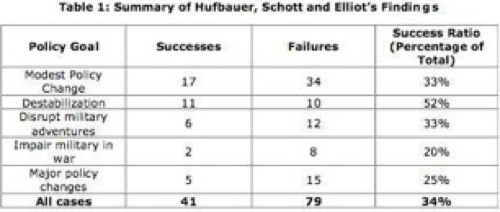
The authors of the book Economic Sanctions Reconsidered, 2nd edition conducted case studies of 115 incidents of sanctions between 1914 and 1990. The successfulness of each sanctions regime was determined by examining both the policy result and the degree to which sanctions aided in achieving the policy change (Pape, 1997, p. 98). According to Robert Pape, the results (Table 1)(Pape, 1997, p. 99) of Economic Sanctions Reconsidered contradict the wide-spread belief that any economic sanctions are able to achieve substantial foreign policy objectives (Pape, 1997, p. 106). Indeed, when the objective was to affect a "modest policy change," which is described as nonproliferation or human rights issues, sanctions succeeded only thirty-three percent of the time (Pape, 1997, p. 99). In addition, sanctions only succeeded in affecting "major changes in target country's policies, including surrender of territory" one time out of four (Hufbauer, Schott & Elliot, 2007, p. 38). Sanctions as a general practice are not particularly effective as a means to an end, especially when the sender country seeks to achieve any goal except for destabilization.
One obstacle to the effectiveness of sanctions is the relevancy of the issue for both the sender and recipient. If the target state and the sender state do not place equal value on the issue about which the sanctions are instituted, then it is unlikely that the sanctions regiment will be successful (Ang & Peksen, 2007, p. 135). For example, if Iran places the importance of its uranium enrichment program above the need to easily conduct trade, then sanctions seeking to end enrichment by impeding Iran's ability to trade in global markets will almost certainly fail. The salience of issues is related to what is known as the "psychology of sanctions" (Pedersen, 2008, p. 218). This is the manner in which the targeted state responds to international pressure.
Galtung has described a "naïve theory" of sanctions that affects how policy makers think about sanctions. He explained this theory as being predicated on a belief that,
there is a limit to how much value-deprivation [a] system can stand and that once this limit is reached (resulting in a split in leadership or between leadership and people), then political disintegration will proceed very rapidly and will lead to surrender or willingness to negotiate (Galtung, 1967, p. 388).
Unfortunately, people who follow this naïve theory of sanctions ignore the fact that the targeted state is able to adapt to economic hardships, which means the state's breaking point, when a state will give in to sanctions, is not a constant (Galtung, 1967, p. 388). Sanctioned governments, such as the one in Iran, can find various methods of circumventing sanctions, either by instituting domestic changes or forging relationships with states not party to the sanctions. In addition, the effectiveness of sanctions is influenced by the targeted state's form of government.
"The Last Sandwich": Differing Responses to Sanctions
The more representative a government the more likely it is that it will make concessions in the face of sanctions. This is because democratic governments are subject to domestic elections. In addition, democratic leaders are not particularly able to insulate themselves and their supporters from the effects of sanctions. When, in 1956, the United States instituted sanctions against Great Britain and France during the Tripartite Aggression (Suez Crisis), the two democracies promptly capitulated to U.S. demands (Allen, 2008, p. 258). While democratic governments are more likely to make concessions in the face of sanctions, it is not always the case. If domestic opinion favors continuing a set of actions despite sanctions or if the benefits outweigh the costs, then it is unlikely that the government will cede the issue (McGillivray & Stam, 2004, p. 164). Compared to representative governments, however, forcing nondemocratic governments to make concessions through a sanctions regiment is very difficult.
Lektzian and Souva have stated, correctly, that "the political costs of economic harm are minimal [in nondemocratic countries] because the lack of political accountability gives the leader little incentive to alleviate civilian suffering" (Lektzian & Souva, 2007, p. 853). Authoritarian leaders are able to shelter their supporters from the effects of sanctions, to the detriment of the general population. In fact, being able to shelter political allies is an essential ability for autocrats, since rewarding loyal supporters is a necessary prerequisite for their continued power and authority (Allen, 2008, p. 261). According to Susan Hannah Allen, the experience of Haiti during the 1990s is an example of an autocratic government insulating itself from sanctions. She states that,
although the average Haitian lived in the most abject poverty in the Northern Hemisphere during the mid-1990s under the comprehensive sanctions imposed by the OAS [Organization of American States], the military, upon whose support the [Raoul] Cedras government was dependent, continued to receive new technology, ammunition, and uniforms (Allen, 2008, p. 261).
A common saying among those familiar with the sanctions against Iraq was that "Saddam will eat the last sandwich in Baghdad." It is safe to assume that the ruling elite and the Islamic Revolutionary Guard Corps would be the last groups to suffer if further BBES were to be instituted against Iran.
Politics and Public Opinion in Iran
The constitution of the Islamic Republic does make some room for democratic participation, albeit very limited, by the Iranian people; however, it would be difficult to make a convincing argument that Iran's government could be classified as even a pseudo-democracy since June 12th. The overwhelming majority of power is vested in the totalitarian office of the Supreme Leader, Ayatollah Khamene'i. Indeed, the post-June 12th political climate in Iran's government is defined not so much by the conflict between the reformers and the hardliners but by tensions within the hardliner camp. Jerry Guo refers to the rise of the "New Right," which is primarily composed of members of Iran's security forces (Guo, 2009). The reformers have been largely forced out of the high-offices of the Iranian government. Iran's current leadership behaves as though collectively they are suffering from paranoid schizophrenia: the hardliners in Iran's government see the Turanian king Afrasiab (a legendary enemy of Persia) at the head of every western government. As a result, they are constantly maneuvering against perceived enemies to maintain their power and position within both domestically and internationally.
According to a recent poll conducted by World Public Opinion, fifty-six percent of Iranians would oppose stopping enrichment in return for the removal of sanctions (World Public Opinion, 2009). The numbers reported by the poll indicate that further economic sanctions against Iran have a good chance of bolstering support for the current government, and not, as they are hoped, causing a split between the Iranian people and the Iranian government. Sanctions, especially if they are unilaterally imposed by the United States, would most likely fan the flames of nationalism within Iran. As Richard Haass has pointed out, "sanctions that harm the population at large can bring about undesired effects, such as strengthening the regime, triggering large-scale emigration, and retarding the emergence of a middle class and civil society" (Haass, 1998, p. 202). This could lead to an increase in support for the government above the current level of fifty-six percent. The result would be the failure to prevent the potential for nuclear proliferation in Iran, which would be the goal of new sanctions. In addition, new BBES would provide the Islamic Republic with a greater rational for repressing dissenting organizations and viewpoints.
Sanctions and Iran
In 1997, Jahangir Amuzegar pointed out that American sanctions against Iran have "created a siege mentality," and the government's supporters are more resolute than ever before to become wholly reliant upon domestic resources (Amuzegar, 1997, p. 34). A decade later, Amuzegar's observation remains an accurate representation of the Iranian political, religious and military leaderships thought process. The Islamic Republic has adapted to the sanctions imposed on it by Europe and the United States. Iran is not yet entirely self-reliant for needed goods and services, and it will never truly be completely independent; however, the more the government is able to provide for its needs domestically BBES will have less positive effects. Thus far, it appears that the various governments in favor of continued sanctions against Iran have fallen victim to the naïve theory of sanctions. Instead of continuing the same BBES regime the best method of gaining Iranian compliance with demands regarding its nuclear program would be continued diplomacy; however, the best of the worst options would be selective sanctions.
The possibility that sanctions will cause Iran to capitulate to demands to relinquish its pursuit of nuclear weapons is dependent on a number of factors. The government of Iran's potential rationale for the future pursuance of nuclear weapons is of central importance. In their study of nuclear proliferation between the years 1945 and 2000, Sonali Singh and Christopher R. Way find that,
Security factors play a powerful, perhaps central, role in explaining proliferation decisions. Participating in enduring rivalries or taking part in more frequent militarized disputes strongly increase the chances a state will pursue nuclear arms, but credible support from a great-power ally dampens the temptation...[and] domestic factors, such as more externally oriented economic policies, reduce the likelihood of proliferation (Singh & Way, 2004, p. 861).
Iran is, therefore, a prime candidate to, at some point, develop nuclear weapons. The Islamic Republic has been engaged in a rivalry with the United States and, to a lesser extent, Great Britain for thirty years. Iran's military strategy is defensive in nature, and is constructed around a deterrence-based approach (Ward, 2005, p. 573-574). Nuclear weapons, or the ability to quickly build them, symbolize and announce the Iranian leadership's authority to the world.
Iran's military strategy, the siege mentality of its leadership and its autocratic form of government combine to create a political culture that is unlikely to be swayed by further BBES. In addition, such sanctions may very well have the effect of increased public support for the current government and leadership, and possibly even increased support for building nuclear weapons. The most likely outcome of the United States and Europe increasing the current BBES regime is a more recalcitrant Iran. Instituting selective sanctions against the Iranian elites would, at the least, avoid a negative reaction amongst the population, and would not be any less effective than the current sanctions regime against Iran. One example of a potentially effective measure that can be taken is for the United States and other countries to actively block Iran's attempts to enter the World Trade Organization, which the state's leaders have announced will occur in the next decade. Blocking Iran's entry would be both a public embarrassment for the government and deny groups like the IRGC access to broader markets and investments; thereby stymieing their capacity for further development.
Conclusion
If sanctions must be pursued, then selective sanctions are the best method for preventing nuclear proliferation. As was previously stated, the goal of sanctions is not the infliction of pain and suffering, but to affect a change in the policy or behavior of the target state. Broad-based economic sanctions are quite effective as a means of causing hardship on the general population, but have not proved very effective at effecting policy changes. Therefore, enacting selective sanctions against the Iranian leadership, such as travel restrictions and financial sanctions targeted at foreign investments and properties, would deliver the greatest amount of targeted damage, while avoiding an over abundance of collateral damage which has a high probability of causing an adverse reaction.
Works Cited
1.) Allen, S. H. (2008). Political Institutions and Constrained Response to Economic Sanctions. Foreign Policy, 4, 255-274.2.) Amuzegar, J. Adjusting to Sanctions. Foreign Affairs, 76, 31-41.3.) Ang, A. U. & Peksen, D. (2007). When Do Economic Sanctions Work? Asymmetric Perceptions, Issue Salience, and Outcomes. Political Research Quarterly, 60, 135-145.4.) Galtung, J. (1967). On the Effects of International Economic Sanctions: With Examples from the Case of Rhodesia. World Politics, 19, 378-416.5.) Guo, J. (2009). Letter from Tehran: Iran's New Hard-liners. Retrieved December 2, 2009, from Foreign Affairs website: http://www.foreignaffairs.com/features/letters-from/letter-from-tehran-irans-new-hard-liners?page=show6.) Haass, R. (1998). Economic Sanctions and American Diplomacy. New York, NY: Council on Foreign Relations.7.) Hufbauer, G. C., Schott, J. J., & Elliot, K. A. (2007). Economic Sanctions Reconsidered, 3rd edition. Washington, DC: Peter G. Petersen Institute for International Economics.8.) Lacy, D. (2004). A Theory of Economic Sanctions and Issue Linkage: The Roles of Preferences, Information and Threats. The Journal of Politics, 66, 25-42.9.) Lektzian, D. & Souva, M. (2007). An Institutional Theory of Sanctions Onset and Success. Journal of Conflict Resolution, 51, 848-871.10.) McGillivray, F. & Stam, A. C. (2004). Political Institutions, Coercive Diplomacy, and the Duration of Economic Sanctions. Journal of Conflict Resolution, 48, 154-172.11.) Pape, R. A. (1997). Why Economic Sanctions Do Not Work. International Security, 22, 90-136.12.) Pedersen, M. B. (2008). Promoting Human Rights in Burma: A Critique of Western Sanctions Policy. Lanham, MD: Rowman and Little Field Publishers.13.) Singh, S. & Way, C. R. (2004). The Correlates of Nuclear Proliferation: A Quantitative Test. Journal of Conflict Resolution, 48, 859-885.14.) Ward, S. R. (2005). The Continuing Evolution of Iran's Military Doctrine. Middle East Journal, 59, 559-576.15.) World Public Opinion. (2009). Iranians on their Nuclear Program. Retrieved December 2, 2009, from World Public Opinion website: http://www.worldpublicopinion.org/pipa/pdf/sep09/IranNuc_Sep09_quaire.pdf