Matthew Weiner

Matthew Weiner

Posted May 7, 2009 | 10:23 PM (EST)

Talking with the Enemy

digg Share this on Facebook Huffpost - stumble reddit del.ico.us RSS

The Dalai Lama Talks with Chinese Leaders in New York


While governments negotiate about negotiations, debate who they can talk to, and enforce hard parameters for diplomatic discussions, the world's preeminent Buddhist leader does things differently.

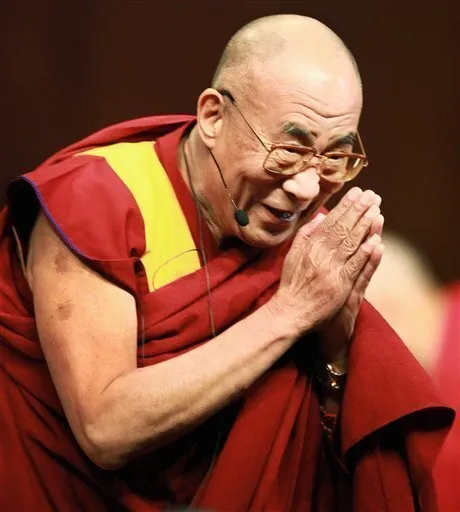
Yesterday in Midtown Manhattan His Holiness the Dalai Lama met for over two hours with a group of Chinese students and dissidents living here in the United States. The Chinese Government accuses him of being a demon and a separatist. They will not talk with him. But this does not stop the ever laughing monk from speaking with Chinese people, every chance he has. It is both a religious and spiritual practice for him, and something we can all learn from.

The audience stood as he entered. While people didn't bow the way devotees do when he teaches Dharma, they were very polite. Then he sat and discussed issues of history, culture, and current politics as they relate to the situation of his homeland. He emphasized the need for Tibetans to have autonomy, not national freedom; he also said that the Chinese government needed to be helped out of its political problems by the Tibetan and Chinese people themselves. When the meeting was over, groups clustered around him for photographs.

Ever since The Dalai Lama fled Tibet as Chinese government forces invaded, the world's most famous monk has concentrated his diplomatic efforts on the gaining the backing of western nations, most notably the United States. Indeed, the Tibetan Government in Exile has offices here in New York, but also in Washington, and through out Europe. This leads him to be attacked by the Chinese government as a Western Imperialist. He laughs often at the accusation, as has his own problems with capitalist democracies.

His efforts have had considerable effect. Besides tons of money being donated to the Tibetan cause, and helping their refugees in India, The Dalai Lama is by far the world's most famous Buddhist leader and perhaps the world's most respected religious figure. Except, that is, for the billion plus people living in China, the country that took over Tibet in 1959.

Until recently this decision, to focus on the western audience, seemed to be a necessary choice. Tibetans and their friends in the west have freedom of speech and a democratic process, not to mention capitalist dollars, to help their important non-violent cause. Meanwhile how to communicate with the Chinese people under a dictatorship? Besides, the Tibetans have never had a problem with the Chinese, but with their government.

Or so the line went. Yet with the latest Tibetan uprising that took place a little over a year ago, besides the horror of monks and civilians being killed, the most shocking aspect was the popular Chinese response, which was overwhelmingly anti-Tibetan. Even when the Dalai Lama came here, he was confronted with angry Chinese students.

He said as much in this meeting. "I was shocked at their anger." He said. "Maybe some were paid by the Chinese government. But some were really angry. So now I think it is best for me to meet them, whenever I can. Now things seem to cool down."

The power of the Dalai Lama's ability to engage Chinese citizens, even the ones here, should not be underestimated. While engaging Hollywood will not affect the Chinese government, perhaps their own citizenry will. Things have changed in China in the last decade. There are now human rights lawyers in China who openly represent Tibetan clients who are under arrest from the uprising. And there are many cases of the government responding to the growing force of their new civil society. Yes this response to civil society is in its infancy, yes the government remains brutal, but as its citizenry grows, the Tibetan's opportunity for change grows, if they engage with the Chinese people anyway that they can.

In this meeting, without being explicitly Buddhist, the Dalai Lama continued to use Buddhist ideas. That anger could be dispelled through honest discussion. That honest discussion and questioning was critical to problem solving. That having an equanimous mind was important for political leaders as much as for religious leaders. That religious freedom was essential for all of China, and for Tibet.

In fact, though Tibetans have played down their relationship with China as a way to emphasize their unique culture, there were deep relationships between the two nations, through Buddhism.

As Gray Tuttle, a scholar of Tibetan History at Columbia University has said, "For over 700 years these (Buddhist) connections have been the prime means of intercultural contact, and even in the past 100 years when national politics have come to the fore in Asia, Buddhism has consistently been the one area where the two cultures had the most promising developments. For peace to be restored in the troubled Chinese-Tibetan relations, respect for Buddhism is probably the key element."

With the resurgence of Buddhism in China, and the powerful allure of the Dalai Lama as a spiritual leader, Tuttle may be right. One student leader in attendance said that he had originally organized an anti-separatist meeting when the Dalai Lama visited Michigan last year, but now "I am somehow in the middle. I am not against the Dalai Lama. This is a good meeting to see." When asked why, he said, "Well, I'm a Buddhist."

The Dalai Lama Talks with Chinese Leaders in New York While governments negotiate about negotiations, debate who they can talk to, and enforce hard parameters for diplomatic discussions, the world...
 
Comments
8
Pending Comments
0
iPhone App Promo

Want to reply to a comment? Hint: Click "Reply" at the bottom of the comment; after being approved your comment will appear directly underneath the comment you replied to

View Comments:
- Jonahson I'm a Fan of Jonahson 6 fans permalink

Pt.2 Whatever the Dalai Lama did or said I am not interestd, since he has taken up politics then it is a matter between him and China. The Dalai Lama had also spoken and wrote many books on the Dharma, so it is through these teachings that we see the Buddha Dharma. If we worship a person then we are blind to his faults and will defend that person no matter what.
Where is our wisdom then?

    Favorite    Flag as abusive Posted 11:15 AM on 05/13/2009
- Jonahson I'm a Fan of Jonahson 6 fans permalink

I wish monks do not get involved with politics. The Buddha never did. Buddhism is more tolerated in China now as was compared to the past. Unlike those days where they forced monks to marry without the need to disrobe. I think there is a Shao Lin monk who took asylum in US where he married yet and still wears the monk's robe. I have been to China recently as a tourist and visited Chengdu and Peking. I also visited a Taoist Temple. The plus side of what I saw are the temples are well kept and restored. However there are more as tourist attraction than for cultivation, with the arrival of tourist there are less quiet place for contemplation. Before the Dalai Lama left China he was unknown out side Tibet and I don't think many people know about Vajarana Buddhism. Only with the assistance of the US that he is now well known through out the World. I wish people see the Buddha's teachings through the Dalai Lama and not just worship him. It is like admiring the finger that points to the moon and not the beautiful orb. When you totally depend on other's wisdom you stop developing your own realization. The Mahaya's teaching which include the Vajarana is about Great Compassion to save people from sufferings, lives after lives it is the practice of the Ten Perfections.

    Favorite    Flag as abusive Posted 09:32 PM on 05/11/2009
- FairTalk I'm a Fan of FairTalk 18 fans permalink
photo

I agree Monks shouldn't get involved in politics. Dalai Lama, though, no ordinary Monk, is also paid by the CIA, and repetedly been involved in violent campaignes against China.

Here is part 2 of a three part series about how the violent riots in Tibet, and the violent demponstrations around the world last year were planned in advance, not spontaneous uprisings of the people.
http://www.youtube.com/watch?v=US4Jqt36fb8&feature=related
One thing I would add, is that the action training manuals of the AEI were translated into Tibetan, with a froward, introduction writen by the Dalai Lama. Yep. And if you watch part 3 you will see, that when confrontyed about the violence, the Tibetans deny there was any violence, and say the action was a good thing.

Here is an example of Chinese Buddhism that is not performed as a tourist attraction...
http://www.youtube.com/watch?v=ImNcIDlXfsU

I suggest that if the Dalai Lama is seeking peace, he should practice Buddhism, not covert operations.

Here is the Dalai Lama exorting illegal discrimination against a Tibetan Buddhist practioners who follow Sugden teaching. The Dalai Lama has banned and ostricized Shugden practioners, and when those in New York City peacefully protested outside one of the Dal;ai Lamas talks, ther were attacked by the Dalai Lama's "peaceful" followers.
http://www.youtube.com/watch?v=4Zm44E1V4Ao

the ban in the Dalai Lama's words...
http://www.youtube.com/watch?v=xqsrHiSa7Zc

this is what he has banned...
http://www.youtube.com/watch?v=6GWr76aMuDQ

    Favorite    Flag as abusive Posted 04:49 PM on 05/12/2009
- Jonahson I'm a Fan of Jonahson 6 fans permalink

Pt.1 In Ancient India politics and religion do not mix. Even Kings respect a cultivator and allow them to enter their private garden. It is only later that rulers get involved with religion to have better control over his subjects. Even today in India politicians take advantage of religion to win votes. In this sense I am not interested in politics but leaders who do not truly practice Universal compassion sometime make cruel decisions that can cause tremendous sufferings to people and animals alike. These leaders practice selective compassion and they treat their dogs much more better than people. What is a human worth if he/she have no compassion in their heart?
Your parents are your first Dhama teachers. "All talks with good imtention is Dharma."
Your parents taught you not to steal, lie, kill, get drunk, take drugs and to treat your wife well. These are also the first five percepts, the Buddha ask us to keep. Even in Christanity you can find the percepts in the Ten Commandments.The Buddha did not 'invent' the Dharma. After many years we forgot our morality so we cause suffering to each other and also started to destroy other living things through our greed hatred and delusion so a Fully Enlightened Buddha come to show us the way again.

    Favorite    Flag as abusive Posted 11:14 AM on 05/13/2009
- Jonahson I'm a Fan of Jonahson 6 fans permalink

Pt.2 Whatever the Dalai Lama did or said I am not interestd, since he has taken up politics then it is a matter between him and China. The Dalai Lama had also spoken and wrote many books on the Dharma, so it is through these teachings that we see the Buddha Dharma. If we worship a person then we are blind to his faults and will defend that person no matter what.
Where is our wisdom then?

    Favorite    Flag as abusive Posted 11:16 AM on 05/13/2009
- FairTalk I'm a Fan of FairTalk 18 fans permalink
photo

Chinese Premier answers questions on tibet and Dalai Lama

http://www.youtube.com/watch?v=Lnu8hwqATgA&feature=related

Parapharsed: We have held talks with the Dalai Lama, and the door is always open to have talks with him. We must look at what the Dalai Lama does, not just what he says. There is a question of his sincerety. Several days ago, the Dalai Lama tried to rebut what was said by the Chinese Foreign Minister in his press conference, the Dalai Lama told sheer lies. Of course, the Dalai Lama may change his course, but he cannot deny what he has said and writen in the past. ( he includes detailed references)

    Favorite    Flag as abusive Posted 11:00 PM on 05/08/2009
- FairTalk I'm a Fan of FairTalk 18 fans permalink
photo

According to the Dalai Lama's own teaching, the ego, egomaniacs, are the greatest demon facing us. Therefore, I can understand why China may call him a demon. He is the epitomy of an out of control ego, and his behavior is the exact opposite of the Buddha's example.

The Dalai Lama truely is not free, as he claims, but what enthralls him is not the Chinese, but his own bad decisions, his own ego: his decision to refuse to peacefully help bring democratic change to Tibet, his decision to refuse to emancipate his slaves and serfs, his decision to throw in with the CIA, his decision to become a rich, powerful and public figure, his decision to use the ignorance of people who know nothing about either history, Buddhism, nor his own despotic "rule,"

Yes, the Dalai Lama loves to talk with those who don't know the issues, but he is having a difficult time snowing those of us who do know:
http://www.youtube.com/watch?v=h19OBF6_K_4&feature=related

    Favorite    Flag as abusive Posted 05:33 PM on 05/08/2009
- Sinick I'm a Fan of Sinick 7 fans permalink
photo

The very definition of a great man and there have only been a handful of them throughout history. The world needs to pay attention because we are so fortunate to have the opportunity to have one living among us in our lifetime. Buddha be praised . . .

    Favorite    Flag as abusive Posted 09:03 AM on 05/08/2009
Comments are closed for this entry

 You must be logged in to comment. Log in  or connect with 

Connect