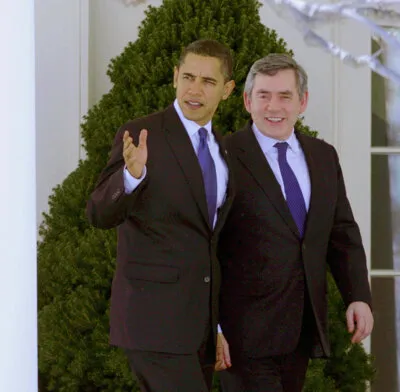
The special relationship is losing its luster and it relevance. Contrary, to the UK press, this has little to do with the personal relationship between Obama and Brown or his electoral troubles, but is a byproduct of Iraq and the UK's growing estrangement with Europe.
On the face of it everything now seems fine. As Brown departed for Washington, there was a lot of British commentary about whether Obama and the U.S. even cared about the "special relationship." Personal relations between Obama and Brown were interpreted to be frosty and much was made over Obama's statement prior to Brown's arrival that called the U.S.-UK alliance a "special partnership," not a relationship. It was even said that Obama hated the British because they tortured his father.
But in their meeting at the White House, Obama made pains to stress the relationship was special and Gordon Brown's speech yesterday was so rah rah America it could have been given at CPAC. So everything is right in the relationship, right? Well not really, especially if your British. As the FT noted, Obama is not going to turn down an ally: "The Obama administration wants cordial productive relations with Britain, as with other countries."
But that does not make the UK particularly relevant to the U.S. right now. Yes over the last eight years the Brits have been with us side by side in Iraq and Afghanistan, but that in some ways is sort of the problem. By backing the Bush administration in Iraq the UK hasn't exactly enhanced their global clout and their military is now under great stress, which prevents greater assistance in Afghanistan. Furthermore, the UK's relationship with Europe - never cozy - has become increasingly estranged.
Blair claimed that the UK was a "pivotal" country in world affairs, due to, as the Economist noted, "Britain's possession of efficient armed forces, together with its twin loyalty to America and the European mainland, give it a unique bridging role." In the run-up to the Iraq war, Blair leveraged these dual loyalties to America and Europe to make the UK an important international player that was essential to the U.S. The Economist had a great cartoon at the time showing Blair with a foot in both an American row boat and a European row boat that were headed in opposite directions. Bush offered the UK a choice, Europe or the U.S. Having chosen the Atlantic relationship, it was natural that there would be growing estrangement with Europe. But this has been compounded by American disinterest under Bush in rebuilding U.S.-European relations, as well as by the arrival of Brown, who is much more disinterested in Europe then Blair was.
The problem for the "special relationship" is that an increasingly eurosceptic Britain is much less relevant to the U.S. than a Britain that is firmly entrenched as an important player in the EU. So British debates over what's more important, the relationship with Europe or America offer a false choice, especially since the American president is no longer George Bush. For the UK to maintain its traditional relevance to the U.S., it needs its place in Europe. Without that place in Europe, Britain will no doubt be an important and close ally - just like Canada, Australia, and Japan - but they bring a lot less influence to the table.
With the possibility of David Cameron unseating Brown - ushering in one of the most eurosceptic governments the UK has had since it joined in 1973 - and overall anti-immigrant and anti-Europe sentiment growing in the UK, the Obama administration should make it clear that we want the UK to play a constructive role in Europe. U.S. pressure could at the very least serve as a check on potential British obstructionism on the Lisbon Treaty, as well as on other efforts to de-link the UK from Europe.
It's high time we used the special relationship to attempt to influence British behavior in Europe, just as they use it to influence our behavior globally.
http://www.huffingtonpost.com/2009/03/04/gordon-brown-addresses-co_n_171776.html
http://www.huffingtonpost.com/2009/03/03/obama-brown-meeting-whats_n_171503.html
http://www.huffingtonpost.com/2009/03/03/britains-brown-looks-for-_n_171359.html
Want to reply to a comment? Hint: Click "Reply" at the bottom of the comment; after being approved your comment will appear directly underneath the comment you replied to
Americans see the "special relationship" with England the way that germans saw the "Chrysler" part of "Daimler-Chrysler": invisible from their side of the pond.
It's hard to know where to start, as Max Bergman makes so many mistakes in his analysis of the 'special relationship'.
Bergman says -
“The special relationship is losing its luster and its relevance”.
True, it's vital right now to Gordon Brown as he's in a hole and can't stop digging. So tucking up behind your new man is a cynical ploy. As we've all seen this we can relax.
We next are told -
“an increasingly eurosceptic Britain is much less relevant to the U.S. than a Britain that is firmly entrenched as an important player in the EU”.
That's not a problem for the UK, it's what 65% of voters want.
Finally Berman says -
“It's high time we used the special relationship to attempt to influence British behavior in Europe, just as they use it to influence our behavior globally”.
I say it's high time we all stopped kidding each other. Presidents and Prime Ministers included.
the relationship of the UK with the EU is really something to look at with disgust . They are in enough to ASK to influenceeverything it but not in to be in the euro zone or other transnational activities or other acitivities that would add weight to the Eurpean diplomacy and military. What is the UK doing if nothing else than a preWWII Chamberlain like-maneuvering but without a Nazi germany?
May be it is smart to be the sidekick of the US but it really does not look good to any person with ideals of progress, peace and stability in the european continent. The world would be better served with a stronger EU wth the uK in it rather than with a weaker EU without the UK in it. The UK alone cannot do a thing.
Yes!! Too many of us Brits just do not get this, they somehow think we could leave and influence the EU from the outside. For our future's sake, we must be fully engaged, the wider Europe is our future. The warring European tribes have created an institution that has overcome more than a thousand years of enmity, we've created ways of co-operation that are an example to the world. Not perfect, it's a work in progress, as political institutions always are. It has to be our future, nothing less than total commitment will do.
Nice article, thank you.
I have no particular affection for the UK but do hold a healthy, weary respect for the understated cunning of the Normans... and their centuries-long ability to land on all fours just like cats.
It's a lot easier to deal with people you don't trust because you don't end up backing them except explicitly.
It's about money.
They are in deeper than us. We are bailing their AIG investments. They want more. They are addicted to our bailouts over the years like we are addicted to China bailing us out on spending. Hillary's first trip was not to Britain, it was to China.
Brown mentioned nothing about the EU and such in his prep before the visit. All he spoke about, elliptically, was about money.
The relationship is "special" because there is a cultural and language affinity. That will remain to some degree.
Not a single British citizen or politician genuinely believes there is a special relationship anymore (if indeed there ever was one). The press like to use this stick to beat the incumbent Prime Minister with (too close to the US and you are a poodle, too distant and you have lost a key ally) The US has a more important relationship to forge with China and the UK has more important relationships with Europe (which I don't believe is increasingly strained) to develop. Let's stop this ridiculous pretence and halt this talk about this 'special' relationsh ip...
Mr. Bergmann, you say: "It's high time we used the special relationship to attempt to influence British behavior in Europe, just as they use it to influence our behavior globally."
Sorry but surely you're persuading us into not one but two earth-shakingly disastrous wars coutns as you using your special relationship to influence British behaviour? And it that is any indication, we should aim to be as uninfluenced as possible.
Britain's growing Euroscepticism may not be to your taste, but it might be worth keeping in mind the fact that you need all the allies you can get, particularly the only European power that is somewhat pro-America. Unless of course you think that Poland's support alone will help you in your disastrous Middle East invasions.
Isn't this a rather high-handed approach? How do you Americans feel when an ally tries to use its relationship with you to influence your behavior?
Several senior Bush administration people, sorry I can't remember their names, made it clear that any opposition from Mr Blair would have made no difference at all. We already know that Mr Blair was as eager to ignore the intelligence as Mr Bush, he was just a rubber stamp.
On the point about us becoming estranged from the European Union, Mr Bergmann is entirely correct. We need to strengthen that relationship, not because it might benefit the USA, but because it benefits us.
The British being with us in Iraq has in fact exacerbated the problem. At the time, we didn't have an informed head of government; they did.
He could have talked us out of the imminent fiasco instead of going along.
You must be logged in to comment. Log in or connect with