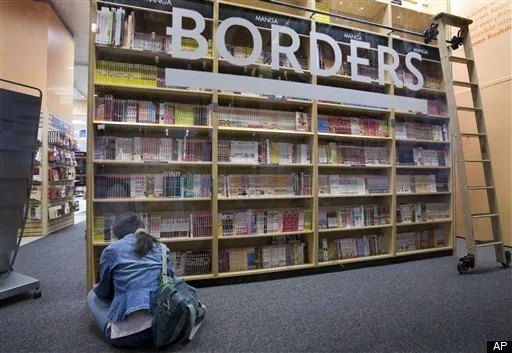
Borders revealed their ebook self-publishing platform, Borders Get Published, powered by BookBrewer, touting it as the place where authors can get started in this world of digital publishing. Aside from the company's serious financial trouble casting into doubt whether or not anyone would actually ever see royalty payments from them until cleared, years later, through a bankruptcy court; this is the worst major deal being offered to writers.
The deal looks simple: you provide content, they'll put the book up through Amazon, Barnes & Noble, the iBookstore and Borders' own Kobobooks -- as other services will do. Where they get really nasty is in offering their "package" for publishing. The author will pay $89.99 for each book, plus 25% of the take from any sales. Books must be priced between $2.99 and $9.99 -- the price range necessary for Amazon to pay a 70% royalty on the sale of each book.
The math is frighteningly simple: A $3 book creates a payment of $2.10. BookBrewer will then take .53 cents, leaving the author with $1.57 which, presumably, will be paid at least 60 days after the sale (since that's when Amazon would pay). So, the first 60 copies of the book sold will pay off the fee, then the author will be making a profit.
This all sounds great, especially when writers have dreams of being the next J. A. Konrath, but the reality is not so rosy. Selling those 60 copies could take six months or longer -- which could well be considerably longer than Borders will survive.
If the author did the prep work herself, she'd be making that 70% (or more) directly. If you've ever bought a book through Amazon, you're halfway set up to selling through them. It is not rocket science, and certainly isn't worth $90 and a piece of the action. Putting books up on Barnes & Noble is also easy, and between the two of them your work would be listed in the two marketplaces that capture over 80% of all ebook sales.
Three rules all authors would do well to bear in mind in this age of digital:
1) You do not pay a royalty to anyone who is doing day-labor. All book production should be done for a flat fee (and there are plenty of folks who will do it for very reasonable fees). Paying a royalty to someone for prepping an ebook is akin to paying the kid who cuts your grass a percentage of the purchase price when you sell your house. It makes no sense.
2) Ebooks and ebook sales are immune to audit. You do not know and cannot know how many books have actually been sold. I sell a lot of ebooks from my website, and encourage authors to set up their own stores. Not only do we make more money selling directly (around 95% of the purchase price), but we get a feel for this new digital economy. The big lesson I've learned is that traditional publishing (and Borders is part of that) has no clue as to how this market is going to grow, or where it is going to go. Looking to traditional publishers to lead the way through the change is akin to expecting buggywhip manufacturers to set the pace in the automotive age.
3) Money flows to the author, not from the author. If someone is going to profit from your work, they need to earn it. BookBrewer is doing nothing that free software won't do; and doing it yourself makes you profitable a lot faster. The only way you can guarantee you're not being ripped off is to keep your money in your pocket.
Authors should run, very fast, away from Borders Get Published. Publishing can be tough. It has the ability to kill dreams. Borders Get Published is the last gasp attempt by a failing company to become relevant in a world where its business model has failed.
Authors should not let their failure become our failure.
Editor's note: an earlier version of this post did not distinguish between Borders Get Published and Bookbrewer. This has been corrected.
Follow Michael A. Stackpole on Twitter: www.twitter.com/MikeStackpole
Harry Oliver: Expression Origins: Where Did THAT Come From?
digitalcontentcenter.com is less than $5 a month. Lulu wants access to eBook contents for their own purposes and everybody else wants a cut of the profits.
I've published my ebooks to Smashwords, to Amazon for Kindle, and to Lulu for print. All without *any* up front costs. If no one were to buy my books, I've lost nothing.
So this service 'allows' writers to be published. Great. So do vanity press publishers.
Speaking of Smashwords, it's a good example of a more technical DIY service that doesn't appeal to everyone. It requires you to read a 70-page manual to understand all the things you need to do to your Word document so their system can turn it into an eBook. With BookBrewer's tools you just copy and paste and you're done. That simplicity is very appealing to authors we work with.
Smashwords also requires authors to publish DRM-free before they will distribute it to retailers, and distribution is not guaranteed (they have to welcome you into an exclusive program). BookBrewer gives authors the choice to publish with or without DRM, and we send your book to retailers regardless. We also provide tips along the way on what to do to be accepted by every retailer.
But like BookBrewer Smashwords also takes royalties after distributing your book to retailers.
I must say, the fact that this article did not even interview bookbrewer or investigate his facts re: the link between bookbrewer and Borders (since a major tenet was--you may never get paid if Borders goes belly up) prior to writing this piece reflects very poorly on Huffpro's editors and this author.
Shame on you.
To be totally honest, we (BookBrewer) aren't that interested in authors' royalties. The only reason we keep a percentage is so that you know we have an incentive to promote you and your content. And we're also working on some bigger plans around that:
http://borders.bookbrewer.com/content/we-want-feature-you
It's also worth repeating that we offer tools that let you get your full ePub file. None of the competition do anything remotely close to that, and that's a valuable service. We have an option for those who want to sell directly to customers or sell through retailers, or both.
Most of the authors we serve are not like you. They're very good at writing and editing but they have no desire to "geek out" with XHTML and buggy free ePub creation software.
I think most people understand that to provide this type of service we need to be paid somehow. We chose royalties at first and we will continue offer that as an option, but in the future we're planning to provide other methods for those who want to keep a higher share of their royalties.
A few more points:
1) We provide full, consolidated eBook sales data to authors who use our service and the data comes directly from what we get from the retailers.
2) We (BookBrewer) manage the relationship with customers of BookBrewer and services like Borders Get Published that are powered by BookBrewer. If they were disappear we would still be able to continue running the service, but we hope they survive.
3) Retailers currently offer the only economically feasible way for authors to distribute eBooks using Digital Rights Management (DRM) technology, and most authors we talk t like that. But we still provide a way for authors to directly sell their eBooks from their own sites if that's what they prefer.
Thanks for your comments. They help us fine-tune our service to open up publishing to everyone -- not just the tech-savvy.
Dan Pacheco
I'm the founder and CEO of BookBrewer, which just to be clear is completely separate from Borders. We run BookBrewer.com as well as Borders Get Published, and we have a marketing relationship with Borders for the latter.
I appreciate your perspective on authors' ability to make more money by doing everything themselves. That's why we offer an option to get a full ePub file. The price is admittedly high right now ($199.99), but based on customer feedback we're getting ready to drop that significantly within the next few weeks, so stay tuned.
My sense is that as an accomplished author you're forgetting just how much of a hurdle it is for people to publish eBooks everywhere -- not just to the Amazon Kindle, but to ALL the places where people may want to buy their books.
As just one example, getting a book listed in the Apple iBooks store requires a fully ePubCheck-compliant file, as well as a dynamic table of contents. If you use BookBrewer it takes care of both so that authors can stay focused on what they know best: their writing.
I have some other thoughts but need to post them in a second comment.
Dan Pacheco
Founder & CEO, BookBrewer and FeedBrewer, Inc.