As a study by the Center for Science in the Public Interest and New York University famously found, dietitians had no idea how many calories or how much fat restaurant meals contained. The researchers showed more than 200 registered dietitians, who devote their lives to helping people eat healthier meals, five items. Those food professionals underestimated the calorie content of such meals as lasagna and a tuna salad sandwich by about 40 percent, or 200 to 700 calories. For instance, they thought that a typical dinner-house meal of a hamburger and onion rings had 865 calories, when it actually contained 1,550 calories.
If those food experts didn't know how many calories were in the meals, you can bet that Joe and Jane Diner are even more lost. That's a real problem when two-thirds of American adults are overweight or obese, conditions that increase the risk of everything from employment discrimination to diabetes to cancer.
It's been said by a former official of the National Restaurant Association that one of the most insidious innovations in American restaurants was the 12-inch dinner plate. That aided and abetted the growth of restaurant meals. When I was a kid, McDonald's served just one size hamburger, which had only about 250 calories. Now, you can down a Double Quarter Pounder with Cheese and quart-size Vanilla Shake, and waddle out through the golden arches with an extra 1,850 calories under your belt.
And as one fast-food industry executive once told me, "If you think our food is bad, you should look at table-service restaurants." I did. And what I found was shocking. For instance, a Fajita Quesadillas Beef w/Rice & Beans with a Sprite at Chili's Grill & Bar will sock you with 2,400 calories.
Those meals pose threats to many parts of your anatomy in addition to your waistline. Some meals at Red Lobster, Denny's, Olive Garden, and their like provide three or four days' worth of sodium (mostly from salt). All that sodium boosts blood pressure, which can cause heart attacks and strokes.
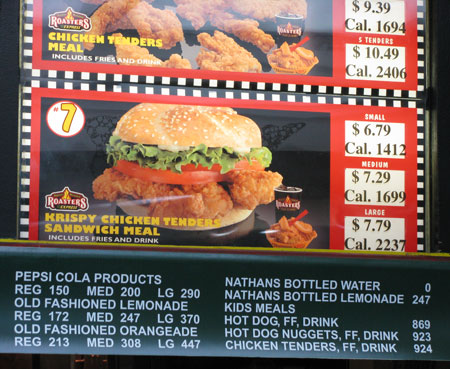
You'd never know how many calories were in your favorite restaurant meals unless you either scoured a restaurant's web site before you went out to eat (though Applebee's, IHOP, T.G.I. Friday's, Outback Steakhouse, and many others do not disclose any nutrition information) or if you lived in New York City or Seattle. Laws have gone into effect in those two places that require chain restaurants to list calories on their menus, so a TGIF menu in New York clearly states that a Jack Daniel's Ribs & Shrimp has 1,910 calories, while Grilled Cedar Salmon has 690 calories. Customers are informed and can choose.
California, Massachusetts, and about a dozen cities and counties have passed laws like New York City's, but those have not yet taken effect. In addition, Yum Brands, owner of KFC, Pizza Hut, and Taco Bell, said that it would voluntarily list calories in all its company-owned restaurants (and its franchisees probably would do the same).
Clearly, it would be inconvenient for everyone who wanted a few morsels of nutrition information before they ordered to visit New York or Seattle. Much better would be the passage of a national law, such as the "Affordable Health Choices Act," which was released by the Senate Health, Education, Labor, and Pensions Commitee on June 10th. That measure contains an agreement worked out by Senators Tom Harkin, Lisa Murkowski, and Tom Carper between a stronger consumer bill and a weaker industry bill (my CSPI colleague, Margo Wootan, helped bring the agreement about). If passed, the health care reform legislation would put calories on the menus--and menu boards (including at the drive-throughs) of tens of thousands of restaurants that are parts of chains of 20 or more units. It also would put calories on vending machines.
The restaurant industry had resisted calorie labeling for years, but the future is clear: consumers, accustomed to the nutrition labels on packaged foods, want at least a modicum of nutrition information when they're ordering at restaurants. And they are going to get that information--either from a patchwork of sometimes inconsistent state and local laws or one national law.
______________
Jacobson is executive director of the Center for Science in the Public Interest, the nonprofit publisher of Nutrition Action Healthletter
Want to reply to a comment? Hint: Click "Reply" at the bottom of the comment; after being approved your comment will appear directly underneath the comment you replied to
Sometimes, even when we think we are making healthy decisions, we are being mislead. We all know that a baked or grilled fish and vegetable dinner should be good for us, but in some places, the way the food is prepared makes it go from healthy to artery-clogging. I was surprised to learn that Red Lobster, a seafood restaurant, was so secretive. Seafood should not be high in calories if prepared to be a healthy meal. Asian seafood might be a better alternative to restaurants that use European and American cooking techniques, right or wrong?
The proposed federal pre-emptive menu labeling bill is a good start, but should be expanded further as a matter of public policy. Consumers have a right to make informed purchase decisions about the foods they eat, regardless of whether they are purchasing them from a restaurant chain of 20 or more, a supermarket, convenience store or independent restaurant. Of the 945,000 restaurants in the U.S., 75% are chains of 3 or less. The bill, as it is currently written, only would provide calorie information in restaurant chains of 20 or more. So consumers eating in three-quarters of the nation's restaurants won't receive calorie information. Moreover, supermarkets now account for nearly 10% of the take-out prepared meals, so those foods should be labeled with calorie information, too. The software to create this information is readily available, and it costs as little as $20 to purchase MasterCook software, among others. Yum! Brands is pleased to be the first in the nation to voluntarily agree to post calories on menus in our company-owned restaurants by January 1, 2011, and we will encourage our franchisees to do the same. In the meantime, we should improve the compromise language in the proposed federal bill to make it more encompassing, so that all consumers, regardless of where they purchase prepared foods, will learn the calorie content of it. All food can be part of a balanced lifestyle and this is an important step to help consumers make more informed purchases.
See Michael F. Jacobson's Profile
Yum! Brands deserves great credit for breaking with the rest of the industry and announcing that its company-owned restaurants voluntarily will post calories on their menu boards and menus. That helped lay the groundwork for federal legislation that was recently introduced by Senators Harkin, Murkowski, and Carper. Their bill would cover chain restaurants with 20 or more units, as well as vending machines.
Ideally, every single restaurant (and supermarket carry-out) would provide nutrition information---or at least calories---on their menus and menu boards. But small restaurants are vehemently opposed to that. A possible compromise would be to give restaurants of three or more units (or with sales greater than, say, a million dollars annually) several extra years to list calories.
Get off your butt and EXERCISE!!
See Michael F. Jacobson's Profile
Well, that's rather bluntly put, but I agree that requiring calorie listings at chain restaurants won't by itself solve the nation's weight problem. So, yes, exercise more, eat healthier meals at home, make fresh fruits and vegetables more available, improve the foods in schools, AND let's yank the veil of secrecy from the calorie content of chain-restaurant meals!
See James S. Marks's Profile
This really has to happen. Let's face it. If even trained dieticians can't come close to estimating how many calories are in the food they buy in restaurants or drive throughs, how can a busy mother figure out what to buy to help their kids stay healthy? Restaurant menu labeling has so much to offer. It preserves personal choice. It is relatively cheap to do. And it still allows the enjoyment and convenience of eating out. The Los Angeles health department estimated that if everyone just ate 100 calories less each time they ate out it could cut the excess weight gain by about 40%. You know that if major restaurant chains are doing this more and more that they will find the ways to appeal to customers and turn this into an opportunity. Who knows we might get into a virtuous cycle of restaurants competing with healthier and lower calorie foods.
Perhaps if the rest of the country was as progressive as NYC and Seattle it would encourage wiser menu choices, not to mention teach a crash-course in nutrition to consumers about food choices they make at home and in the grocery store. Given that taxpayers are responsible for financing about half of obesity-related medical costs through Medicare and Medicaid (Journal of Public Health Policy, 2008) it would be an interesting grassroots campaign for citizens to lobby for national calorie labeling in restaurants to get those costs down, particularly as Americans eat out more frequently year after year! And if it helped to force restaurants to make their choices healthier, that would just be a bonus.
I have a daughter that lives in Manhattan where they are required to supply you with the caloric information for the food they serve. It does make you think twice about what you are ordering and has caused me to choose my foods differently.
Obesity and lack of the lack of this basic nutrition information for restaurant meals is a national problem, not just a state-based or regional problem. This would be an extremely cost-effective service that restaurants could provide to their customers at minimal cost.
Congratulations to any restaurant chains that would implement better nutrition labelling as a matter of corporate responsibility, but I wouldn't hold my breath waiting for that. A strong federal disclosure law for calorie counts is a great idea.
Starbucks (at least in Canada) has been doing this with their baked goods for some time, and I find it incredibly helpful. Makes me wish everyone would just do this already...
Do they put nutrition info on the menu board? If so, which store/city. I've never seen calories or any nutrition information on menus at any Starbucks in Canada.
Not to be picky but a mega calorie would be a million calories, the values you list are in the kilo calorie range.
Unless you want to get into dietic vs. physics calories.
You must be logged in to comment. Log in or connect with