Water Cars: Turn on your BS detector
Oil prices are high, and everybody's looking for a quick fix. People in the media know about this, so they are scrambling to find "energy" stories, and as always, many unscientific ones make it through.
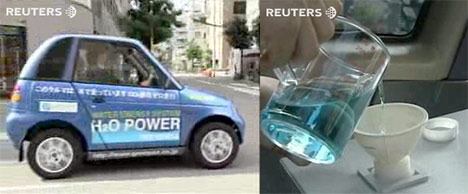
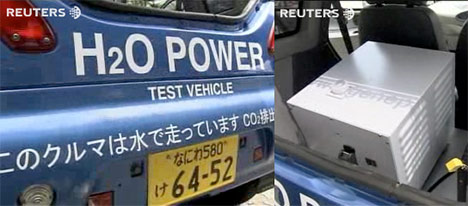
In recent days, a "water-powered car" made by Genepax, a Japanese company, has been making the rounds, and even Reuters featured it.
I think it's important to explain why it is almost certainly not what it claims to be, or at least why with such extraordinary claims, we should wait for extraordinary evidence before being convinced that this is real.
Water is not an energy source, nor is hydrogen
So lets talk about water. Everybody knows it contains hydrogen, and that hydrogen can be burned or used to generate electricity in fuel cells. But what few people seem to realize is that hydrogen is not an energy source, at least not here on Earth. If we could go out and mine some pure hydrogen somehow, that would be an energy source. But we can't find any in pure form on this planet, so we either have to reform natural gas (and so here the energy source is fossil fuels, not the hydrogen itself), or we have to break up water molecules via electrolysis, a process that uses more energy as input than you can then get out of the hydrogen as output. That means that the hydrogen is just a carrier of energy - like a battery - and the real source is whatever you used to power the electrolysis process (so if you use wind power, your hydrogen car is actually powered by the wind via hydrogen).
Are they trying to sell us a perpetual motion machine?
Here's another way to think about it: When you burn a gallon of gasoline, none of the atoms in that fuel just disappear. They are only rearranged, so to speak, and that's what comes out of the exhaust. Carbon atoms combine with oxygen to form carbon monoxide and carbon dioxide, hydrogen combines with oxygen to form water vapor, sulphur forms sulphur oxides (SOx), etc.
"Water car" makers claim that you pour water in the tank, the car drives around, and the only thing coming out of the exhaust is water. So either all the water that goes in comes out of the exhaust, in which case why not loop it back straight to the water tank and voila, you've just raped the first law of thermodynamics and you have a perpetual motion machine! Or if less water comes out than goes in, where does the rest go? Is it destroyed? Do they claim to have a large particle accelerator in there? It just doesn't make any sense.
How they probably do it: Metal Hydrides
So how do they fake it for the television cameras? Some have probably just hidden batteries in the car, or a tank of hydrogen. But the most clever way to do it is with metal hydrides. If you are curious about them, I explain a bit more about they work, as well as why these stories create false hopes, real apathy and hurt the green movement, in this article: Genepax Water Car: Too Good to be True? Yeah.
Want to reply to a comment? Hint: Click "Reply" at the bottom of the comment; after being approved your comment will appear directly underneath the comment you replied to
Yeah, I guess the hydrogen bomb is just a scam, too. It doesn't really exist except as a scare tactic. The energy released in a hydrogen bomb wasn't really created.
It is but it's created using thermonuclear fusion. Unless you have one of those Stark Industries pocket fusion reactors like Tony Stark then it's irrelevant in this discussion.
By the way, are you just playing troll, or are you actually unaware of the difference between what happens in a ICE car burning hydrogen, a fuel cell consuming hydrogen and a H bomb fusing it? Really are there actual adults who are allowed to graduate high school, vote and have children and do all kinds of 'grown-up" things without knowing this? Really?
Because if this is the typical level of understanding then our capacity to use a democracy to make rational choices on this issue is virtually NIL!
It can be done, but the research is TOP SECRET. You will never see it available for you until the military has it first, like velcro.
They are all full of crap. If it was viable, everybody would know it. Scam, scam, scam.
http://en.wikipedia.org/wiki/Fuel_cell
...Fuel cells cannot store energy like a battery, but in some applications, such as stand-alone power plants based on discontinuous sources such as solar or wind power, they are combined with electrolyzers and storage systems to form an energy storage system. The overall efficiency (electricity to hydrogen and back to electricity) of such plants (known as round-trip efficiency) is between 30 and 50%, depending on conditions.[15] While a much cheaper lead-acid battery might return about 90%, the electrolyzer/fuel cell system can store indefinite quantities of hydrogen, and is therefore better suited for long-term storage…..
…The world's first Fuel Cell operated and certified passenger ship was the "HYDRA" (see picture). Mr. Christian Machens was the founder of the company "etaing GmbH" and realised this project with a small team of young engineers in Leipzig. It was christened in June 2000 in Bonn. The Fuel Cell System (AFC type, 6,5 kWel net output) was built in Wurzen near Leipzig, the hull was built in Hamburg and it was certified by the Germanischer Lloyd (Hamburg). The boat has transported around 2.000 persons without any major technical problems. The main advantages of the AFC technology are that the system can start at freezing temperatures (-10°C) and is not sensitive to a salty environment…..
http://en.wikipedia.org/wiki/Hydrogen_vehicle
….The molecular hydrogen needed as an on-board fuel for hydrogen vehicles can be obtained through many thermochemical methods utilizing natural gas, coal (by a process known as coal gasification), liquefied petroleum gas, biomass (biomass gasification), by a process called thermolysis, or as a microbial waste product called biohydrogen or Biological hydrogen production. Hydrogen can also be produced from water by electrolysis. If the electricity used for the electrolysis is produced using renewable energy, the production of the hydrogen would (in principle) result in no net carbon dioxide emissions. On-board decomposition to produce hydrogen can occur when a catalyst is used…..
Does the same principle apply to steam engines, like this one? I assume so, since it says it needs a resource.
http://www.greensteamengine.com
But what about salt water as an energy resource? As shown in the video below, by the man who discovered sea salt will burn:
http://www.youtube.com/watch?v=JiKa4nOkHLw
The engine is a small engine with an apparently novel transmission system designed to run off waste heat from a primary engine or other power source. It is interesting in that it captures a previously wasted resource (waste steam or heat) for a useful purpose, but it's not a 'game changer' by any means.
Mr. Salt Water is just superheating it with (probably) microwaves. Thermodynamics says you'll get back less than you put in so......
HYDROGEN IS NOT AN ENERGY SOURCE. Thank you Mr. Richard, I have to hammer this point over people's heads in virtually every discussion on Huffpost dealing with energy. But I don't know that it will do much to dissuade the hordes who think that basice physics will just roll over and play dead if you chant the word 'technology' enough times. Maybe you could give us a nice article on the basic science behind why the electric car has been such a disappointment for over a century.
But... but... but... doesn't the space shuttle fly on hydrogen?
Yes it does (but only a little, it mostly flies on solid rocket fuel), and that is probably the only thing the science illiterate public knows. What they don't get is that hydrocarbons are not an energy source, either. Hydrogen and hydrocarbons (and coal) are all chemical energy storage media. The difference is that hydrocarbons and coal occur naturally (and store sunlight that fed plants millions of years ago), while there is practically no natural source of hydrogen worth mentioning.
My best guess is that most Americans could not explain these simple facts and if their lives depended on it. Sadly, it looks like our lives do depend on it... and we are trying to undo decades of failed science education in a few short years while the illiterate are running around like headless chickens.
On the same note (water fuel), does anyone here remember carbide cannons? You'd put some water in the cannon and add a smidgen of carbide (a white powder) and then ignite the gun with a cigarette lighter flint. KABOOM! Energy! My grandfater told me they used to use carbide lamps in the early 20th century as headlamps on cars.
What's carbide, and can it be made into a fuel source w/water?
You are talking about Calcium Carbide. It combines with water to produce acetylene gas.
A full description of this tech can be found here:
http://www.answers.com/topic/carbide-lamp?cat=technology
As far as being an energy source here's the money quote:
"Carbide of calcium is manufactured from coke and lime in an electric furnace with an achievable heat of approximately 4000 degrees Fahrenheit. The chemical action converts the coke and lime into carbide calcium and carbon monoxide gas. The chemical action which takes place when the water is brought into contact with the carbide of calcium was discovered by Friedrich Wohler in 1862:[2]
CaC2 + 2 H2O → Ca(OH)2 + C2H2"
Looks like its another energy carrier not an energy source. Clearly it takes a LOT of energy to 'get' the acetylene into the lime.
Good post, thank you.
Come on, Michael. Dimissing hydrogen as some kind of fake fuel is completely disingenuous. Would Honda, GM, and all the other big car manufacturers be staking their futures on hydrogen if it had zero merit as you imply? If Huffington Post wants an honest assessment of hydrogen, you should get it from Patrick Takahashi. He is the one contributor to the Post that knows what he's talking about when it comes to hydrogen.
The big car manufacturers aren't staking their futures on hydrogen or any such thing. They have made few prototypes and one boutique market hybrid fuel vehicle. That's about it.
Remember the American auto companies actually DID stake their future on SUV's. Assuming sensible behavior from big auto companies is a dubious premise.
Takahashi seems to be a fuel cell freak. Fuel cells are a pointlessly complicated technology for running a personal automobile that are 15 years away AND ALWAYS WILL BE. As far as Takahashi goes his thing seems to be methanol not hydrogen as such.
By the way can somebody give me some SCIENTIFICALLY USEFUL numbers on how to estimate how much biofuel we could resonably expect to get from sources like agricultural waste and such? The reason we don't ferment wood chips much is because of it's low yield relative to fermenting things like sugar. It takes the bacteria quite a bit of additional input energy to break down the cellulose into sugar before fermentation can actually take place. Thats why ruminants like cows have such complicated digestive systems, breaking down cellullose is HARD and in the end they depend on microrganisms to do it for them.
"Would Honda, GM, and all the other big car manufacturers be staking their futures on hydrogen if it had zero merit as you imply?"
No, but they'll gladly take a billion bucks from Bush for hydrogen "research"
http://www.grist.org/news/powers/2003/02/26/tough/
You must be logged in to comment. Log in or connect with