
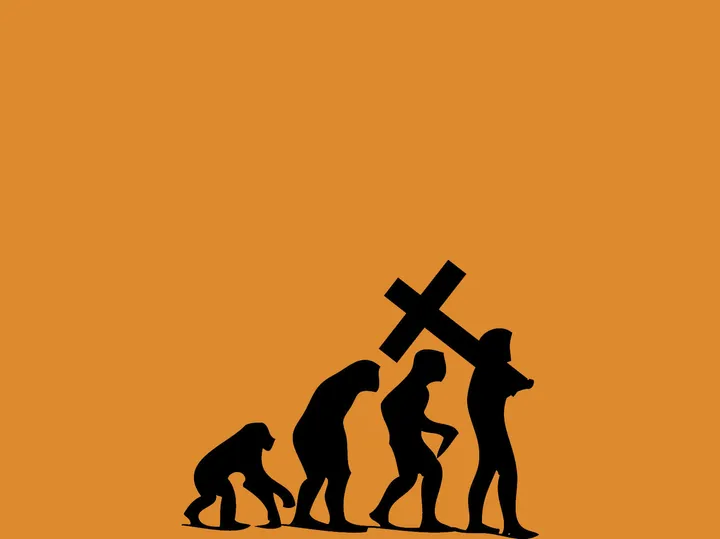
Homo sapiens evolved to be socially intelligent. Over millions of years, perhaps more, the primate brain evolved special machinery to allow us to think socially, to build abstract concepts of each other's minds and to react emotionally to each other in a way that more or less maintains the social web. In one theory that is gaining greater acceptance, the social machinery in the human brain is the direct cause of spirituality. Spirituality is the human brain doing exactly what it is exquisitely well evolved to do. It is the functioning of our social intelligence.
If spiders could ever become super intelligent, they might see the world through the metaphor of a web. They might talk about sticky strands of thought. They might envision a universe pulled out of a spinneret. They might judge beauty by radial symmetry. Looking at the moon, they might see a web-in-the-moon instead of a man-in-the-moon. The natural talent of humans is to spin metaphors of minds and intentions, and that is how we evaluate almost everything around us. We understand and react to the world through our social capability. It defines us more than any other trait. Even language is a refinement of social communication. We are truly Homo socialis.
Yet the theory that spirituality is a product of social intelligence seems to have certain limitations. If spirituality is defined rather narrowly as the human tendency to believe in a spirit world -- in ghosts, gods, angels, and life after death -- then the explanation is plausible. We believe in spirits because we are predisposed to see minds in the things around us. But to most people, spirituality has a much larger halo of meaning including moral decency and love and religious awe and an all-embracing sense of fellowship. How are these spiritual experiences products of an evolved social machinery?
It may be that the more emotional, less tangible aspects of spirituality are particularly well explained by the theory of social intelligence.
Awe, for example, is at its root a social emotion. Its utility lies in shaping our behavior toward others, especially others that we perceive to be wiser or more powerful than us. It is one ingredient in hierarchical social structure. Awe of a beautiful landscape, awe of music (another spiritual experience I've written about before), awe of the spread of stars as you look up at night, all of these instances of awe are traditionally connected in a hazy way in people's thoughts and feelings with awe of a larger, deistic presence. In the social-intelligence theory of spirituality, these instances of spiritual awe are the result of bits of a social machinery constantly spinning, constantly computing. Such emotional reactions follow from the human tendency to see almost everything in our world through the filter of the social machinery.
Religious awe may belong to a category of biological trait along with male nipples and the gill slits in human fetuses. It has an understandable evolutionary past. The adaptive advantages that led to it are real, but the present adaptive advantage of it, if any, is not entirely straightforward. It doesn't need an adaptive advantage to be a part of who we are.
Note that nowhere in my description do I condemn spirituality or scoff at awe. I am not calling for its end. I am no so-called New Atheist advocating the debunking of human spiritual belief. I consider my perspective more that of a strict naturalist trying to understand the behavior of a species of animal that happens to be my own species. I have no interest in fighting a cultural war against a natural phenomenon, the intrinsic behavior of us humans, that I am trying to study.
I would love to see us humans tackle our world problems rationally, but it is difficult to do that without first understanding who we are, and my interest, scientifically speaking, is to understand who we are. We are beings that do not see the world literally or dispassionately. We see the world filtered through our most developed talent, our social intelligence, and spirituality is a direct consequence.
Michael Graziano - Princeton University
Amazon.com: God Soul Mind Brain: A Neuroscientist's Reflections on ...
Your points about the social evolution of the brain may be somewhat true, but the soul has an ego / mind - not the other way around.
"But to most people, spirituality has a much larger halo of meaning including moral decency and love and religious awe and an all-embracing sense of fellowship"
I've always found this odd... why does moral decency and love and an all-embracing sense of fellowship fall under the spiritual umbrella? Seems all that's necessary is that a person is, well, moral, decent and fond of other people.
Christianity is NOT the arbiter of morality in America.
Their twisted ideas of morality must include their conduct, this they won't admit. Find one that walks the talk and you will find a seriously disturbed person.
"It may be that the more emotional, less tangible aspects of spirituality are particularly well explained by the theory of social intelligence."
Translation:
Only the things that cant be proven or disproven work well with this stupid evolutionary theory of social intelligence. Makes it an argument of ignorance.
Christians don't seem to understand that a lot of scientrists ride the coattails of evolutionary fact in pursuit of knowledge. That doesn't necessarily make their theories an automatic FACT but rather a postulation of a theory based on the fact of evolution. The failure of their theory is not a failure of evolution.
Unfortunately, Christianity is a shaky belief based on nothing and therefore they grab at ANYTHING in the desperation to find evidence that supports their faith and blanketly dis fact and failures of scientific investigations.
I will ignore the Christianity part, since you Clearly do not know anything about it and I would be wasting my time with you.
Yes, completely and only that.
-Faith that flies won't go away.
-Faith in diapers
-Will my bed hold me up tonight? A good prayer could come of this.
-Faith in the inevitable when using a garden hose...If it doesn't get tangled on something it will get tangled on itself.
-Faith in postage stamp rates rising
-Faith in shoelaces and toilet paper, buttons and zippers, velcro and duct tape.
But applying these simple faiths to a Magical, Invisible, All Powerful, Big Booger Booger in the Sky is stretching the concept of faith. After all it is a man constructed concept and has never had the definition or integrity to hold back speeding bullets, yellow cabs or gun toting "postals" , much less a "god".
The word "faith" goes back to fairies, fates, fay and other magical thinking of the past.
You may have faith in the sun rising but you had better wear sunscreen.
But to me what makes humans unique is something different. The big brain is able to symbolically imagine and combine and invent in a way that is virtually unknown among other species. Call it the "what if". What if we made spears to hunt meat, what if we could control fire or a nuclear reaction. An animal lives in the "what is" and has no desire to do otherwise, to make a bigger spear so that it doesn't have to evolve longer claws. It just is. And why do we have that ability? Because it makes us the most adaptive creature on the planet. We not only adapt to our environment, but we create our own environment. Our ability to manipulate physical reality makes us ubiquitous upon the earth. Religion and art are unintended consequences. We can't help "what if"-ing ourselves. It comes in all varieties from the rationalist who is deluded that the puny "I" is running the show and all we need to do to do better is think it, to the theist who understands the irrationality of it all and is deluded that by reading myths and going to church the what-we-are can be transformed. We all have that same spiritual journey to grow older and find a way to live with the "what if".
Is that one of those negatives that is impossible to prove. Can an atheist really prove they don't believe? What criteria could I use to examine whether or not they are being truthful? How could I know if they secretly believe in something but deny it?
Most of them, atheists, are plain, simple folks who go about their mundane little lives carrying what they think is such a great revelation when they tell someone else about it. It makes me laugh when I think about how important they feel when they tell others about their great revelation.
Oh, well...
No, a "theist" is someone who believes in god or gods. And, more particularly someone who believes in a personal God who is the creator.
I absolutely do not believe that believing in God is ridiculous. Here's my background...I am a blood relative to Jesus. I am out of the House of David. We, my family, are descended from Seth son of Adam. I am directly related to 39 European Kings and Queens. My Wife is descended from Russian and Swedish royalty.
I read and write four languages: English, Greek, Hebrew, and Spanish. I read latin as well. I have a B.A. Degree in Religion, Philosophy, Humanities, and Chemistry. I graduated with a 3.95 G.P.A.
I attended Baptist and Lutheran Parochial Schools. Raised and Baptized in the Presbyterian Church. Educated in a Disciples of Christ University.
I do not grasp at some incoherent idea that seems bigger than myself. I know, beyond any doubt, who God is. God is the Alpha and the Omega. I speak in the tongues of Angels and am capable of healing. I have seen that "chasm" which separates us from the Trinity and the hosts of Heaven. I knew God from the womb. And, my head will be bowed the lowest in the presence of the Lamb.
Now, tell me "what" I believe. I wouldn't trade places with you for a nano second. May God mercies be upon you.
Many people don't believe in a lot of things and it is all part of life. I don't believe that there is a living dinosaur in the lakes of Scotland. I just don't and never saw any proof of it. I don't believe in white ape men in the mountains of Tibet. Never saw any proof. I don't believe in fairies yet my great grandmother said they danced on raindrops. Never saw proof even, though I liked the idea. The same is with the gods except that religions are institutions of faith and that is a set of traditions and faith-based beliefs that are a major part of society. If they weren't noone would care if people were atheists or agnostics and didn't believe in any of the gods. Noone would care.
So, can any of your people out there prove you don't believe in living Scottish dinosaurs and Tibet white apes , and fairies? Can you prove you don't believe in them? There is always the possibility that you secretly believe but don't even know that you do. Is this it? Most people that don't believe in living dinosaurs, white ape men and fairies and are plain, simple folks who go about their mundane lives thinking they have a great revelation that fairies don't really exist. How arrogant are such folk.
Duh! Man had to be before he could make up things to make himi feel better about dying...