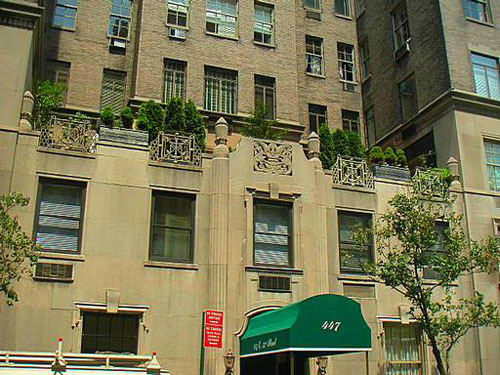
Except for having no golf course, the River Club at 447 East 52nd Street is as close to a country club as one could find in the middle of New York City. Headquartered on five levels at the base of River House, in addition to more conventional recreation facilities it once boasted an enormous marina for members' yachts.
If River House is Manhattan's only apartment with its own club, beyond a mere gymnasium, from very early in the city's history, living in a club-like boarding house had greater cachet than taking a flat in an apartment house. In fact, the first cooperative apartment buildings were formed as exclusive associations in the early 1880's. Called 'home clubs', cooperatives were private stock companies. Even now, the size of any given apartment occupied by a shareholder, its cost and the expense of maintaining common upkeep, for services, for taxes and mortgages, remain directly related to the amount of stock one might hold.
Many of Manhattan's earliest grand cooperatives, The Berkshire from 1881, the Osborne from 1883, or the Dakota from 1884, were explicitly designed to house an aspirant establishment. The idea of varying room sizes and shapes, of creating a series of as many as three different levels in a single suite, much like a house, of including fireplaces and of employing ornate decorations and fine materials, were successful ploys utilized to woo the well-off from their private residences.
Unfortunately, especially at co-ops on the East Side, in close proximity to the mansions of the elite, another tactic calculated to attract the best occupants, was to appeal to their longstanding biases. Here, newcomers and non-WASPs were disdained. Jews, in particular, found they were not welcome at buildings considered to be 'top-flight.' The most fashionable were the most exclusive, emphasizing the notion that people with whom one shared one's roof, ought to share enough general interest and characteristics in common, as members of any well-run club might, ought to be 'nice people', ought to be 'people like us', to be 'people we know!'
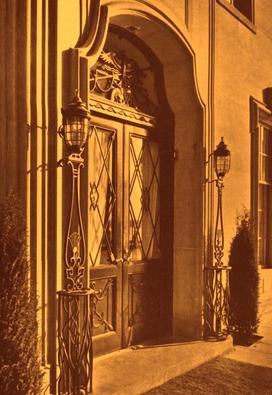
River House sought to take the notion of tribal solidarity, which once so characterized New York high society, to a new level, one which, apart from a small building Emily Post built with friends, had seldom before been achieved. To do this, its management adopted the same sort of communal services for meals, entertaining and sports that had initially been employed 50 years before, at residential hotels and long before that, at private clubs. The assumption was that at River House one had a community made up entirely of people who were socially beyond reproach. In fact, just as all guests at any residential hotel were free to make use of all the amenities, so, early advertisements infer that, becoming a shareholder at River House, conferred automatic eligibility on one for River Club membership too.
What a powerful inducement living in a club-like building with an actual club on the premises was, and is. Chartered in 1930, well before New York society's favorite 'family club' had even been completed, the Times could observe in a headline that, ''River Club Interests Society''. They reported on the eventual provision for abundant opportunities for exercise and amusement in the most fulsome surroundings, including: two tennis courts, three squash courts, a gym, and an arcaded pool.
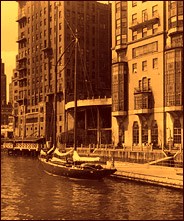
The feature through which the new club most lived up to its dignified sounding name, however, was to be a block-long pier. ''For the convenience of members addicted to their yachts and motor boats." This boat landing, it was stressed, would be strictly "private." The Real Estate Record and Guide seems to have fully grasped the appeal of speedy, easy travel between a country place and town.
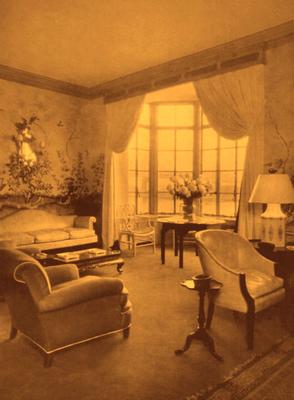
How subtlety conspicuous it was to consume so much energy, so many man-hours, traveling in isolated comfort. All danger of having to forebear the public's vulgar gaze or worse, as on a commercial boat or a train, was eliminated. ''It will be possible to step out of a boat and be whisked immediately by fast elevator to the topmost floor of the building," their reporter predicted.
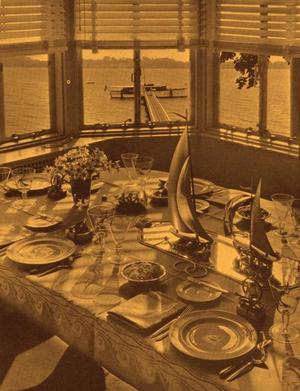
Presenting a diverting and ever changing panorama for lunching or lounging club members, indoors and out, apart from the New York Yacht Club's Wall Street mooring, no other private dock was as active.
Touchingly anticipated for a generation, first by William de Rham's dance classes and then by his widow's, the River Club was a venue for some of the city's most select tea dances, 'small dances' and balls. Bridge games, tennis matches and actual amateur tournaments also became the club's stock in trade, adding luster to an exalted reputation.
"It is possible," boasted one early member with great satisfaction, "to pass through all the major cycles of life -- birth, debut, marriage, anniversaries, divorce and even an affair -- without ever once setting foot outside of the River Club..."
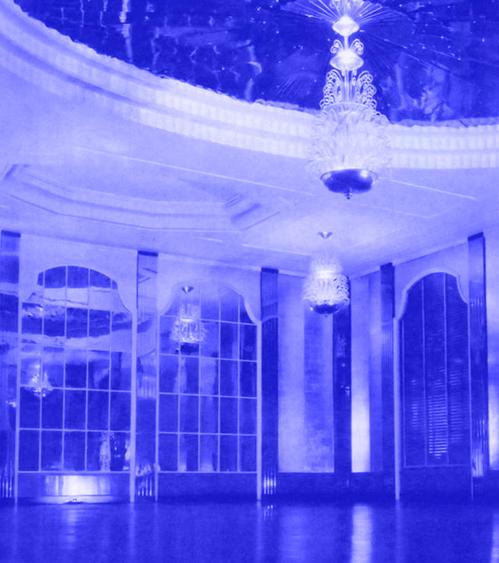
The River Club ballroom, lined in panels of blue glass and silver leaf, was described in Town and Country magazine in 1932, by Augusta Owen Patterson as, "a sapphire with many facets set in platinum..." It was admired as among the most beautiful in the city. Leading up to the Second World War, in 1941, it was the locale of a very different sort of gathering. The threat of socialism, engendered by the Great Depression, saw many German and other European royals and aristocrats make common cause with decidedly déclassé Nazis. So too were a surprising number of uneasy upper class Americans attracted during this dark epoch to authoritarianism.
Isolationism and intensified anti-Semitism were attendant enthusiasms of society figures that were to join the America First Committee at a pivotal meeting held at the River Club. Perhaps their most prominent convert was Charles Lindbergh. Scholar Max Wallace considers Lindbergh to have been "a well-intentioned but bigoted and misguided Nazi sympathizer whose career as the leader of the isolationist movement had a destructive impact on Jewish people." And, as for River House or the River Club, as late as 1954 no Jews lived at, or belonged to, either one.
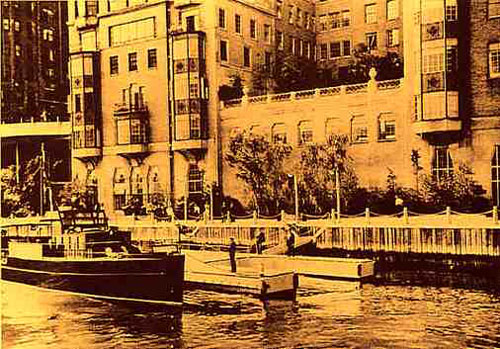
Some suggest that the widely perceived, if unmentioned, partiality at River House and the River Club, so angered powerful New York planning tsar Robert Moses, that he happily eliminated their dockage to construct the East River Drive in retribution. This seems illogical inasmuch as, for all their prejudices, no other fashionable riverside apartment along the roadway's route had a record that was any better.
Indeed, widely divergent compromises were worked out by the city with the affected apartment buildings. On 57th Street, at the co-op One Sutton Place South, almost all of the building's beautifully landscaped back garden was appropriated for the highway. However, through amicable negotiations, it was replicated on a deck over the roadbed, which was leased back to the shareholders.
In distinction, at 10 Gracie Square, at 84th Street, a double-decked highway means that the co-op's first three floors were left facing the blank wall of an unattractive dry moat. So sharp a contrast here is rumored to have arisen out of the unyielding opposition Moses encountered from Vincent Astor.
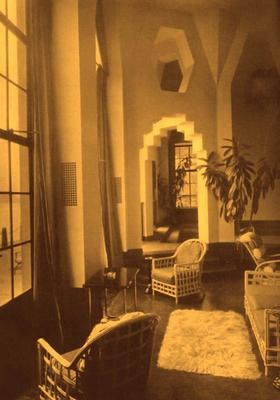
If, at River House the highway is only on a single level, it is the same level as their original dockside landing. Certainly the city built a high wall separating the River Club garden from the highway. There is ample light and air still found past the large windows of the lounge, even if a once expansive outlook is now highly proscribed with one's view confined to a vine-hung wall and a few gnarled trees and shrubs. Outside this wall, beyond the roaring freeway, neither a new riverside landing, completed in 1940, nor an elevated walkway erected to reach it, could ever make up for the loss of such a romantic scene, so picturesque a situation. Long vanished, this substitute yacht landing apparently saw little use, and the walkway does not appear in photographs from the 1950s.
"The River Club," states historian Christopher Gray, noting its marked diminution, "still exists. But on what is now its garden terrace, where the original landing once sat, one cannot hear the water -- only the sound of tires."

Today the largely past difficulty for Jews attempting to live in buildings like River House remains the plight of blacks and some Latinos.
"Just look at how many co-ops up and down Fifth and Park are all white," says Michael Gross, who wrote, 740 Park: The Story of the World's Richest Apartment Building. "I would be surprised if there wasn't de facto discrimination going on all the time," he says.
According to a 2008 report by the Furman Center for Real Estate and Urban Policy at New York University, the vast majority -- 84 percent -- of co-ops in Manhattan are occupied by households identified as white. City-wide, it's a fast shrinking demographic. Yet, due to the public policy of the past 8 years, encouraging ever more luxury housing, evaluating all five boroughs, it's a category that makes up 60 percent of co-op households. Discrimination hasn't disappeared, many urban planners insist, it is simply more difficult to detect.
Besides detailing Martin A. Siegel's extraordinary fall from grace, Den of Thieves, by Pulitzer Prize-winning author James B. Stewart, also chronicles the once respected investment banker's failed bid to join the River Club. Well before he became embroiled in the notorious insider trading scandals of the 1980's, alongside Ivan Boesky and Michael Milken, notwithstanding his prominence at Kidder, Peabody & Co., or his impeccable sponsorship, Seigel's eminence as a takeover specialist struck many members as unduly unsavory.
In the long run, Muriel Siebert was a different matter altogether. In 1976, Ms. Siebert acquired a River House apartment for $115,000, which translated into 320 shares of the building's stock, or almost one percent of the outstanding shares. Doing so, she helped to start to eliminate at least some of most overt discriminatory practices that prevailed there.
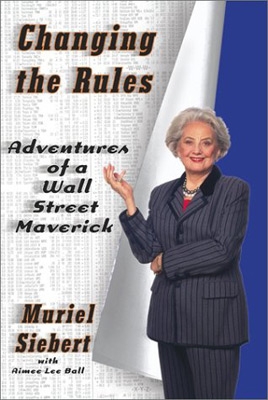
In an illuminating memoir, published seven years ago, Changing the Rules: Adventures of a Wall Street Maverick, this diminutive, determined Cleveland, Ohio transplant, who became the first woman to purchase a seat on the New York Stock Exchange in 1967, relates a fascinating tale about how, both socially and in business, she fought it out with the worst of the 'big boys,' retained her dignity and mostly won!
Seeming, from our current vantage point, perhaps as needlessly oblique, one cannot argue with the effectiveness of Muriel Siebert's strategic course of action. One gambit for dealing with prospective clients whose anti-Semitic jokes at lunch she found unfunny was to send them a card. In an obscure shop once, by chance, she found one that she thought might work and brought them all.
"Roses are reddish, Violets are bluish, In case you don't know (open the card) I am Jewish"
As New York's old-line WASP aristocracy declined in prominence, growing much less rich than it had been before, increasingly, wealthy Jews became less reticent about challenging discrimination. By 1960, even River House and the River Club had begun to open up, if ever so tentatively. In 1985, perhaps 15 out of 80 families who lived here were Jewish, while at the River Club, with 1,000 members, only ten were Jews.
This sort of blatant under-representation, wholly without apology, was far less amusing to Ms. Siebert even than bigoted jokes. For the same reasons as her neighbors who were members, she wished to join the River Club. Despite sponsorship from her friends Robin and Angier Biddle Duke, her proposal was declined.
She had hardly achieved her high position in a male sanctum without some knowledge and appreciation of numbers, naturally. Analyzing figures related to River House stock, it seemed to her that the numbers just didn't add up properly. Occupying a comparatively large portion of the building's square footage, the aloof River Club, ought, by her calculation and by law, to be assessed a greater, more proportionate share of the monthly maintenance. Her lawyers confirmed her worst suspicions. She and other Jewish residents of River House, left languishing for years on a membership waiting list, were in fact subsidizing the River Club!
In accord with the demeanor of any other River Club matron, Muriel Siebert relates what happened next with a certain circumspection, and names no names.
"In October 1987, only two days after Black Monday, I went to a meeting of the co-op board and explained the inequity. I don't know if they were all in a weakened condition on account of seeing their investments decimated, but the word Jewish was never mentioned, and everyone behaved like ladies and gentleman. I was elected a member of the club along with other [Jewish] residents of the building," she says.
In light of the building's history of precarious finances, a notice sent to shareholders explaining how the club would hereafter pay its fair share of cost had to be widely welcomed that December. More importantly, this bulletin had outlined how, "Henceforth applications for club member-ship by tenant/owners will be accorded the same priority consideration as is now given near relatives of club members."
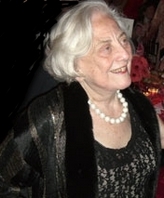

"Now," Siebert says with evident pride, politely subdued, "people of all backgrounds are admitted, even those who do not live in the building." Although River House has yet to have any African American owners, by 1987, thanks largely to Muriel Siebert, at least one family belonging to the august River Club, home away from home to Whitneys, Vanderbilts and Rockefellers, was that of Edgar Thomas Williams, Jr., who is black.
To be continued...